February 18, 2008 weblog
Wearable Robotics Aid Construction Workers
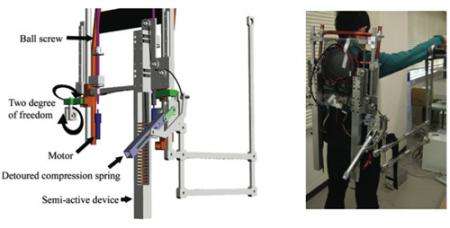
Applied scientists and engineers at Nagayo University in Japan introduced a prototype wearable half-robotic device designed for carpentry workers. The study of carpentry workers utilizing the device in the task of fitting ceiling boards in place concludes marked reduction in muscle output force, thereby reducing arm fatigue. Further study is on going to reduce weight, size and low adjusting speed of the device. The next phase will test the overall effectiveness of the half-robot aid to workers.
The utility of robotics to aid mankind is currently under study at Nagayo University in Japan. The combined efforts of the University's Departments of Micro-Nano Engineering, Mechanical Science and Engineering of the Graduate School of Engineering has developed a wearable half-robot to aid carpenters.
As initially reported by Digital World Tokyo, this wing of robotic engineering research and technology may not have the cuteness factor as Asimo has garnered. Nonetheless, the design and technology will give worker´s super human abilities in performing arduous tasks.
Nagayo University scientists and engineers recently published their findings including a prototype of a half-robot. The study entitled Development of a "Wearable Robot for Assisting Carpentry Worker," was published in Advanced Robotic Systems International. The research was conducted by Junpei Naito, Goro Nabinato, Atushi Nakayama, and Kazunori Hase preeminent researchers in robotics.
The study was successful in proving the utility of the half-robot theme and design in lightening man´s load in the arduous task of fitting ceiling boards in place. This particular task takes extreme brute force. Often, the work requires not only great exertion of strength. The work is inherently counter-human physiognomy as it requires multiple over-the-head manual tasks. These combined factors create varying degrees of muscle fatigue in carpentry workers.
The four phases of this type of carpentry work require the following tasks:
1. Lifting up of the board
2. Setting the board with both hands in the proper plane
3. Support the board with one hand and fix the screws
4. Leave the board and fix the screws with one hand
The researchers found that steps 2 and 3 cause the most muscle fatigue in carpentry workers. This is because the work is repetitive and the physical act of holding heavy boards in place with hands overhead creates fatigue.
In previous studies by other preeminent robotic scientists the aim was to assist patients with neuromuscular diseases with wheel chair robotic devices. These designs enabled severely impaired patients with to perform task utilizing the arm rest robotic device.
Expanding on this research work with the severely disabled, the current research on aids for construction workers was developed.
The scientists at Nagayo University developed the half-robot prototype and found through various phases of experimental study that the arm half-robot did reduce muscle output force and thereby reduced muscle fatigue in workers. The comfort and mobility of the worker was taken into account and design adjusts were made. In addition, the scientists acknowledge that the experiment is confined to the arm. In order to test for overall fatigue rate reduction, modifications to the prototype will be required.
Further, the scientists acknowledge that the size, mass and low adjusting speed of the current prototype will require further modifications to make it practical for every day work use. The scientists are confident these modifications can be made. The next phase of the study involves the effective operation of the half-robot
For further reading See: Development of a Wearable Robot for Assisting Carpentry Workers; Advanced Robotic Systems International, Nagayo University, Naito, Obinata, Nakayama, and Hase; ISSN-1729-8806-4404, (2008).


