Laser light may be able to detect diseases on the breath
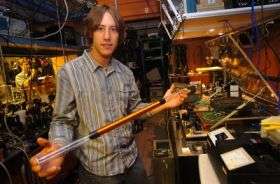
By blasting a person's breath with laser light, scientists from the National Institute of Standards and Technology and the University of Colorado at Boulder have shown that they can detect molecules that may be markers for diseases like asthma or cancer.
While the new technique has yet to be tested in clinical trials, it may someday allow doctors to screen people for certain diseases simply by sampling their breath, according to the research team from JILA, a joint institute of NIST and CU-Boulder. "This technique can give a broad picture of many different molecules in the breath all at once," said Jun Ye, a fellow of JILA and NIST who led the research.
CU-Boulder graduate research assistant Michael Thorpe, Ye, CU-Boulder doctoral student Matthew Kirchner and former CU graduate student David Balslev-Clausen describe the research in a paper that appeared in the Feb. 18 online edition of Optics Express, the free, open-access journal published by the Optical Society of America. Known as optical frequency comb spectroscopy, the technique is powerful enough to sort through all the molecules in human breath and sensitive enough to distinguish rare molecules that may be biomarkers for specific diseases, said Ye.
When breathing, people inhale a complex mixture of gases, including nitrogen, oxygen, carbon dioxide, water vapor and traces of other gases like carbon monoxide, nitrous oxide and methane, said Ye, an adjoint professor of physics at CU-Boulder. Exhaled breath contains less oxygen, more carbon dioxide and a rich collection of more than a thousand types of other molecules, most of which are present only in trace amounts.
Just as bad breath can indicate dental problems, excess methylamine may signal liver and kidney disease, ammonia may be a sign of renal failure, elevated acetone levels can indicate diabetes and nitric oxide levels can be used to diagnose asthma, Ye said.
When many breath molecules are detected simultaneously, highly reliable, disease-specific information can be collected, said Ye. Asthma, for example, can be detected much more reliably when carbonyl sulfide, carbon monoxide and hydrogen peroxide are all detected simultaneously with nitric oxide.
While current breath analysis using biomarkers is a noninvasive and low-cost procedure, approaches are limited because the equipment is either not selective enough to detect a diverse set of rare biomarkers or not sensitive enough to detect particular trace amounts of molecules exhaled in human breath, Ye said.
"The new technique has the potential to be low-cost, rapid and reliable, and is sensitive enough to detect a much wider array of biomarkers all at once for a diverse set of diseases," he said.
The optical frequency comb is a very precise laser for measuring different colors, or frequencies, of light, said Ye. Each comb line, or "tooth," is tuned to a distinct frequency of a particular molecule's vibration or rotation, and the entire comb covers a broad spectral range -- much like a rainbow of colors -- that can identify thousands of different molecules.
Laser light can detect and distinguish specific molecules because different molecules vibrate and rotate at certain distinct resonant frequencies that depend on their composition and structure, he said. He likened the concept to different radio stations broadcasting on separate radio frequencies.
The optical frequency comb was developed in the 1990s by Ye's JILA, NIST and CU-Boulder colleague John L. "Jan" Hall and Theodor W. Hänsch of Germany's Max-Planck Institute, who shared the 2005 Nobel Prize in physics with Roy J. Glauber for their work.
Ye's group has pioneered the application of frequency combs to spectroscopy, or the analysis of light emitted or absorbed by matter. The technique allows for many different gases to be detected all at once with high sensitivity through their interaction with light from such "combs," demonstrated by Thorpe, Ye and colleagues in the journal Science, in 2006.
To test the technology, Ye's team had several CU-Boulder volunteer students breathe into an optical cavity -- a space between two curved mirrors -- and then directed sets of ultrafast laser pulses into the cavity. As the light pulses ricocheted around the cavity tens of thousands of times, the researchers determined which frequencies of light were absorbed, indicating which molecules -- and their quantities -- were present by the amount of light they absorbed.
Ye and his colleagues detected trace signatures of gases like ammonia, carbon monoxide and methane from the samples of volunteers. In one measurement, they detected carbon monoxide in a student smoker that was five times higher compared to a nonsmoking student, Ye said.
Source: Optical Society of America


