Fighting 'fat bloom' can mean a prettier look for Valentine’s Day chocolates
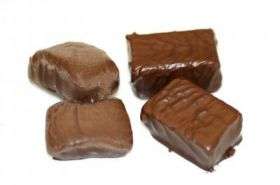
Chemists in England and the Netherlands have discovered a substance that could keep those boxes of Valentine’s Day chocolates, and other goodies, looking fresher and tastier. Their finding, which prevents formation of unsightly white films on the outside of chocolate, is scheduled for the March 12 issue of the ACS’ Journal of Agricultural and Food Chemistry.
Called “fat bloom,” white films are actually tiny particles of crystalline fat and most often appear on the surface of chocolates that contain nut-based fillings. The films often alarm consumers, who may mistakenly think good chocolates have gone bad. Although the blooms have been studied for decades, the phenomenon is poorly understood and researchers have had difficulty finding an effective method to reduce their formation.
In the new study, Kevin W. Smith and colleagues crafted a candy-size mechanical model of a chocolate bon-bon using a series of stacked, steel washers. They layered the bottom of each cylinder with different concentrations of a substance called “antibloom fat” and then filled the top of each cylinder with cocoa butter to represent a chocolate coating. The scientists showed that increasing the amount of “antibloom” used in the filling slowed the rate of crystal formation, thereby preventing fat bloom.
Source: ACS


