Researchers probe a DNA repair enzyme
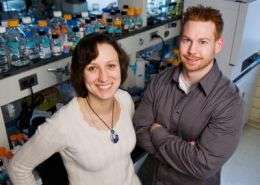
Researchers have taken the first steps toward understanding how an enzyme repairs DNA. Enzymes called helicases play a key role in human health, according to Maria Spies, a University of Illinois biochemistry professor.
“DNA helicases act as critical components in many molecular machineries orchestrating DNA repair in the cell.” she said. “Multiple diseases including cancer and aging are associated with malfunctions in these enzymes.”
Spies’ laboratory undertook a recent study of an enzyme, called Rad3, which defines a group of DNA helicases characterized by a unique structural domain containing iron. The findings appear in the Journal of Biological Chemistry.
Helicases are a special category of molecular motors that modify DNA (deoxyribonucleic acid, the fundamental building block of genes and chromosomes). They do so by moving along strands of DNA, much the same way cars move on roads, using an energy-packed molecule, adenosine triphosphate (ATP) as a fuel source.
Their primary function is to unzip double-stranded DNA, allowing replication and repair of the strands.
DNA is a fragile molecule that undergoes dramatic changes when exposed to radiation, ultraviolet light, toxic chemicals or byproducts of normal cellular processes. DNA damage, if not repaired in time, may lead to mutations, cancer or cell death. Many helicases in the Rad3 family are key players in the cell’s elaborate machinery to prevent and repair such damage. Mutations in the human members of this helicase family impede DNA repair and may contribute to breast cancer, Fanconi Anemia and Xeroderma pigmentosum.
The researchers studied the archaeal version of Rad3. Archaea are microbes whose DNA repair systems are closely related to those of human cells.
“(The archaeal Rad3) is a very good representative of a unique family of structurally related DNA repair helicases, all of which have the same motor core and share an unprecedented (for helicases) structural feature – an accessory domain stabilized by an iron-sulfur cluster,” Spies said.
Working with archaea has the advantage of allowing the researchers to increase the amount available protein and also permits easy genetic manipulation.
Like other helicases, Rad3 is composed of a chain of amino acids. It also contains an ancient prosthetic group called an iron-sulfur cluster, an assembly of four iron and four sulfur atoms incorporated into the protein structure through interaction with four cysteine residues of the amino acid chain.
"DNA helicases, which belong to the Rad3 family, have an auxiliary domain inserted within a conserved motor core. The structure of this domain is stabilized by an iron-sulfur cluster, whose integrity seems to be essential for proper function of these enzymes in DNA repair," Spies said. By mutating the cysteine ligands to the cluster, the researchers probed its role in the molecular mechanism of Rad3 enzymes. Some of these mutations uncoupled DNA translocation and ATP hydrolysis, meaning that the engine of the protein could still use the ATP fuel but was no longer capable of moving along the DNA.
This analysis also revealed that the integrity of the cluster and the iron-containing domain is crucial for recognition of specific DNA structures believed to be physiological targets for this helicase. “On making these mutations, the helicase no longer behaves like it’s supposed to,” said graduate student Robert Pugh, lead author on the study. “The cluster is still there but the environment around it is somehow changing.”
Source: University of Illinois at Urbana-Champaign


