The Dark Side of Light

February 19, 2008 By Lisa Zyga The Dark Side of Light

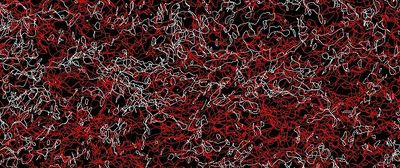
The model of vortex structure in laser speckle. Open vortex lines are in red, while closed vortex loops are in white. Credit: O’Holleran, et al.

Light may not seem very interesting in our everyday lives. But to scientists, light’s properties are a constant source of intrigue. The nature of light as both wave and particle, light as the universal speed limit, and the way light interacts with magnetic fields in the atmosphere to form auroras are a just a few examples of light’s fascinating behavior.

Recently, researchers from the University of Glasgow and the University of Bristol in the UK have discovered another unusual property of light – or, more accurately, the darkness within light. As the researchers explain, natural light fields are threaded by lines of darkness, which create optical vortices that appear as black points within the light. The group has modeled this phenomenon, and found that the lines of darkness exhibit fractal properties with Brownian (random) characteristics. Further, the characteristics of these optical vortices suggest universal properties, which could help connect different areas of physics.

Many people have noticed the phenomenon of laser speckle, which occurs when coherent, monochromatic laser light bounces off a rough surface, giving the surface a speckled appearance. The black specks are interference patterns generated by a superposition of highly coherent light waves reflected from different points on the rough surface. Sometimes the speckled pattern can even appear to sparkle when the viewer moves relative to the surface.

In a recent issue of Physical Review Letters, the UK researchers describe how they developed a model of the superpositions that create the dark optical vortices, using numerical simulations and experiments. In their experiments, they created laser speckle with a 10-mm-diameter helium neon laser beam shining through a screen made of ground glass.

By measuring the superpositions with an interferometer, the scientists could generate a 3D map of the structure of the optical vortices. They found two types of vortices. Infinite vortex lines, which account for about 73% of the dark vortices, percolate entirely through the light beam. The remaining 27% of the vortices form closed loops, which occur when a vortex line returns to its starting point within a small enough area.

When investigating the lines of darkness further, the researchers found that they exhibit scale invariance. In other words, the vortices look the same no matter how much you zoom out – they are fractals. Lead author Kevin O’Holleran of the University of Glasgow said that, while he and his colleagues suspected vortex lines to exhibit fractal properties, they were quite surprised to find that the fractality was of a Brownian nature.

“To find that the vortex lines in light have Brownian characteristics is exciting,” O’Holleran told PhysOrg.com. “Brownian structures are inherently random, so the coherence of our model was in no way limiting the fractal behavior of the vortex lines. We are looking forward to exploring these properties in more detail. More specifically, we hope to investigate the topological side of random light fields, such as how often vortex lines are knotted or linked.”

Interestingly, the researchers noted that these properties of optical vortices (the ratio of vortex lines to loops and their scale invariance) are very similar to the properties of cosmic strings, according to the cosmic string lattice model. The model describes the configuration of cosmic strings in the early universe – the very thin but very dense one-dimensional defects in space-time that could be responsible for the formation of galaxies.

The researchers don’t think this similarity is likely to be coincidental. They suggest that these properties could be universal for all optical fields, and they plan to investigate the analogy further.

“The greatest significance [of this study] is the connection to other fields in physics,” O’Holleran said. “Universal properties connect fields of research at deeper levels than the exact formulation of each system. Shared fundamental properties or restrictions (like how lines can be embedded in 3D space) result in universal exponents appearing in varied and apparently disconnected fields of research. The fact that vortex lines in light exhibit power laws suggesting universal properties means that these lines are governed by more general laws than wave equations.”

More information: O’Holleran, Kevin, Dennis, Mark R., Flossmann, Florian, and Padgett, Miles J. “Fractality of Light’s Darkness.” Physical Review Letters 100, 053902 (2008).

Copyright 2008 PhysOrg.com.
All rights reserved. This material may not be published, broadcast, rewritten or redistributed in whole or part without the express written permission of PhysOrg.com.


print this article email this article download pdf blog this article bookmark this article     Stumble it Digg this share on Facebook retweet share on Reddit add to delicious
Rate this story - 4.5 /5 (193 votes)

Rank Filter

Move the slider to adjust rank threshold, so that you can hide some of the comments.


Display comments: newest first

  • earls - Feb 19, 2008
    • Rank: 2.6 / 5 (8)
    Sounds like what I've been searching for... Random and recursive structures in... spacetime?

    "closed vortex loops are in black" You mean white?

    "Vortices," oh my... And I like how it pulls in Knot theory as well.

    I look forward to any follows up & developments from their research. Especially a description of the "power laws suggesting universal properties."
  • dfwrunner - Feb 19, 2008
    • Rank: 3.7 / 5 (11)
    I frequent this site hoping for more literate, illumninating commentary...always to be disappointed
  • mattytheory - Feb 19, 2008
    • Rank: 4.2 / 5 (9)
    I think it is interesting how 73% of the vortices are infinite (and form "Open Strings"), corresponding to the (approximate) 73% of the universe which we call "Dark Energy". Also interesting is how the remaining 27% of vortices form "Closed Loops", corresponding to the measurement of regular matter plus "Dark Matter" we observe in the known universe. This 27% is known due to the gravitational effects it has on space-time, and via Loop Quantum Gravity, particles of gravity are represented by "Closed Strings", analogous to the "Closed Loops" that the remaining 27% of vortices form.

    Just an interesting observation..
  • quantum_flux - Feb 19, 2008
    • Rank: 2.2 / 5 (10)
    If and only if you consider god to be a mathematical entity. I have seen the light, and it is full of fractals, probability amplitudes, bifurcations, and cellular automaton! Oh, and by the way, he came down from his big throne in heaven and arranged to have himself psuedo-killed in order to save your life, and aliens don't exist, and evolution never happened, and having an imagination is wrong, and god is concerned with all of your decision making.

    But, why the heck would a mathematical entity be concerned with the moral laws of moses anyhow!? Wouldn't a mathematical entity address the important issues like curing aids or cancer, or world hunger which also all happen to follow a fractal pattern? Hasn't, in a sense, his design failed due to inefficiencies and imperfections in the creation process!?

    I think that he is more of a historo-mythical figure than a supreme deity, like Zeus and Oden.
  • moebiex - Feb 19, 2008
    • Rank: 3.7 / 5 (6)
    Would it be reasonable to expect the same property to show up in the microwave background map- I'll look forward to further developments
  • earls - Feb 20, 2008
    • Rank: 1 / 5 (3)
    mattytheory - Fantastic correlation!

    moebiex - Indeed!

    In addition to these two examples, it would be interesting to find out just how many phenomenon follow this ratio and what decides the ratio.

    How many times did they repeat the experiment? For example, after every "simulation" was the ratio at or close to 27% & 73%?

    They mentioned that the "lines of darkness exhibit fractal properties" ... Is this true for the lines of... lightness as well?

    Again, quite a revelation.
  • monkeyleader - Feb 20, 2008
    • Rank: 3.7 / 5 (3)
    How exactly does god relate to this article?
  • shathippens - Feb 20, 2008
    • Rank: 4.3 / 5 (6)
    How does God relate to this article??........ HOW DOES GOD RELATE TO THIS ARTICLE???...Well to be honest, I don't think he's read it yet , cause I didn't see a post from him on here..
  • Nikola - Feb 20, 2008
    • Rank: 3 / 5 (2)
    interesting
  • blengi - Feb 20, 2008
    • Rank: 2 / 5 (4)
    Hmmm curious, when I pared down my abiogenesis simulator which modelled evolution of quasi brownian flotsam against a virtualise substrate topology, and generalised the basic mathematical form into an uber simple physics model, the resulting simulations seem to similarly imply various aspects more fundamental than typical quatum wave nature of things - axiomatically so. Mindu model also implied rank speculative delusions like: expansion of space is actually a hollowing out of some initially unitary hypervolume; that relativity is an information rate phenomenon; that past is literary the future; that completely contrary to the putative GUT desert is actually a teeming menagerie of semi incomprehensible sub-quantum oddness etc etc...
  • brant - Feb 20, 2008
    • Rank: 3 / 5 (2)
    Holy smokes, its just light!!!!!
  • Rohitasch - Feb 20, 2008
    • Rank: 1 / 5 (5)
    It is clear here that God gave the laser sparkle His own form.
    rAmen!
  • shathippens - Feb 20, 2008
    • Rank: 1 / 5 (2)
    YEA....What Blengi said!
  • deepsand - Feb 20, 2008
    • Rank: 3.7 / 5 (6)
    Genesis 1:4
    And God saw the light, that it was good: and God divided the light from the darkness.

    I know the atheists will cry "crank" when I say this, but to me, this article is proof positive of underlying design in the universe, right down to the background media itself.

    The universe cannot be fundamental because it is based on laws for which it cannot have been the origin.

    All laws come from the First Cause, and that is God.

    In the Beginning God created...


    And, then, by your own argument, Who/What created God?

    Your argument is infinitely recursive.

    While avoiding such by way of exiting the loop at an arbitrary interation named "God" may be emotionally satisfying to you, for those of us who prefer a logically consistent one it fails miserably.

    Best stick to Faith, as you fail at Science.
  • Jesus_Einstein - Feb 20, 2008
    • Rank: 1 / 5 (5)
    Please. Would you all you atheists and theists just stop pretending that you're not God and just kiss and make up?
  • DBheemeswar - Feb 21, 2008
    • Rank: 1.3 / 5 (3)
    It is quite interesting to see darker side of the light, which behaves in dual nature. If this is true, then the particle theory holds good, that is photon theory, a highly spinning particles around its centrail axis and moving in the direction of path giving raise to white or yellow light, as the axis of rotation changes to 90 degrees it may show the other light colours, and if its axis of rotation is 180 degrees this darkness may come. The wave lengths what we observe is due to change in the direction of spinning axis, when the entire energy in the particle is absobed it gves raise to heat (Infra red region), when it is nearer 90 degrees it gives the ultra violet wave lengths.

    this phenomenon may be explained by the reverse swing in the cricket during which the ball holds bit, this may create a darkness, other phenomenon may top spin. This what I understand from these.

    when it grazes the materials, the spinning angle may be changing all the other physical phenomenon can be explained.
  • Adriab - Feb 21, 2008
    • Rank: 2 / 5 (2)
    Let's consider how light is its own antiparticle, and so is it postulated that dark matter is also its own antiparticle.

    We are now seeing what seems to be scale-invariance in this structure, or the simulation anyway. This brings to mind the recent theoretical research into 'unparticles', structures that are, like this simulation, scale-invariant.

    And since the percentage of vortices correlate in a close manner to the percentage of known matter in the universe, well, we have some interesting science on our hands.
  • rwolf2001 - Feb 21, 2008
    • Rank: 1 / 5 (1)
    Perhaps The Wolford Centres, 0-, each representing Zero Point Energy attempting to exist, are a better explanation of how something from nothing was and is possible.
  • rwolf2001 - Feb 21, 2008
    • Rank: 1 / 5 (1)
    Sorry, my comment should read- Perhaps The Wolford Centres, 0-, each representing Zero Point Energy attempting to exist, are a better explanation of how something from nothing was and is possible.
  • rwolf2001 - Feb 21, 2008
    • Rank: not rated yet
    I do not know why the plus sign is always omitted before ZPE. So, it should read plus0minus.
  • Ashibayai - Feb 23, 2008
    • Rank: not rated yet
    The remaining 27% of the vortices form closed loops, which occur when a vortex line returns to its starting point within a small enough area.


    I think the part of this sentence that might be most important is, "within a small enough area".

    Possibly meaning this was a limitation set by the people doing the experiment and possibly rendering any coincidences of % in the occurrence of loops moot.

    Just food for thought.
  • superhuman - Feb 25, 2008
    • Rank: 1 / 5 (1)
    Isn't the light structure directly related to the surface they bounce it off? I would expect that those properties they describe have more to do with the surface topology of "screen made of ground glass" then inherent properties of light.
  • deepsand - Mar 20, 2008
    • Rank: 5 / 5 (1)
    It is quite interesting to see darker side of the light, which behaves in dual nature. If this is true, then the particle theory holds good, that is photon theory, a highly spinning particles around its centrail axis and moving in the direction of path giving raise to white or yellow light, as the axis of rotation changes to 90 degrees it may show the other light colours, and if its axis of rotation is 180 degrees this darkness may come. The wave lengths what we observe is due to change in the direction of spinning axis, when the entire energy in the particle is absobed it gves raise to heat (Infra red region), when it is nearer 90 degrees it gives the ultra violet wave lengths.

    this phenomenon may be explained by the reverse swing in the cricket during which the ball holds bit, this may create a darkness, other phenomenon may top spin. This what I understand from these.

    when it grazes the materials, the spinning angle may be changing all the other physical phenomenon can be explained.


    Wherever did you get the notion that wavelength is a function of the orientation of spin axis?

February 19, 2008 all stories

Comments: 23

4.5 /5 (193 votes)
  • Stumble this up

  • Digg this

  • share this

  • hide
  • Related Stories

  • A long night falls over Saturn's rings
    created Oct 24, 2009 | popularity not rated yet | comments 0
  • Race for Superconductors Shrinks to Nanoscale
    created Oct 09, 2009 | popularity not rated yet | comments 0
  • Coherent X-Ray Diffraction Patterns of Collagen Measured in Soft Tissues
    created Sep 01, 2009 | popularity not rated yet | comments 0
  • NASA's A-Train of satellites 'on track' with hurricane research
    created Aug 20, 2009 | popularity not rated yet | comments 0
  • New exotic material could revolutionize electronics
    created Jun 15, 2009 | popularity not rated yet | comments 0


  • hide
  • Relevant PhysicsForums posts

  • Work done on femur
    created 3 hours ago
  • Magnet and Motors?
    created 4 hours ago
  • Effect of Volume on Revolution
    created 4 hours ago
  • Hydrostatic pressure
    created 6 hours ago
  • How are bubbles created?
    created 6 hours ago
  • quick question: how does air friction work?/why do things float
    created 8 hours ago
  • More from Physics Forums - General Physics

Other News

Stars Fueled by Dark Matter Could Hold Secrets to the Universe

Stars Fueled by Dark Matter Could Hold Secrets to the Universe

Physics / General Physics

created Nov 03, 2009 | popularity 4.5 / 5 (51) | comments 41

(PhysOrg.com) -- The first stars in the universe may have been very different from the stars we see today, yet they may hold clues to understanding some of the mysterious features of the universe. These "dark ...


Second Law of Thermodynamics May Explain Economic Evolution

Second Law of Thermodynamics May Explain Economic Evolution

Physics / General Physics

created Nov 02, 2009 | popularity 4.3 / 5 (30) | comments 28

(PhysOrg.com) -- Terms such as the "invisible hand," laissez-faire policy, and free-market principles suggest that economic growth and decline in capitalist societies seem to be somehow self-regulated. Now, ...


High-performance plasmas may make reliable, efficient fusion power a reality

High-performance plasmas may make reliable, efficient fusion power a reality

Physics / Plasma Physics

created Nov 02, 2009 | popularity 4.7 / 5 (39) | comments 32

In the quest to produce nuclear fusion energy, researchers from the DIII-D National Fusion Facility have recently confirmed long-standing theoretical predictions that performance, efficiency and reliability ...


'Teapot effect' solved

Solving Teapot Effect

Physics / General Physics

created Nov 02, 2009 | popularity 4.9 / 5 (11) | comments 10

(PhysOrg.com) -- A team of scientists from France have worked out why teapots dribble at low flow rates, and how to stop them. The effect is called the "teapot effect", and solving it could finally put an ...


Laser accelerated protons to the highest energies so far

Researchers use trident laser to accelerate protons to record energies

Physics / General Physics

created Nov 02, 2009 | popularity 4.7 / 5 (6) | comments 10

An international team of physicists at Los Alamos National Laboratory has succeeded in using intense laser light to accelerate protons to energies never before achieved. Using this technique, scientists can ...