Directed self-ordering of organic molecules for electronic devices
February 19th, 2008 Directed self-ordering of organic molecules for electronic devices

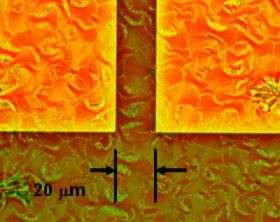
Optical micrographs of typical FET structures in the NIST/Penn State/UK experiments show the effect of pretreating contacts to promote organic crystal formation. Treated structure (l) shows crystal structure extending from the rectangular contacts and merging in the channel in contrast to untreated contacts (r). Credit: NIST

A simple surface treatment technique demonstrated by a collaboration between researchers at the National Institute of Standards and Technology, Penn State and the University of Kentucky potentially offers a low-cost way to mass produce large arrays of organic electronic transistors on polymer sheets for a wide range of applications including flexible displays, “intelligent paper” and flexible sheets of biosensor arrays for field diagnostics.

In a paper posted this week, the team describes how a chemical pretreatment of electrical contacts can induce self-assembly of molecular crystals to both improve the performance of organic semiconductor devices and provide electrical isolation between devices.

Organic electronic devices are inching towards the market. Compounds with tongue-twisting names like “5,11-bis(triethylsilylethynyl) anthradithiophene” can be designed with many of the electrical properties of more conventional semiconductors. But unlike traditional semiconductors that require high-temperature processing steps, organic semiconductor devices can be manufactured at room temperature. They could be built on flexible polymers instead of rigid silicon wafers. Magazine-size displays that could be rolled up or folded to pocket size and plastic sheets that incorporate large arrays of detectors for medical monitoring or diagnostics in the field are just a couple of the tantalizing possibilities.

One unsolved problem is how to manufacture them efficiently and at low cost. Large areas can be coated rapidly with a thin film of the organic compound in solution, which dries to a semiconductor layer. But for big arrays like displays, that layer must be patterned into electrically isolated devices. Doing that requires one or more additional steps that are costly, time-consuming and/or difficult to do accurately.

The NIST team and their partners studied the organic version of a workhorse device—the field effect transistor (FET)—that commonly is used as a switch to, for example, turn pixels on and off in computer displays. The essential structure consists of two electrical contacts with a channel of semiconductor between them.

The researchers found that by applying a specially tailored pretreatment compound to the contacts before applying the organic semiconductor solution, they could induce the molecules in solution to self-assemble into well-ordered crystals at the contact sites.

These structures grow outwards to join across the FET channel in a way that provides good electrical properties at the FET site, but further away from the treated contacts the molecules dry in a more random, helter-skelter arrangement that has dramatically poorer properties—effectively providing the needed electrical isolation for each device without any additional processing steps. The work is an example of the merging of device structure and function that may enable low cost manufacturing, and an area where organic materials have important advantages.

In addition to its potential as a commercially important manufacturing process, the authors note, this chemically engineered self-ordering of organic semiconductor molecules can be used to create test structures for fundamental studies of charge transport and other important properties of a range of organic electronic systems.

Citation: .J. Gundlach, J.E. Royer, S.K. Park, S. Subramanian, O.D. Jurchescu, B.H. Hamadani, A.J. Moad, R.J. Kline, L.C. Teague, O. Kirillov, C.A. Richter, J.G. Kushmerick, L.J. Richter, S.R. Parkin, T.N. Jackson and J.E. Anthony. Contact-induced crystallinity for high-performance soluble acene-based transistors and circuits. Nature Materials Advanced Online Publication, 17 February 2008.

Source: National Institute of Standards and Technology


print this article email this article download pdf blog this article bookmark this article     Digg this Stumble it share on Facebook share on Reddit add to delicious save to Yahoo! bookmarks
4.3/5 after 19 votes

Rank Filter

Move the slider to adjust rank threshold, so that you can hide some of the comments.


Display comments: newest first

  • Nikola - Feb 20, 2008
    • Rank: 5 / 5 (1)
    Hopefully this will eventually lead to self-assembling sheets of photovoltaics.

February 19th, 2008 all stories
Physics / Condensed Matter

Comments: 1
Rank: 4.3/5 after 19 votes

  • Stumble this up

  • Digg this

  • Share it:
  • share on Facebook
  • share on MySpace
  • share on Slashdot
  • rss-newsfeed
  • share on Google
  • share on Reddit
  • add to delicious
  • save to Yahoo! bookmarks
  • share on Windows Live
  • Add to Mixx!
Rating: 4.3/5 after 19 votes

  • Related Stories

  • New 'electronic glue' promises less expensive semiconductors
    created Jun 11, 2009 | popularity not rated yet | comments 0
  • Researchers create freestanding nanoparticle films without fillers
    created Jun 09, 2009 | popularity not rated yet | comments 0
  • Enabling graphene-based technology via chemical functionalization
    created May 17, 2009 | popularity not rated yet | comments 0
  • Sensor Detects Onset of Acute Myocardial Ischemia
    created Apr 23, 2009 | popularity not rated yet | comments 0
  • GaAs self-assembled nanowires could make chips smaller and faster
    created Apr 20, 2009 | popularity not rated yet | comments 0

Tags


  • Physicists Demonstrate Quantum Memory with Matter Qubits
    Physicists Demonstrate Quantum Memory with Matter Qubits
    Physics / General Physics
    created Jul 03, 2009 | popularity 4.4 / 5 (16) | comments 1
  • 'Holey' Nanosheets for Wastewater Dye Removal
    Nanotechnology / Nanomaterials
    created Jul 01, 2009 | popularity 5 / 5 (5) | comments 1
  • Jellyfish Robot Swims Like its Biological Counterpart
    Jellyfish Robot Swims Like its Biological Counterpart
    Electronics / Robotics
    created Jun 26, 2009 | popularity 4.4 / 5 (8) | comments 1
  • Could Maxwell's Demon Exist in Nanoscale Systems?
    Could Maxwell's Demon Exist in Nanoscale Systems?
    Physics / General Physics
    created Jun 24, 2009 | popularity 4.4 / 5 (18) | comments 29
  • Living Safely with Robots, Beyond Asimov's Laws
    Living Safely with Robots, Beyond Asimov's Laws
    Electronics / Robotics
    created Jun 22, 2009 | popularity 4.6 / 5 (52) | comments 40
  • Other News

    Science journals

    How to Spot an Influential Paper Based on its Citations

    Physics / General Physics

    created 20 hours ago | popularity 4 / 5 (9) | comments 5

    (PhysOrg.com) -- At first it may seem that the number of citations received by a published scientific paper is directly related to that paper's quality of content. The higher the quality, the more people read ...


    Scientists create first electronic quantum processor

    Scientists create first electronic quantum processor

    Physics / General Physics

    created Jun 28, 2009 | popularity 4.8 / 5 (52) | comments 39

    A team led by Yale University researchers has created the first rudimentary solid-state quantum processor, taking another step toward the ultimate dream of building a quantum computer.


    Fermilab's CDF observes Omega-sub-b baryon

    Fermilab's CDF observes Omega-sub-b baryon

    Physics / General Physics

    created Jun 29, 2009 | popularity 4.7 / 5 (16) | comments 7

    (PhysOrg.com) -- At a recent physics seminar at the Department of Energy’s Fermi National Accelerator Laboratory, Fermilab physicist Pat Lukens of the CDF experiment announced the observation of a new particle, ...


    New insights, and a new angle, on high-temperature superconductivity

    New insights, and a new angle, on high-temperature superconductivity

    Physics / Superconductivity

    created Jun 29, 2009 | popularity 4.8 / 5 (13) | comments 6

    (PhysOrg.com) -- A Princeton-led research team has revealed surprising information about how electron behavior influences the conduction of electricity in a class of high-temperature superconductors. An increased ...


    The art of invisibility and the perfect cat's eye

    The art of invisibility and the perfect cat's eye

    Physics / Optics & Photonics

    created Jun 30, 2009 | popularity 4 / 5 (8) | comments 6

    (PhysOrg.com) -- In recent years scientists have explored the impossible by developing invisibility or 'cloaking' devices, but can the same technology also help make things more visible?