'NMR on a chip' features magnetic mini-sensor
February 19th, 2008 'NMR on a chip' features NIST magnetic mini-sensor

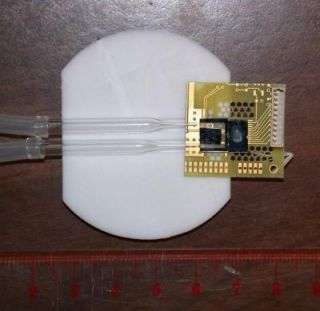
Prototype microchip device combining NIST's miniature atomic magnetometer with a fluid channel for studies of tiny samples. Credit: NIST

A super-sensitive mini-sensor developed at the National Institute of Standards and Technology can detect nuclear magnetic resonance (NMR) in tiny samples of fluids flowing through a novel microchip. The prototype chip device, developed in a collaboration between NIST and the University of California, may have wide application as a sensitive chemical analyzer, for example in rapid screening to find new drugs.

As described in Proceedings of the National Academy of Sciences, the NMR chip detected magnetic signals from atomic nuclei in tap water flowing through a custom silicon chip that juxtaposes a tiny fluid channel and the NIST sensor.

The Berkeley group recently co-developed this “remote NMR” technique for tracking small volumes of fluid or gas flow inside soft materials such as biological tissue or porous rock, for possible applications in industrial processes and oil exploration. The chip could be used in NMR spectroscopy, a widely used technique for determining physical, chemical, electronic and structural information about molecules. NMR signals are equivalent to those detected in MRI (magnetic resonance imaging) systems

Berkeley scientists selected the NIST sensor, a type of atomic magnetometer, for the chip device because of its small size and high sensitivity, which make it possible to detect weak magnetic resonance signals from a small sample of atoms in the adjacent microchannel. Detection is most efficient when the sensor and sample are about the same size and located close together, lead author Micah Ledbetter says. Thus, when samples are minute, as in economical screening of many chemicals, a small sensor is crucial, Ledbetter says.

Its small size and extreme sensitivity make the NIST sensor ideal for the microchip device, in contrast to SQUIDs (superconducting quantum interference devices) that require bulky equipment for cooling to cryogenic temperatures or conventional copper coils that need much higher magnetic fields (typically generated by large, superconducting magnets) like those in traditional MRI.

The results reported in the PNAS demonstrate another use for the NIST mini-sensor, a spin-off of NIST’s miniature atomic clocks. The sensor already has been shown to have biomedical imaging applications.

Citation: M.P. Ledbetter, I.M. Savukov, D. Budker, V. Shah, S. Knappe, J. Kitching, D. Michalak, S. Xu , and A. Pines. Zero-field remote detection of NMR with a microfabricated atomic magnetometer. Proceedings of the National Academy of Sciences, posted online Feb. 6, 2008.

Source: National Institute of Standards and Technology


print this article email this article download pdf blog this article bookmark this article     Digg this Stumble it share on Facebook share on Reddit add to delicious save to Yahoo! bookmarks
4.4/5 after 16 votes


February 19th, 2008 all stories
Physics / General Physics

Comments: 0
Rank: 4.4/5 after 16 votes

  • Stumble this up

  • Digg this

  • Share it:
  • share on Facebook
  • share on MySpace
  • share on Slashdot
  • rss-newsfeed
  • share on Google
  • share on Reddit
  • add to delicious
  • save to Yahoo! bookmarks
  • share on Windows Live
  • Add to Mixx!
Rating: 4.4/5 after 16 votes


Tags


  • Physicists Demonstrate Quantum Memory with Matter Qubits
    Physicists Demonstrate Quantum Memory with Matter Qubits
    Physics / General Physics
    created Jul 03, 2009 | popularity 4.4 / 5 (17) | comments 1
  • 'Holey' Nanosheets for Wastewater Dye Removal
    Nanotechnology / Nanomaterials
    created Jul 01, 2009 | popularity 5 / 5 (5) | comments 1
  • Jellyfish Robot Swims Like its Biological Counterpart
    Jellyfish Robot Swims Like its Biological Counterpart
    Electronics / Robotics
    created Jun 26, 2009 | popularity 4.4 / 5 (8) | comments 1
  • Could Maxwell's Demon Exist in Nanoscale Systems?
    Could Maxwell's Demon Exist in Nanoscale Systems?
    Physics / General Physics
    created Jun 24, 2009 | popularity 4.4 / 5 (18) | comments 29
  • Living Safely with Robots, Beyond Asimov's Laws
    Living Safely with Robots, Beyond Asimov's Laws
    Electronics / Robotics
    created Jun 22, 2009 | popularity 4.6 / 5 (53) | comments 40
  • Other News

    Physical reality of string theory demonstrated

    Physics / General Physics

    created 41 minutes ago | popularity 4.8 / 5 (6) | comments 1

    String theory has come under fire in recent years. Promises have been made that have not been lived up to. Leiden (The Netherlands) theoretical physicists have now for the first time used string theory to describe a physical ...


    UQ researchers break the law -- of physics

    Physics / General Physics

    created 6 hours ago | popularity 4.5 / 5 (10) | comments 4

    (PhysOrg.com) -- Two UQ Science researchers have proved two famous physical laws that have been widely used for the past 25 years do not always work.


    Scientists create first electronic quantum processor

    Scientists create first electronic quantum processor

    Physics / General Physics

    created Jun 28, 2009 | popularity 4.8 / 5 (54) | comments 44

    A team led by Yale University researchers has created the first rudimentary solid-state quantum processor, taking another step toward the ultimate dream of building a quantum computer.


    Science journals

    How to Spot an Influential Paper Based on its Citations

    Physics / General Physics

    created Jul 04, 2009 | popularity 3.9 / 5 (10) | comments 6

    (PhysOrg.com) -- At first it may seem that the number of citations received by a published scientific paper is directly related to that paper's quality of content. The higher the quality, the more people read ...


    Fermilab's CDF observes Omega-sub-b baryon

    Fermilab's CDF observes Omega-sub-b baryon

    Physics / General Physics

    created Jun 29, 2009 | popularity 4.7 / 5 (18) | comments 7

    (PhysOrg.com) -- At a recent physics seminar at the Department of Energy’s Fermi National Accelerator Laboratory, Fermilab physicist Pat Lukens of the CDF experiment announced the observation of a new particle, ...