Amazing minaturized 'SIDECAR' drives Webb telescope's signal
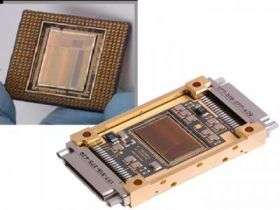
Many technologies have become so advanced that they've been miniaturized to take up less space and weigh less. That's what happened to detector controls and data conversion electronics on the James Webb Space Telescope being built by Northrop Grumman.
The electronics will convert analog signals to digital signals and provide better images to Earth.
These components, called a "SIDECAR" have been miniaturized from a volume of about one cubic meter (35.3 cubic feet) to a small integrated circuit.
SIDECAR ASIC means "System for Image Digitization, Enhancement, Control And Retrieval Application Specific Integrated Circuit." This tiny advanced low-noise, low-power microprocessor-based control chip was designed by Teledyne Imaging Sensors, Thousand Oaks, Calif. to convert the analog signals (which is what television stations currently broadcast) into digital signals (which television stations will broadcast starting Feb. 2009). Like televisions, the Webb telescope is getting several of those converter boxes." Digital signals can be easily transmitted and stored.
There are also several benefits to the extreme miniaturization of the SIDECAR. Further, it's about the size of a half-dollar and can do the same job as an electronics box weighing 20 pounds. It's smaller weight also makes it easier to launch.
"In addition, a smaller SIDECAR enables the ASIC to be physically close to the detector it is controlling. This close proximity minimizes the distance the analog signal travels, thus reducing the noise of the system," said Matt Greenhouse, Integrated Science Instrument Module Scientist at NASA Goddard Space Flight Center, Greenbelt, Md.
The three instruments that will use the SIDECAR on the Webb telescope are the Near Infrared Camera (NIRCam), Near Infrared Spectrograph (NIRSpec), and the Fine Guidance Sensors (FGS). These instruments all use highly sensitive infrared detectors to study distant stars, planets, and galaxies. SIDECAR will sit next to each of these detectors like a sidecar on a motorcycle, and the microprocessor will control these infrared detectors.
SIDECAR will convert the analog signals from the infrared detectors into digital data which is much more robust and easier to transmit. Without the SIDECAR, the analog signals might be corrupted in transmission and the science images would be lost or damaged.
"The significant technical advancement in the SIDECAR is its very low noise - the analog to digital conversion is nearly perfect, adding no significant noise to the image; and its very low power - the SIDECAR consumes only 11milliwatts of power," said Markus Loose, lead designer of the SIDECAR at Teledyne. Low consumption of power is important for keeping the telescope's science instruments cold (37° Kelvin or minus 400° Fahrenheit) as they collect faint signals from objects near the edge of the universe.
It's important to make sure SIDECAR is fully functional before it goes into the Webb telescope, so it's already being used to improve astronomy on the ground.
Astronomers are "test-driving" four SIDECARs that were installed in early 2007 in the University of Hawaii's 2.2 meter telescope on Mauna Kea. Since then they have been collecting science data and giving scientists experience in operating the SIDECAR so that its performance is optimal by the time that the Webb telescope flies.
The concept for the SIDECAR was proposed in June 2000 through a program for Webb telescope technology development by the University of Hawaii and Teledyne Imaging Sensors, formerly the Rockwell Science Center. After seven years, the SIDECAR passed an important milestone in 2007 when an independent review team concluded that the technology had been shown to be ready for use on the Webb telescope. That test confirmed that SIDECAR could handle the radiation, vacuum, and the cold of the space environment.
As a result of SIDECAR's success in the review and in ground-based telescopes other missions are planning to use it, and there's a plan to install it in the Hubble Space Telescope in 2008.
Source: NASA's Goddard Space Flight Center


