Aromaticity may occur in unexpected materials
February 20, 2008 Aromaticity may occur in unexpected materials

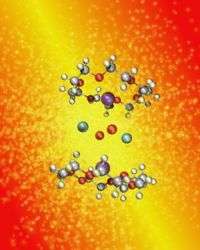
Shiv Khanna, Ph.D., professor of physics, and colleagues from Virginia Commonwealth University and Penn State, were recently highlighted in the Editor’s Choice section of the journal Science, as well as the trade publication Chemical & Engineering News, for the group’s work on the synthesis of an unusual inorganic ring molecule made of arsenic and tellurium, As2Te2-2, found to have magnetic and aromatic characteristics.

The findings suggest that traditionally nonmagnetic elements can become magnetic. For physicists, this work extends the understanding of aromaticity and shows that it may occur in unexpected materials.

Magnetic materials are used in a variety of applications, including magnetic stickers, motors, credit cards, refrigerators, magnetic memory storage and sensors.

“In this particular case, the interesting aspect is that both the elements are traditionally semiconducting elements that are nonmagnetic. We also expect the solid to be semiconducting which is quite exciting because of the recent interest in semiconducting magnets for quantum computing and spintronics,” said Khanna.

According to Khanna, aromaticity and magnetism are generally thought to be mutually exclusive; aromatic molecules are unusually stable and nonmagnetic. The new molecule, As2Te2-2, is ferromagnetic, suggesting a source of magnetism that is “new and unknown.” This also shows that assembling materials with nonmagnetic components may result in magnetic assemblies, suggesting that cluster assembled materials may have unusual properties.

In the mid-19th century, the term aromaticity was used to describe organic substances that had pleasant smell, Khanna said. It was later used as a marker for unusual stability of organic molecules and is linked to the delocalized rings of charge that form above and below the stable molecular rings and sometimes within the molecule itself.

Khanna said that the aromatic molecule synthesized by the team is unusually electron-rich. When one electron partially disrupts each ring, this leads to a magnetic moment, a distortion toward a parallelogram structure and an only partial disruption of the charged rings.

These findings were published in the January 2008 issue of the Journal of the American Chemical Society. Khanna collaborated with VCU researchers Arthur C. Reber and Meichun Qian and Penn State researchers Angel Ugrinov and Ayusman Sen.

Source: Virginia Commonwealth University


print this article email this article download pdf blog this article bookmark this article     Stumble it Digg this share on Facebook retweet share on Reddit add to delicious
Rate this story - 4.6 /5 (7 votes)


February 20, 2008 all stories

Comments: 0

4.6 /5 (7 votes)
  • Stumble this up

  • Digg this

  • share this

  • hide
  • Related Stories

  • Study: Added oxygen during stroke reduces brain tissue damage
    created Oct 19, 2009 | popularity not rated yet | comments 0
  • Scientists discover magnetic superatoms
    created Jun 15, 2009 | popularity not rated yet | comments 0
  • NJIT receives funding to improve Big Bear Telescope, study solar energy
    created Nov 20, 2009 | popularity not rated yet | comments 0
  • Atomic-level Snapshot Catches Protein Motor in Action (w/ Video)
    created Nov 20, 2009 | popularity not rated yet | comments 0
  • Tapering a Free-Electron Laser to Extract More Juice
    created Nov 20, 2009 | popularity not rated yet | comments 0


  • hide
  • Relevant PhysicsForums posts

  • avoidance of admitting that we dont know somethin
    created 6 hours ago
  • Speed of light : missing energy
    created 9 hours ago
  • Can light produce darkness and can noise procude quiteness 4
    created 12 hours ago
  • Magnetic Oscillation Equations
    created 18 hours ago
  • More from Physics Forums - General Physics

Other News

Restored machine to explore mysteries of Big Bang (AP)

Restored machine to explore mysteries of Big Bang

Physics / General Physics

created 10 hours ago | popularity 4.4 / 5 (12) | comments 6

(AP) -- Scientists are preparing the world's largest atom smasher to explore the depths of matter after successfully restarting the $10 billion machine following more than a year of repairs.


nuclear power plant

Doubts raised on nuclear industry viability

Physics / General Physics

created Nov 19, 2009 | popularity 3.2 / 5 (19) | comments 18

(PhysOrg.com) -- The investment in nuclear power has been growing around the world over the last few years, being viewed as a means for countries to control their energy security, avoid the price fluctuations ...


Researchers Find Innate Correlations Among Different Power Law Phenomena

Researchers Find Innate Correlations Among Different Power Law Phenomena

Physics / General Physics

created Nov 17, 2009 | popularity 4.3 / 5 (15) | comments 12

(PhysOrg.com) -- Studying the patterns that emerge in natural and social phenomena is a popular area of research, although usually individual phenomena are studied separately from each other. In a recent study, ...


Scientists demonstrate 'universal' programmable quantum processor

Scientists demonstrate 'universal' programmable quantum processor

Physics / Quantum Physics

created Nov 15, 2009 | popularity 4.6 / 5 (21) | comments 11

Physicists at the National Institute of Standards and Technology have demonstrated the first "universal" programmable quantum information processor able to run any program allowed by quantum mechanics -- th ...


Proton's party pals may alter its internal structure

Proton's party pals may alter its internal structure

Physics / General Physics

created Nov 18, 2009 | popularity 4.6 / 5 (18) | comments 9

A recent experiment at the DOE's Thomas Jefferson National Accelerator Facility has found that a proton's nearest neighbors in the nucleus of the atom may modify the proton's internal structure.