Drifting off to sleep
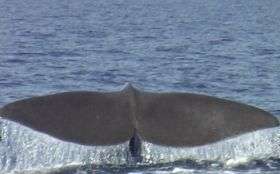
Researchers studying the resting behaviour of wild sperm whales have found evidence that whales literally 'drift' off to sleep.
The new study, by Dr Patrick Miller of the University of St Andrews, reveals a novel drifting behaviour that sperm whales perform and is backed up by rare video footage captured on the ocean.
The research demonstrates that sperm whales in the wild switch off completely for short periods of time, having 'cat naps' while performing slow rhythmic dives. The St Andrews team believe their study shows that sperm whales may sleep less than any other mammal in the wild.
The drifting behaviour - known as 'drift-dives' - was recorded by tagging devices attached with suction cups to 59 whales around the world. Since whales were recorded consistently performing this behaviour in each location the new study indicates that it is stereotypical for the entire species.
Dr Miller, of the School of Biology's Sea Mammal Research Unit, said, "Many mammals show species-typical sleeping behaviour, such as dogs circling before lying down, lending support to the idea that sperm whales sleep during these drift dives.
"One exciting aspect of this finding is that it suggests that the largest toothed whale actually might sleep in a fashion that we recognise as similar to sleep in terrestrial mammals. The sperm whale behaviour we describe seems to allow normal-looking quiescent sleep, possibly including REM sleep which has never been clearly observed in any cetacean," he said.
The related video was co-incidentally captured by a team led by fellow St Andrews' researcher Dr Luke Rendell off the coast of Northern Chile. The footage shows half a dozen sperm whales eerily floating vertically in a motionless manner, with their heads either at or just below the surface of the sea. Three of them were `unusually non-responsive' to the approaching boat, until it accidentally touched one of them.
"Reduced responsiveness that reverses with sufficient stimulation to cause waking is another important criteria that allows us to consider this to be a sleeping behaviour," explained Dr Miller.
The researchers believe that the video also seems to show that the whales were asleep with both eyes shut. Previous studies of captive dolphins has suggested that cetaceans sleep with one side of the brain at a time.
Dr Miller said, "Our study presents the first evidence that whales in the wild may sleep with both sides of the brain (bihemispheric). This is supported by the fact that the whales we approached did not react to the boat even though it was visible to both eyes. From what we have found, the amount of time sperm whale seem to have for sleep is very little, so it would make more sense for them to sleep both sides at a time.
"Very little is known about sleeping behaviour of whales in the wild as previous research has involved captive cetaceans. One of the theories for why cetaceans in captivity sleep with one side of their brain at a time (uni-hemispheric) is so they can keep looking out for their pod-mates or for danger with one open eye. Instead, the whales that we approached seemed to be non-responsive with either eye - which is unusual because it is very rare to ever get that close to sperm whales at sea," he said.
The data, gathered over 562 hours, also revealed that such whales appeared to sleep for just 7.1% of the time, most often between 6pm and midnight.
"Another exciting aspect of our study is that it suggests that the time cetaceans actually sleep in the wild might be very different from captivity. The sperm whales conducted these resting dives for just 7.1% of the tag time, which would be less sleep than any mammal and is also much less than is reported for captive cetaceans.
"This results show that we have a lot to learn about how cetaceans actually sleep in the wild as opposed to the captive settings where most of the research has been conducted to date. The challenge for the future is to develop new technologies that might allow us to measure the brain waves of these animals during sleep at sea," Dr Miller continued.
The research is published in the current edition of Current Biology.
Source: University of St Andrews


