Greenland's rising air temperatures drive ice loss at surface and beyond
February 20, 2008
Greenland's rising air temperatures drive ice loss at surface and beyond

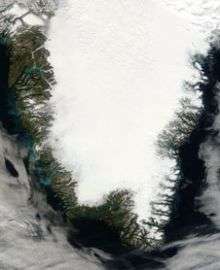
This MODIS Terra image, acquired August 23, 2006, shows the southern portion of Greenland. The Greenlandic ice cap covers about 80% of the island's surface. Credit: NASA

A new NASA study confirms that the surface temperature of Greenland's massive ice sheet has been rising, stoked by warming air temperatures, and fueling loss of the island's ice at the surface and throughout the mass beneath.

Greenland's enormous ice sheet is home to enough ice to raise sea level by about 23 feet if the entire ice sheet were to melt into surrounding waters. Though the loss of the whole ice sheet is unlikely, loss from Greenland's ice mass has already contributed in part to 20th century sea level rise of about two millimeters per year, and future melt has the potential to impact people and economies across the globe.

So NASA scientists used state-of-the-art NASA satellite technologies to explore the behavior of the ice sheet, revealing a relationship between changes at the surface and below. The new NASA study appears in the January issue of the quarterly Journal of Glaciology.

"The relationship between surface temperature and mass loss lends further credence to earlier work showing rapid response of the ice sheet to surface meltwater," said Dorothy Hall, a senior researcher in Cryospheric Sciences at NASA's Goddard Space Flight Center, in Greenbelt, Md., and lead author of the study.

A team led by Hall used temperature data captured each day from 2000 through 2006 from the Moderate Resolution Imaging Spectroradiometer (MODIS) instrument on NASA's Terra satellite. They measured changes in the surface temperature to within about one degree of accuracy from about 440 miles away in space. They also measured melt area within each of the six major drainage basins of the ice sheet to see whether melt has become more extensive and longer lasting, and to see how the various parts of the ice sheet are reacting to increasing air temperatures.

The team took their research at the ice sheet's surface a step further, becoming the first to pair the surface temperature data with satellite gravity data to investigate what internal ice changes occur as the surface melts. Geophysicist and co-author, Scott Luthcke, also of NASA Goddard, developed a mathematical solution, using gravity data from NASA's Gravity Recovery and Climate Experiment (GRACE) twin satellite system. "This solution has permitted greatly-improved detail in both time and space, allowing measurement of mass change at the low-elevation coastal regions of the ice sheet where most of the melting is occurring," said Luthcke.

The paired surface temperature and gravity data confirm a strong connection between melting on ice sheet surfaces in areas below 6,500 feet in elevation, and ice loss throughout the ice sheet's giant mass. The result led Hall's team to conclude that the start of surface melting triggers mass loss of ice over large areas of the ice sheet.

The beginning of mass loss is highly sensitive to even minor amounts of surface melt. Hall and her colleagues showed that when less than two percent of the lower reaches of the ice sheet begins to melt at the surface, mass loss of ice can result. For example, in 2004 and 2005, the GRACE satellites recorded the onset of rapid subsurface ice loss less than 15 days after surface melting was captured by the Terra satellite.

"We're seeing a close correspondence between the date that surface melting begins, and the date that mass loss of ice begins beneath the surface," Hall said. "This indicates that the meltwater from the surface must be traveling down to the base of the ice sheet -- through over a mile of ice -- very rapidly, where its presence allows the ice at the base to slide forward, speeding the flow of outlet glaciers that discharge icebergs and water into the surrounding ocean."

Source: NASA's Goddard Space Flight Center

2.9 /5 (11 votes)  

Filter


Move the slider to adjust rank threshold, so that you can hide some of the comments.


Display comments: newest first

NotParker
Feb 20, 2008

Rank: 2 / 5 (4)
WAIT!!

Sea level has been rising 2mm per year for the whole of the 20th century????

Couldn't be CO2 then. Must be the Sun.

http://en.wikiped...vel_rise

In fact, sea levels have been rising for 18,000 years - since the end of the last ice age.

Rank 2.9 /5 (11 votes)
Tags

Relevant PhysicsForums posts
  • Discrepancy between oxygen and carbon-dioxide levels
    createdFeb 09, 2012
  • where gems are found in the world
    createdFeb 09, 2012
  • Wind Waves in Reservoir ~ Wind run-up and Wind set-up
    createdFeb 08, 2012
  • Balance of oxygen in the atmosphere
    createdFeb 01, 2012
  • The case for a methanol-based economy
    createdJan 30, 2012
  • Weather in a rotating cylinder
    createdJan 25, 2012
  • More from Physics Forums - Earth

More news stories

Humans may have helped the decline of African rainforests 3000 years ago

(PhysOrg.com) -- Large areas of rainforests in Central Africa mysteriously disappeared over three thousand years ago, to be replaced by savannas. The prevailing theory has been that the cause was a change ...

Space & Earth / Environment

created 19 hours ago | popularity 4.3 / 5 (11) | comments 12 | with audio podcast report

Could Venus be shifting gear?

(PhysOrg.com) -- ESA’s Venus Express spacecraft has discovered that our cloud-covered neighbour spins a little slower than previously measured. Peering through the dense atmosphere in the infrared, the ...

Space & Earth / Space Exploration

created 15 hours ago | popularity 5 / 5 (7) | comments 7 | with audio podcast

NASA budget will axe Mars deal with Europe: scientists

US President Barack Obama's budget proposal to be submitted next week for 2013 will cut NASA's budget by 20 percent and eliminate a major partnership with Europe on Mars exploration, scientists said Thursday.

Space & Earth / Space Exploration

created 18 hours ago | popularity 5 / 5 (2) | comments 18

Mars Science Laboratory computer issue resolved

(PhysOrg.com) -- Engineers have found the root cause of a computer reset that occurred two months ago on NASA's Mars Science Laboratory and have determined how to correct it.

Space & Earth / Space Exploration

created 16 hours ago | popularity 4.7 / 5 (6) | comments 3 | with audio podcast

Two new moons for Jupiter

Advances in technology have lead to the discovery of new planets outside of our Solar System, and now even new moons in our own backyard.

Space & Earth / Space Exploration

created 15 hours ago | popularity 4 / 5 (1) | comments 7


Google users warned of threat to smartphone wallets

Users of Google smartphone wallets were being warned on Friday that there is a way to crack pass codes intended to thwart thieves from going on illicit shopping sprees.

Anonymous knocks CIA website offline (Update)

The website of the Central Intelligence Agency was inaccessible on Friday after the hacker group Anonymous claimed to have knocked it offline.

New error-correcting codes guarantee the fastest possible rate of data transmission

Error-correcting codes are one of the triumphs of the digital age. They’re a way of encoding information so that it can be transmitted across a communication channel — such as an optical fiber o ...

New power source discovered

(PhysOrg.com) -- Researchers at the Massachusetts Institute of Technology (MIT) and RMIT University have made a breakthrough in energy storage and power generation.

Complex wiring of the nervous system may rely on a just a handful of genes and proteins

Researchers at the Salk Institute have discovered a startling feature of early brain development that helps to explain how complex neuron wiring patterns are programmed using just a handful of critical genes. ...

The power of estrogen -- male snakes attract other males

A new study has shown that boosting the estrogen levels of male garter snakes causes them to secrete the same pheromones that females use to attract suitors, and turned the males into just about the sexiest ...