Attack on computer memory reveals vulnerability of widely-used security systems
February 21, 2008 Attack on computer memory reveals vulnerability of widely-used security systems

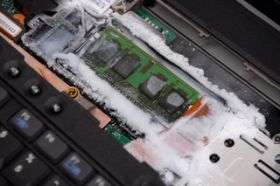
A combination of frost and refrigerant around the computer’s memory chips. At this temperature, memory contents last for several minutes with almost no loss of information.

A team of academic, industry and independent researchers has demonstrated a new class of computer attacks that compromise the contents of “secure” memory systems, particularly in laptops.

The attacks overcome a broad set of security measures called “disk encryption,” which are meant to secure information stored in a computer’s permanent memory. The researchers cracked several widely used technologies, including Microsoft’s BitLocker, Apple’s FileVault and Linux’s dm-crypt, and described the attacks in a paper and video published on the Web Feb. 21. (Video is available here: http://www.youtube.com/watch?v=JDaicPIgn9U)

The team reports that these attacks are likely to be effective at cracking many other disk encryption systems because these technologies have architectural features in common.

“We’ve broken disk encryption products in exactly the case when they seem to be most important these days: laptops that contain sensitive corporate data or personal information about business customers,” said Alex Halderman, a Ph.D. candidate in Princeton’s computer science department. “Unlike many security problems, this isn’t a minor flaw; it is a fundamental limitation in the way these systems were designed.”

The attack is particularly effective against computers that are turned on but are locked, such as laptops that are in a “sleep” or hibernation mode. One effective countermeasure is to turn a computer off entirely, though in some cases even this does not provide protection.

Halderman’s Princeton collaborators included graduate students Nadia Heninger, William Clarkson, Joseph Calandrino, Ariel Feldman and Professor Edward Felten, the director of the Center for Information Technology Policy. The team also included Seth Schoen of the Electronic Frontier Foundation, William Paul of Wind River Systems and independent computer security researcher Jacob Appelbaum.

Felten said the findings demonstrate the risks associated with recent high-profile laptop thefts, including a Veterans Administration computer containing information on 26 million veterans and a University of California, Berkeley laptop that contained information on more than 98,000 graduate students and others. While it is widely believed that disk encryption would protect sensitive information in instances like these, the new research demonstrates that the information could easily be read even when data is encrypted.

“Disk encryption is often recommended as a magic bullet against the loss of private data on laptops,” Felten said. “Our results show that disk encryption provides less protection than previously thought. Even encrypted data can be vulnerable if an intruder gets access to the laptop.”

The new attacks exploit the fact that information stored in a computer’s temporary working memory, or RAM, does not disappear immediately when a computer is shut off or when the memory chip is taken from the machine, as is commonly thought. Under normal circumstances, the data gradually decays over a period of several seconds to a minute. The process can be slowed considerably using simple techniques to cool the chips to low temperatures.

Disk encryption technologies rely on the use of secret keys -- essentially large random numbers -- to encode and protect information. Computers need these keys to access files stored on their own hard disks or other storage systems. Once an authorized user has typed in a password, computers typically store the keys in the temporary RAM so that protected information can be accessed regularly. The keys are meant to disappear as soon as the RAM chips lose power.

The team wrote programs that gained access to essential encryption information automatically after cutting power to machines and rebooting them. The method worked when the attackers had physical access to the computer and when they accessed it remotely over a computer network. The attack even worked when the encryption key had already started to decay, because the researchers were able to reconstruct it from multiple derivative keys that were also stored in memory.

In one extremely powerful version of the attack, they were able to obtain the correct encryption data even when the memory chip was physically removed from one computer and placed in another machine. After obtaining the encryption key, they could then easily access all information on the original machine.

“This method is extremely resistant to countermeasures that defensive programs on the original computer might try to take,” Halderman said.

The attacks demonstrate the vulnerability of machines when they are in an active state, including “sleep mode” or the “screen lock” mode that laptops enter when their covers are shut. Even though the machines require a password to unlock the screen, the encryption keys are already located in the RAM, which provides an opportunity for attackers with malicious intent.

None of the attacks required specialized equipment. “I think we're going to see attackers doing things that people have previously though impractical or impossible,” Appelbaum said.

The researchers were able to extend the life of the information in RAM by cooling it using readily available “canned air” keyboard dusting products. When turned upside down, these canisters spray very cold liquid. Discharging the cold liquid onto a memory chip, the researchers were able to lower the temperature of the memory to -50 degrees Celsius. This slowed the decay rates enough that an attacker who cut power for 10 minutes would still be able to recover 99.9 percent of the information in the RAM correctly.

“Hints of problems associated with computers retaining their temporary memory have appeared in the scientific literature, but this is the first systematic examination of the security implications,” said Schoen.

The researchers posted the paper describing their findings on the website of Princeton’s Center for Information Technology Policy. They submitted the paper for publication and it is currently undergoing review.

In the meantime, the researchers have contacted several manufacturers to make them aware of the vulnerability: Microsoft, which includes BitLocker in some versions of Windows Vista; Apple, which created FileVault; and the makers of dm-crypt and TrueCrypt, which are open-source products for Windows and Linux platforms.

“There’s not much they can do at this point,” Halderman said. “In the short term, they can warn their customers about the vulnerability and tell them to shut their computers down completely when traveling.”

In the longer term, Halderman said new technologies may need to be designed that do not require the storing of encryption keys in the RAM, given its inherent vulnerability. The researchers plan to continue investigating this and other defenses against this new security threat.

More information: http://citp.princeton.edu/memory/

Source: Princeton University


print this article email this article download pdf blog this article bookmark this article     Stumble it Digg this share on Facebook retweet share on Reddit add to delicious
Rate this story - 4.8 /5 (62 votes)

Rank Filter

Move the slider to adjust rank threshold, so that you can hide some of the comments.


Display comments: newest first

  • Nikola - Feb 21, 2008
    • Rank: 3 / 5 (2)
    So after dismounting your encrypted volume, shutting down computer, or going into standy, the encryption software should wipe the key location in RAM. Is this possible?
  • Adriab - Feb 21, 2008
    • Rank: 5 / 5 (1)
    You can, and should, overwrite any sensitive areas of the RAM with zeros after it is done being used.
  • Nikola - Feb 21, 2008
    • Rank: 3 / 5 (2)
    Any good (free) RAM wiping software out there?
  • flyingpig98 - Feb 21, 2008
    • Rank: 2 / 5 (1)
    This was of course under lab conditions.
    It would more than likely result in a dead chip and maybe the mainboard as well, as the chip warms up and gathers moisture.
    Don't try this at home!
  • JohnSawyer - Feb 22, 2008
    • Rank: 5 / 5 (2)
    Nikola:
    Yes, there's no barrier to wiping encryption keys from RAM--those areas of RAM just have to be replaced with zeros, or ones, or whatever--just as easy as writing any other data to those areas. The people who have created existing encryption software, just haven't bothered. Maybe now they will.

    flyingpig98:
    You're right, things like spraying your computer's RAM boards with freeze mist, and then yanking them out and plugging them into another computer to read their contents, shouldn't be tried using your home computer. But from my experience with electronics for the past 30 years, I wouldn't be surprised if doing this, with an extra couple of computers, not under lab conditions, would still work much of the time. Even if any of the lab's conditions were required, I wouldn't be surprised if those conditions could be duplicated without much effort. Using freeze mist to diagnose problems with electronics, while they're running, is a common technique among those trying to track down intermittent heating/cooling-related problems, and one I've done many times, without damaging the live electronics, though when I first started out trying this, I too was worried about shorting out and frying components--but it hasn't happened to me so far. The article's procedures are very duplicatable outside the lab.
  • SDMike - Feb 22, 2008
    • Rank: not rated yet
    Crypto programs should reside on removable memory. Their working values should reside completely on removable memory that is wiped when unplugged. Much more secure. Trust me, you'll notice when someone sprays -50 degree C vapor into your pocket.
  • JerryS - Feb 26, 2008
    • Rank: 5 / 5 (1)
    This attack is about discovering the encryption/decryption key, and not the particular algorithm used. The exploit works because as each sector of data is read from or written to the hard drive, it must be individually encrypted/decrypted, which means the key must, at a minimum, become visible when a sector of data needs to be crypted, and of course it can be "erased" after the sector has been processed. There is still this window where the key is in cleartext in memory during the *crypt operation, and so even erasing memory between sector processing still gives a good chance of getting the key.

    For performance reasons, general disk encryption is done with symetric cyphers (same key to encode and decode), but even for a Public/Private PKI pair, the secret key must be dumped into system memory where the algorithm repeatedly uses the key as one input (the other input being disk data).

    To prevent this type of exploit, it is important to never have the key(s) in cleartext in any register or memory that is user accessible. Granted. Although this memory-decay attack is one way of reading memory, there are forensic tools that can scan physical memory using standard FireWire hardware, which is why the preliminary work on "recognizing keys" was done before this. From the description, it sounds like the current attack has improved upon the earlier work!

    So how can this be avoided? The generally-accepted designs are a black-box, with the encrypting/decrypting key(s) stored within, usually with some mechanisms for erasing them if tampering is detected. For practical use, a computer chip built in layers with the key storage located in the middle layers of silicon is often the BB of choice. Most enterprise-class computers (laptops/desktops) have a TPM (Trusted Program Module) that, among other things, is a secure container for various keys.

    While it is possible to use a TPM chip to encrypt/decrypt blocks of data, the performance is often not very good, and would represent a big bottleneck in disk I/O if all data had to be passed thru the TPM.

    Seagate and a couple of other hard drive manufacturers are bringing FDE (Full disk encryption) products to market where the keys and the encryption/decryption is performed in the computer chips in the drive itself, and thus the key is never visible on any computer data bus. Authentication keys are themselves encrypted such that only the disk chip can decrypt and confirm the authenticity of requests from outside the circuits.

    A TPM can encrypt and pass commands to the hard drive to control the data encryption itself, but it still is necessary to have at least one clear-text key to load up the TPM and/or FDE drive at the factory, and thus there is always this one weak link in the security.

    Bottom line is that practical disk encryption should rely on special hardware designed to encrypt/decrypt data securely. The software-based schemes require the key(s) to be in the clear at least some of the time, and will always present a much easier target for attacks such at the memory-decay exploit described here.

February 21, 2008 all stories

Comments: 7

4.8 /5 (62 votes)
  • Stumble this up

  • Digg this

  • share this

  • hide
  • Related Stories

  • Trust Linux!
    created Nov 20, 2009 | popularity not rated yet | comments 0
  • 'Fingerprinting' RFID Tags: Researchers Develop Anti-Counterfeiting Technology
    created Nov 19, 2009 | popularity not rated yet | comments 0
  • Scientists demonstrate 'universal' programmable quantum processor
    created Nov 15, 2009 | popularity not rated yet | comments 0
  • Cryptographic voting debuts
    created Nov 13, 2009 | popularity not rated yet | comments 0
  • Secure computers aren't so secure
    created Oct 30, 2009 | popularity not rated yet | comments 0


  • hide
  • Relevant PhysicsForums posts

  • Help with a camera choice
    created Nov 18, 2009
  • casio calculator that's similar to TI-89
    created Nov 08, 2009
  • Advice on what cell phone to get
    created Nov 08, 2009
  • Changing the language options on your phone.
    created Nov 03, 2009
  • HP strange RPN operation???
    created Nov 02, 2009
  • Databases in physics
    created Oct 31, 2009
  • More from Physics Forums - Computing & Technology

Other News

Key scientist says politics behind stolen e-mails

Technology / Other

created 14 minutes ago | popularity not rated yet | comments 0

(AP) -- A leading climate change scientist said hackers breaking into a university's computer server and then posting documents online show the nasty politics of global warming.


Intel logo A

Intel wants a chip implant in your brain

Technology / Hi Tech

created 23 hours ago | popularity 4.2 / 5 (17) | comments 28

(PhysOrg.com) -- Computer chip maker Intel wants to implant a brain-sensing chip directly into the brains of its customers to allow them to operate computers and other devices without moving a muscle.


Just in time for Black Friday: students turn iPhone into barcode scanner

Just in time for Black Friday: students turn iPhone into barcode scanner

Technology / Software

created 11 hours ago | popularity 4.7 / 5 (3) | comments 0

(PhysOrg.com) -- Comparing prices over the Internet has become a common practice for consumers. Now, just in time for Black Friday, a group of Missouri University of Science and Technology students is putting ...


IBM Researchers Lower Language Barrier With Text Translator

Technology / Computer Sciences

created 13 hours ago | popularity 4.5 / 5 (4) | comments 0

IBM Researchers are helping to break the language barrier with the advent of technology dubbed "n.Fluent" -- smart software that translates text between English and 11 other languages. IBM employees use it to instantaneously ...


The KLM airplane which runs on biokerosene is seen at Schiphol airport, near Amsterdam

KLM flies world's first 'passenger flight on biofuel'

Technology / Energy

created 12 hours ago | popularity 5 / 5 (1) | comments 0

A Boeing 747, one of four engines powered by a 50-percent biokerosene mix, circled the Netherlands for an hour on Monday for what airline KLM called the world's first passenger flight using biofuel.