Worm defecation holds clues to widespread cell-to-cell communication process
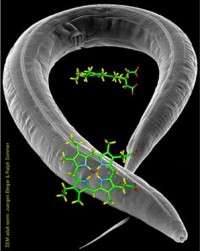
The focus of two recent Nobel prizes, a species of roundworm has made possible another advance in the understanding of how cells talk to one another, according to a study published online Feb. 21 in the journal Current Biology.
In 2002, researchers won the Nobel Prize for Medicine for work in the roundworm Caenorhabditis elegans (C. elegans) on the genetics of how cells “decide” to self-destruct, a topic now central to human cancer research. Another team won in 2006 for the discovery in C. elegans of an ancient defense mechanism against attempts by viruses to disrupt cells’ genetic machinery.
In the latest worm-related news, today’s publication provides evidence of a new mechanism through which cells in the worm’s intestine signal for nearby muscle cells to flex by briefly making the area between them more acidic. Researchers believe that short-lived changes in acidity may have implications for cell signaling throughout the animal kingdom, from the sending of human nerve messages to worm defecation. The worm’s influence proceeds from the fact that its cells resemble human cells in many ways, but are easier to study.
“I worked with mammals during my training, but my research is focused now exclusively in worms,” said Keith Nehrke, Ph.D., assistant professor of Medicine within the Nephrology Division at the University of Rochester Medical Center, and corresponding author of the Current Biology study. “We don’t restrain or anesthetize the worms during our experiments, which allows us to study complex interactions between organs that only occur in eating, moving animals. It remains to be seen whether pH signaling is commonly utilized in man, but the potential impact is fantastic, as almost all biologic processes are regulated by acidity.”
Theory holds that atoms are the building blocks of the universe. Atoms, in turn, are thought to be composed of energy bundles called electrons that orbit around protons and neutrons at the atom’s center. Furthermore, atoms exhibit a property called charge that explains their behavior. Like charges repel each other; opposites attract, and cells have harnessed these forces to drive life processes.
Some cellular machines work by pumping positively charged particles (e.g. calcium, sodium and potassium ions) into or out of cells. In some cases particles of like charge build up outside the cell, and are eager to rush back in if given the chance. That chance comes, under careful regulation, when cells open channel proteins in their outer membranes, enabling say calcium ions to enter. The charge flow is used as an energy source in some instances, and in others, as a biological switch to kick on life processes. Past studies have shown that the rhythmic wave of muscle contractions that push waste along the worm intestine is carefully regulated by signals captured in rising and falling levels of positively charged calcium ions.
What the current study found is that intertwined with calcium signaling may be a second mechanism, where positively charged hydrogen ions, also called protons, are employed to send signals.
A substance that by nature donates protons to a solution or other molecules is called an acid, and pH is a measure of proton concentration in a fluid. Outside a certain pH range, the proteins that make up human cells and tissues break down and the body fails. One reason that the current work is so intriguing is proteins involved in worm muscle signaling are the same ones recognized for many years as those in charge of maintaining pH balance, a basic housekeeping function. The results of the current work suggest that cells may have usurped this housekeeping function to better communicate.
Nehrke’s Current Biology publication dovetails on an article (Cell 2008, 132, 149) published in January by Eric Jorgensen, Ph.D., professor of Biology at the University of Utah. Jorgensen used a genetic approach to define a signaling link between two specific proteins, a sodium-proton exchanger that pushes protons out of the worm intestine and a proton receptor on adjacent muscle cells that responds to protons by causing muscular contractions that make possible defecation.
The current study validated these conclusions, and demonstrated that protons move from the lumen of the intestine and across the cell prior to signaling adjacent muscles, resulting in pH oscillations inside as well as outside the cells. Sodium/proton exchangers enable the flow of protons across cell membranes while maintaining charge balance. Although this class of proteins has been recognized for many years as capable of helping cells regulate pH and fluid levels, this is the first example of sodium/proton exchangers being involved in communication.
The team used molecular biology techniques to genetically express in the nematode intestinal cells a fluorescent molecule whose brightness is sensitive to pH. Fluorescent imaging then showed proton levels to be carefully controlled during defecation, oscillating in tandem with calcium levels in the intestine. Many calcium regulatory processes are sensitive to pH, and the study suggests that crosstalk occurs between these two signaling mechanisms to regulate the frequency as well as the execution of the defecation muscle contractions.
If this is confirmed in humans, proton signaling could conceivably represent a new target for regulating cell communication, perhaps with therapeutic implications. Many regions in the human body are subject to an acidic environment, and in some cases, are already known to recognize pH changes in their surroundings. In addition, several of proteins that contribute to synaptic transmission, signaling between nerve cells, can be regulated by pH. Are there cellular proton depots near synaptic junctions, with proteins in place to export them as part of signaling mechanisms, and nearby proton receptors awaiting their call? Does abnormal proton signaling contribute to Parkinson’s, Alzheimer’s or other neurodegenerative diseases? Future studies will tell.
Source: University of Rochester


