Powerful explosions suggest neutron star missing link
February 21, 2008
Magnetar

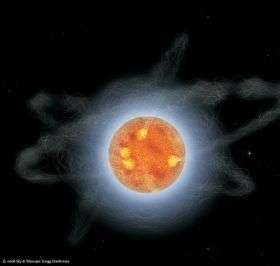
This artist rendering depicts how a magnetar might appear if we could travel to one and view it up close, something that would not be advisable. Credit: Sky & Telescope, Gregg Dinderman

Observations from NASA's Rossi X-ray Timing Explorer (RXTE) have revealed that the youngest known pulsing neutron star has thrown a temper tantrum. The collapsed star occasionally unleashes powerful bursts of X-rays, which are forcing astronomers to rethink the life cycle of neutron stars.

"We are watching one type of neutron star literally change into another right before our very eyes. This is a long-sought missing link between different types of pulsars," says Fotis Gavriil of NASA's Goddard Space Flight Center in Greenbelt, Md., and the University of Maryland, Baltimore. Gavriil is lead author of a paper in the February 21 issue of Science Express.

A neutron star forms when a massive star explodes as a supernova, leaving behind an ultradense core. Most known neutron stars emit regular pulsations that are powered by rapid spins. Astronomers have found nearly 1,800 of these so-called pulsars in our galaxy. Pulsars have incredibly strong magnetic fields by Earthly standards, but a dozen of them - slow rotators known as magnetars - actually derive their energy from incredibly powerful magnetic fields, the strongest known in the universe. These fields can stress the neutron star's solid crust past the breaking point, triggering starquakes that snap magnetic-field lines, producing violent and sporadic X-ray bursts.

But what is the evolutionary relationship between pulsars and magnetars" Astronomers would like to know if magnetars represent a rare class of pulsars, or if some or all pulsars go through a magnetar phase during their life cycles.

Gavriil and his colleagues have found an important clue by examining archival RXTE data of a young neutron star, known as PSR J1846-0258 for its sky coordinates in the constellation Aquila. Previously, astronomers had classified PSR J1846 as a normal pulsar because of its fast spin (3.1 times per second) and pulsar-like spectrum. But RXTE caught four magnetar-like X-ray bursts on May 31, 2006, and another on July 27, 2006. Although none of these events lasted longer than 0.14 second, they all packed the wallop of at least 75,000 Suns.

"Never before has a regular pulsar been observed to produce magnetar bursts," says Gavriil.

"Young, fast-spinning pulsars were not thought to have enough magnetic energy to generate such powerful bursts," says coauthor Marjorie Gonzalez, who worked on this paper at McGill University in Montreal, Canada, but who is now based at the University of British Columbia in Vancouver. "Here's a normal pulsar that's acting like a magnetar."

Observations from NASA's Chandra X-ray Observatory also provided key information. Chandra observed the neutron star in October 2000 and again in June 2006, around the time of the bursts. Chandra showed the object had brightened in X-rays, confirming that the bursts were from the pulsar, and that its spectrum had changed to become more magnetar- like.

Astronomers know that PSR J1846 is very young for several reasons. First, it resides inside a supernova remnant known as Kes 75, an indicator that it hasn't had time to wander from its birthplace. Second, based on the rapidity that its spin rate is slowing down, astronomers calculate that it can be no older than 884 years - an infant on the cosmic timescale. Magnetars are thought to be about 10,000 years old, whereas most pulsars are thought to be considerably older.

The fact that PSR J1846's spin rate is slowing down relatively fast also means that it has a strong magnetic field that is braking the rotation. The implied magnetic field is trillions of times stronger than Earth's field, but it's 10 to 100 times weaker than typical magnetar field strengths. Coauthor Victoria Kaspi of McGill University notes, "PSR J1846's actual magnetic field could be much stronger than the measured amount, suggesting that many young neutron stars classified as pulsars might actually be magnetars in disguise, and that the true strength of their magnetic field only reveals itself over thousands of years as they ramp up in activity."

Source: NASA's Goddard Space Flight Center

4.4 /5 (21 votes)  

Filter


Move the slider to adjust rank threshold, so that you can hide some of the comments.


Display comments: newest first

earls
Feb 21, 2008

Rank: 2 / 5 (2)
Wait, so this star went supernova (died) in 884 years? Or it's been 884 years since it went nova?

This article seems to completely contradict star evolution.

And how does the magnetic field brake the rotation? Against what? Space? It is a neutron star after all. How is an ultra dense ball of neutral particles producing a magnetic field in the first place?
gopher65
Feb 21, 2008

Rank: not rated yet
http://en.wikiped...tion.jpg

There is a decent image of a neutron star from Wikipedia. As you can see, they aren't believed to be homogeneous. They have a "solid" crust and a "liquid" interior (though those terms aren't exactly correct). Also, a neutron star isn't made up entirely of neutrons.

From Wiki:

"The neutron star's density varies from below 1×10⁹ kg/m³ in the crust increasing with depth to above 6 or 8×10¹⁷ kg/m³ deeper inside."
brant
Feb 21, 2008

Rank: 2.3 / 5 (3)
A neutron star is made up of imaginons.....
saucerfreak2012
Feb 28, 2008

Rank: 1 / 5 (1)
Such an exotic body to account for a "simple" (yet enormous) electrical discharge.

Isn't electric current required for magnetic field and X-ray production in the first place?
Graeme
Apr 21, 2008

Rank: not rated yet
In response to Earls

There will be a large electric current in the pulsar generating the magnetic field.

A spinning magnet radiates electromagnetic radiation, and it will interact with plasma in the neighbourhood. When the electric field is strong enough, vacuum will break down into electrons and positrons, creating a plasma from a vacuum.
Rank 4.4 /5 (21 votes)
Tags

Relevant PhysicsForums posts
  • Never ending outer space.....
    createdFeb 11, 2012
  • Neutron Star fragments?
    createdFeb 11, 2012
  • stationary or not?
    createdFeb 11, 2012
  • Scale of the Universe
    createdFeb 10, 2012
  • Titan's lack of impact craters
    createdFeb 09, 2012
  • Real pictures of black hole eating a star?
    createdFeb 08, 2012
  • More from Physics Forums - General Astronomy

More news stories

Latin America mining boom clashes with conservation

Latin America is experiencing a mining boom as prices rise fuelled by a hike in global demand, but the region is also being hit by a wave of violent protests, strikes and rallies by environmentalists.

Space & Earth / Environment

created 19 hours ago | popularity 5 / 5 (1) | comments 1

Salvage workers begin pumping fuel from Italian shipwreck

Salvage workers Sunday began pumping fuel from the shipwrecked Italian cruise liner Costa Concordia, a day ahead of schedule, officials said.

Space & Earth / Environment

created 11 hours ago | popularity 5 / 5 (2) | comments 0

Political leaders play key role in how worried Americans are by climate change: study

More than extreme weather events and the work of scientists, it is national political leaders who influence how much Americans worry about the threat of climate change, new research finds.

Space & Earth / Environment

created Feb 06, 2012 | popularity 5 / 5 (8) | comments 75

NASA budget will axe Mars deal with Europe: scientists

US President Barack Obama's budget proposal to be submitted next week for 2013 will cut NASA's budget by 20 percent and eliminate a major partnership with Europe on Mars exploration, scientists said Thursday.

Space & Earth / Space Exploration

created Feb 10, 2012 | popularity 5 / 5 (4) | comments 58

Humans may have helped the decline of African rainforests 3000 years ago

(PhysOrg.com) -- Large areas of rainforests in Central Africa mysteriously disappeared over three thousand years ago, to be replaced by savannas. The prevailing theory has been that the cause was a change ...

Space & Earth / Environment

created Feb 10, 2012 | popularity 4.1 / 5 (14) | comments 21 | with audio podcast report


Scientists discover molecular secrets of 2,000-year-old Chinese herbal remedy

For roughly two thousand years, Chinese herbalists have treated Malaria using a root extract, commonly known as Chang Shan, from a type of hydrangea that grows in Tibet and Nepal. More recent studies suggest that halofuginone, ...

New method to examine batteries -- MRI from the inside

There is an ever-increasing need for advanced batteries for portable electronics, such as phones, cameras, and music players, but also to power electric vehicles and to facilitate the distribution and storage of energy derived ...

A mitosis mystery solved: How chromosomes align perfectly in a dividing cell

Although the process of mitotic cell division has been studied intensely for more than 50 years, Whitehead Institute researchers have only now solved the mystery of how cells correctly align their chromosomes during symmetric ...

Google might launch Drive for cloud storage soon

(PhysOrg.com) -- Google's next big move, according to the Wall Street Journal, is a cloud storage service called Drive. Hardly first to the plate, Google is simply catching up to introducing its cloud reposi ...

Lab study raises questions over nano-particle impact

Tests involving chickens have raised questions about the impact on health from engineered nano-particles, the ultra-fine grains commonly used in drugs and processed foods, scientists said on Sunday.

Starve a virus, feed a cure? Findings show how some cells protect themselves against HIV

A protein that protects some of our immune cells from the most common and virulent form of HIV works by starving the virus of the molecular building blocks that it needs to replicate, according to research published online ...