Off the hook: Stronger soft-plastic fishing lure reels in raves
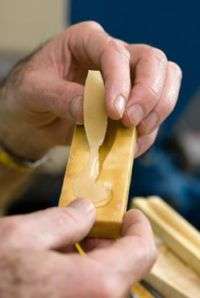
Working with University of Wisconsin-Madison engineering and business school faculty and students, a Wisconsin entrepreneur has perfected a fiber-reinforced fishing lure that may prevent millions of pounds of toxic plastics from polluting waters nationwide.
Earning raves in the sport-fishing world, entrepreneur Ben Hobbins plans to launch his strong, sustainable soft lure in sporting goods stores in late February.
Each year, more than 12,000 tons of rubbery "soft baits" land at the bottom of lakes, streams and rivers, says Hobbins, who is president and CEO of Waunakee-based Lake Resources Group.
The lures are so pliable that a run through thick weeds or a fish's misdirected attempt to gobble the bait can rip the lure or pull it off the hook entirely. "If you go into a sporting-goods store, every soft-plastic fishing lure on the wall is lost in the environment," he says. "And that's a staggering thought."
Most sporting goods stores house a veritable rainbow of these soft-plastic lures, which come in every shape and size imaginable. For years, anglers have used the brightly colored, realistic swimmers to successfully attract and land fish ranging from tiny bluegill and crappie to bass, walleye and the mighty muskie.
But the highly plasticized PVC material that makes these soft, flexible lures an asset to fishermen also makes them a detriment to the environment. "Half the weight of these lures is plasticizer, or very-low molecular-weight materials that are called phthalates," says Tim Osswald, a UW-Madison professor of mechanical engineering.
Manufacturers add phthalates to polyvinyl chloride, or PVC, products to make them flexible. Several studies have linked the chemical compounds with a variety of adverse health effects; California recently passed a law banning phthalates in children's toys, beginning in 2009.
An environmentalist and ice fisherman who dreaded constant fumbling with cold hands to replace torn soft-bait lures, Hobbins devised his soft-bait alternative one chilly November morning back in 2006.
Key to the technology is tiny microfibers embedded in the soft-plastic material, says Osswald, who co-directs the UW-Madison Polymer Engineering Center. "They're placed in such a way that you still have the flexible lure, but you can't rip it," he says. "Now, they're stiffer to the pull, if you stretch them - but they're still flexible and deliver the desired performance."
Armed with his idea, Hobbins immediately began working on a patent, becoming somewhat of a regular in the patent section of the UW-Madison Kurt F. Wendt Engineering Library. He drew on product assessment resources at UW-Whitewater's Wisconsin Innovation Service Center, and on product-development and prototyping resources at the UW-Extension Wisconsin Entrepreneurs' Network. He developed and entered a business plan in the Wisconsin Governor's Business Plan Contest, where he finished in the advanced manufacturing category top 10. And he contacted Wisconsin School of Business Assistant Professor Phil Kim, who teaches a senior-level introductory course in entrepreneurship, to propose his invention as a class project.
In that course, the major assignment is for students to write a business plan for a local business owner. "By putting students into situations where they have to meet and interact with business owners, we're giving them a wealth of new insight and a greater appreciation for what they're studying," says Kim. "It puts the classroom learning into a bigger context. And also in the end, in many cases, they have an opportunity to influence the way the business owner is running their business."
Undergraduates Alex Wysocki, Matt Karcher and James Woods signed on to Hobbins' project. Throughout the semester, they analyzed the soft-plastic lure market and the industry. They put together a good analysis for Hobbins and Lake Resources Group, says Kim.
In particular, the trio applied known information about the size of the soft-plastic lure market to their calculations of the amount, in weight, of the lures sold annually. It's data, says Hobbins, that previously was unknown. "They came up with some hard numbers that now are applied in market research as viable for the industry," he says. "That's an important contribution."
Through their research of existing polymer manufacturing technologies, the students interviewed Osswald, who is interested in sustainability issues in polymers and plastics. The idea of a more durable fiber-reinforced fishing lure intrigued him, and soon he and Hobbins established a research partnership through the Polymer Engineering Center.
Initially, Osswald and graduate students Nick Newmann and Eric Folz helped Hobbins address materials and manufacturing questions. Hobbins was preparing to debut his idea in July 2007 at the International Convention of Allied Sportfishing Trades, or ICAST, the world's largest sport-fishing trade show - but he needed new-product prototypes to show off.
With very little time to spare, Newmann and Folz drew on their recent experiments in rapid prototyping to develop several working models. The ICAST new-product showcase competition drew nearly 180 companies with 600 new products in 17 categories. In the "soft lure" category, Hobbins' lures - called "IronClads" - finished runner-up to an entry from international sport-fishing giant Pure Fishing. "We made a very good impact and the buzz has continued since then," says Hobbins.
Since then, he has received accolades for the IronClads in outdoors publications and shows nationwide. Most recently, he earned the Best in Show Award at the 2008 Chicagoland Outdoors Show.
Meanwhile, Polymer Engineering Center researchers have continued to study the IronClad technology. They have conducted measurements to learn what stresses the fibers can endure before they break. The overall outlook for IronClad lures, says Osswald, is positive. "You could continue using and reusing them," he says. "In fact, even if you still use PVCs with phthalates, they no longer end up on the bottoms of lakes and rivers."
True to their commitment to sustainability, however, the researchers also are investigating environmentally benign materials for the lures. In addition, they are studying alternate applications - everything from golf-club grips and ladder hand-holds to the hand-contact points on a military weapon - for the IronClad technology.
In late February, Hobbins plans to offer the IronClad lures for sale in such national sporting goods chains as Gander Mountain. Initially, he will subcontract the injection molding and simply package the lures in house - though he hopes Lake Resources Group will begin its own full-scale manufacturing at its Waunakee facility within the year.
The IronClad lures will sell in two-packs for about $6 - a price comparable, Hobbins says, to the "use-and-lose" soft-plastic lures currently on the market. The difference, he says, is that the IronClad lures lock onto hooks and stay put. "It adds a lot of pleasure to the fishing experience and allows anglers to catch many more fish," he says. "It also stops soft-plastic waste in the environment. And that is substantial in itself. Anglers never wanted to drop the plastic - that's all there was."
Hobbins, who is aiming for $3 million in gross sales in 2008, credits Osswald, Kim and their students for his products' success to date. "Our rapid ramp-up is due in large part to the efforts of the engineering and business school team," he says.
Source: University of Wisconsin-Madison


