Ulysses mission coming to a natural end
February 22, 2008 Ulysses mission coming to a natural end

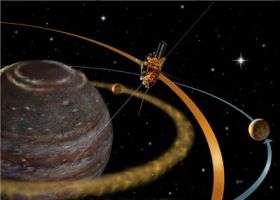
A joint ESA and NASA mission, Ulysses (named after the hero of Greek legend) is charting the unknown reaches of space above and below the poles of the sun. Exploring our star's environment is vital if scientists are to build a complete picture of the sun, how it works and its effect on the solar system. In particular, the satellite is studying the solar wind that blows non-stop from the sun and carves a huge bubble in space called the heliosphere. Ulysses is providing the first-ever map of the heliosphere from the equator to the poles. Ulysses is equipped with a comprehensive range of scientific instruments. These are able to detect and measure solar wind ions and electrons, magnetic fields, energetic particles, cosmic rays, natural radio and plasma waves, cosmic dust, interstellar neutral gas, solar X-rays and cosmic gamma-ray bursts. This combination of experiments will help scientists understand the sun and its heliosphere, and perhaps the sun's influence on Earth's climate. Ulysses was launched by the Space Shuttle Discovery in October 1990. It headed out to Jupiter, arriving in February 1992 for the gravity-assisted manoeuvre that swung the craft into its unique solar orbit. It passed over the sun's south pole in 1994, and the north pole in 1995. Credits: ESA

Ulysses, the mission to study the Sun’s poles and the influence of our star on surrounding space is coming to an end. After more than 17 years in space – almost four times its expected lifetime – the mission is finally succumbing to its harsh environment and is likely to finish sometime in the next month or two.

Ulysses is a joint mission between ESA and NASA. It was launched in 1990 from a space shuttle and was the first mission to study the environment of space above and below the poles of the Sun. The reams of data Ulysses has returned have forever changed the way scientists view the Sun and its effect on the space surrounding it.

Ulysses is in a six-year orbit around the Sun. Its long path through space carries it out to Jupiter’s orbit and back again. The further it ventures from the Sun, the colder the spacecraft becomes. If it drops to 2ºC, the spacecraft’s hydrazine fuel will freeze.

This has not been a problem in the past because Ulysses carries heaters to maintain a workable on-board temperature. The spacecraft is powered by the decay of a radioactive isotope and over the 17-plus years, the power it has been supplying has been steadily dropping. Now, the spacecraft no longer has enough power to run all of its communications, heating and scientific equipment simultaneously.

‘We expect certain parts of the spacecraft to reach 2ºC pretty soon,” says Richard Marsden, ESA’s Ulysses Project Scientist and Mission Manager. This will block the fuel pipes, making the spacecraft impossible to manoeuvre.

In an attempt to solve this problem, the ESA-NASA project team approved a plan to temporarily shut off the main spacecraft transmitter. This would release 60 watts of power that could be channelled to the science instruments and the heater. When data was to be transmitted back to Earth, the team planned to turn the transmitter back on. Unfortunately, during the first test of this method in January, the power supply to the radio transmitter failed to turn back on.

“The decision to switch the transmitter off was not taken lightly. It was the only way to continue the science mission,” says Marsden, who is a 30-year veteran of the project, having worked on it for 12 years before the spacecraft was launched.

After many attempts, the Ulysses project team now consider it highly unlikely that the X-band transmitter will be recovered. They believe the fault can be traced to the power supply, meaning that the extra energy they hoped to gain cannot be routed to the heater and science instruments after all.

So, the spacecraft has lost its ability to send large quantities of scientific data back to Earth and is facing the gradual freezing of its fuel lines. This spells the end of this highly successful mission. “Ulysses is a terrific old workhorse. It has produced great science and lasted much longer than we ever thought it would,” says Marsden. “This was going to happen in the next year or two, it has just taken place a little sooner than we hoped.”

The team plan to continue operating the spacecraft in its reduced capacity for as long as they can over the next few weeks. “We will squeeze the very last drops of science out of it,” says Marsden.

Source: European Space Agency


print this article email this article download pdf blog this article bookmark this article     Stumble it Digg this share on Facebook retweet share on Reddit add to delicious
Rate this story - 4.4 /5 (9 votes)


February 22, 2008 all stories

Comments: 0

4.4 /5 (9 votes)
  • Stumble this up

  • Digg this

  • share this

  • hide
  • Related Stories

  • Space shuttle Atlantis, 7 astronauts back on Earth
    created 5 hours ago | popularity not rated yet | comments 0
  • Kepler Mission Manager Update
    created Nov 24, 2009 | popularity not rated yet | comments 0
  • Astronauts await word of baby girl on Earth
    created Nov 20, 2009 | popularity not rated yet | comments 0
  • Hunting for Planets in the Dark
    created Nov 19, 2009 | popularity not rated yet | comments 0
  • NASA's Wise Gets Ready to Survey the Whole Sky (w/ Video)
    created Nov 17, 2009 | popularity not rated yet | comments 0


  • hide
  • Relevant PhysicsForums posts

  • Some help with a X-Ray astronomy question please!
    created 10 hours ago
  • Help with Images and Optical Instrument Question..
    created 21 hours ago
  • Redshift as a distance indicator
    created Nov 26, 2009
  • Question about 2-body gravity
    created Nov 24, 2009
  • More from Physics Forums - General Astronomy

Other News

The Energy Sources of Ultraluminous Galaxies

The Energy Sources of Ultraluminous Galaxies

Space & Earth / Astronomy

created 4 hours ago | popularity 4 / 5 (5) | comments 0

(PhysOrg.com) -- Ultraluminous infrared galaxies ((ULIRGs) are galaxies whose luminosity exceeds that of a trillion suns; for comparison, the Milky Way galaxy has a typical (and much more modest) luminosity ...


Space shuttle Atlantis, 7 astronauts back on Earth (AP)

Space shuttle Atlantis, 7 astronauts back on Earth

Space & Earth / Space Exploration

created 5 hours ago | popularity not rated yet | comments 0

(AP) -- Space shuttle Atlantis and its seven astronauts returned to Earth with a smooth touchdown Friday to end an 11-day flight that resupplied the International Space Station.


Fermi Telescope Peers Deep into Microquasar

Fermi Telescope Peers Deep into Microquasar (w/ Video)

Space & Earth / Astronomy

created 3 hours ago | popularity 4.5 / 5 (2) | comments 0

(PhysOrg.com) -- NASA's Fermi Gamma-ray Space Telescope has made the first unambiguous detection of high-energy gamma-rays from an enigmatic binary system known as Cygnus X-3. The system pairs a hot, massive ...


China is set to launch its second moon orbiter next October, state media have reported

China to launch second lunar probe: state media

Space & Earth / Space Exploration

created 9 hours ago | popularity 5 / 5 (3) | comments 0

China will launch its second moon orbiter next October, state media reported Friday, as it powers ahead with a space programme that has sparked concerns abroad.


Herschel takes a peek at the ingredients of the galaxies

Herschel takes a peek at the ingredients of the galaxies

Space & Earth / Astronomy

created 2 hours ago | popularity not rated yet | comments 0

(PhysOrg.com) -- The European Space Agency has today released spectacular new observations from the Herschel Space Observatory, including the UK-led SPIRE instrument. Spectrometers on board all three Hershel ...