Scientists explain intriguing phenomenon on Saturn's moon
February 22nd, 2008 Scientists explain intriguing phenomenon on Saturn's moon

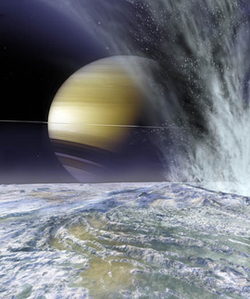
Geyser on Enceladus. Credit: Michael Carroll, www.stock-space-images.com

An enormous plume of dust and water spurts violently into space from the south pole of Enceladus, Saturn's sixth-largest moon. This raging eruption has intrigued scientists ever since the Cassini spacecraft provided dramatic images of the phenomenon.

Now, physicist Nikolai Brilliantov, at the University of Leicester, and colleagues in Germany, have revealed why the dust particles in the plume emerge more slowly than the water vapour escaping from the moon's icy crust.

Enceladus orbits in Saturn's outermost "E" ring. It is one of only three outer solar system bodies that produce active eruptions of dust and water vapour. Moreover, aside from the Earth, Mars, and Jupiter's moon Europa, it is one of the only places in the solar system for which astronomers have direct evidence of the presence of water.

The erupting plume on Enceladus is ejected by geyser-like volcanic eruptions from deep, "tiger-stripe" cracks within the moon's south pole. Some astronomers have suggested that the myriad tiny grains of dust from these eruptions could be the actual source of Saturn's E-ring. However, the dynamics and the origin of the plume itself have remained a mystery.

Now, Brilliantov, who is also on the faculty at the University of Potsdam, Germany and Moscow State University, working with Juergen Schmidt and Frank Spahn of Potsdam and Sascha Kempf of the Max Planck Institute for Nuclear Physics in Heidelberg, and the Technical University of Braunschweig, Germany have developed a new theory to explain the formation of these dust particles and to explain why they are ejected into space.

The researchers point out that once ejected the dust particles, which are in fact icy grains, and water vapour are too dilute to interact with each other and so the water vapour cannot be the cause of the dusty slowdown. Instead, the team suggests that the shift in speed must occur below the moon's surface before ejection.

The numerous cracks through which the plume material escapes from the moon's icy surface, and which can be hundreds of metres deep, are narrower at some points along their length. At these points temperature and pressure of vapour drop drastically down, causing condensation of vapour into icy grains and hence to formation of the dust-vapour mixture. The required vapour density to accelerate the grains to the observed speeds implies temperatures where liquid water can exist in equilibrium with solid ice and water vapour within the moon's frozen crust.

These peculiar conditions allow the water vapour to erupt rapidly carrying with it the dust particles. However, these particles undergo countless frequent collisions with the inside of the channel walls which causes friction that slows them down before final ejection. The larger the particle the slower the ejection speed. This effect, quantified by the new theory, explains the structure of the plume and eventually the particle size distribution of the E-ring of Saturn.

The existence of liquid water is a prerequisite for life and, while not suggesting there is life on Enceladus, offers another extraterrestrial place that might be searched.

The scientists published details of their findings in the journal Nature.

Source: University of Leicester


print this article email this article download pdf blog this article bookmark this article     Digg this Stumble it share on Facebook share on Reddit add to delicious save to Yahoo! bookmarks
4.4/5 after 36 votes

Rank Filter

Move the slider to adjust rank threshold, so that you can hide some of the comments.


Display comments: newest first

  • Zen - Feb 22, 2008
    • Rank: not rated yet
    "Brilliantov"

    Ya, I bet.
  • saucerfreak2012 - Feb 22, 2008
    • Rank: 5 / 5 (1)
    "The numerous cracks through which the plume material escapes from the moon's icy surface, and which can be hundreds of metres deep, are narrower at some points along their length".

    Based on what data??? The Cassini orbiter has no subsurface imaging instruments onboard. All we can do (relative to structure) is map the surface with the RADAR and ISS subsystems. We have no data on the subsurface STRUCTURE of Enceladus yet. Considering the tidal forces exerted by Saturn and Dione, I'd be surprised if these "hundred meter deep cracks" exist at all.

    Interesting theory, even if based on speculation and not aquired data.
  • ronplk84 - Feb 25, 2009
    • Rank: not rated yet
    Good article. Interesting synopsis.
    rdplka@bellsouth.net

February 22nd, 2008 all stories
Space & Earth / Astronomy

Comments: 3
Rank: 4.4/5 after 36 votes

  • Stumble this up

  • Digg this

  • Share it:
  • share on Facebook
  • share on MySpace
  • share on Slashdot
  • rss-newsfeed
  • share on Google
  • share on Reddit
  • add to delicious
  • save to Yahoo! bookmarks
  • share on Windows Live
  • Add to Mixx!
Rating: 4.4/5 after 36 votes

  • Related Stories

  • Most distant detection of water in the Universe
    created Apr 22, 2009 | popularity not rated yet | comments 0
  • Largest virtual telescope for short wavelengths opened
    created Nov 25, 2008 | popularity not rated yet | comments 0
  • Hubble directly observes planet orbiting Fomalhaut
    created Nov 13, 2008 | popularity not rated yet | comments 0
  • Birth of a new ocean
    created Oct 31, 2008 | popularity not rated yet | comments 0
  • Discovery of a type of aerosols from Sahara which will be useful to study climate change
    created Oct 03, 2008 | popularity not rated yet | comments 0

Tags


  • Physicists Demonstrate Quantum Memory with Matter Qubits
    Physicists Demonstrate Quantum Memory with Matter Qubits
    Physics / General Physics
    created Jul 03, 2009 | popularity 4.4 / 5 (16) | comments 1
  • 'Holey' Nanosheets for Wastewater Dye Removal
    Nanotechnology / Nanomaterials
    created Jul 01, 2009 | popularity 5 / 5 (5) | comments 1
  • Jellyfish Robot Swims Like its Biological Counterpart
    Jellyfish Robot Swims Like its Biological Counterpart
    Electronics / Robotics
    created Jun 26, 2009 | popularity 4.4 / 5 (8) | comments 1
  • Could Maxwell's Demon Exist in Nanoscale Systems?
    Could Maxwell's Demon Exist in Nanoscale Systems?
    Physics / General Physics
    created Jun 24, 2009 | popularity 4.4 / 5 (18) | comments 29
  • Living Safely with Robots, Beyond Asimov's Laws
    Living Safely with Robots, Beyond Asimov's Laws
    Electronics / Robotics
    created Jun 22, 2009 | popularity 4.6 / 5 (52) | comments 40
  • Other News

    Forty years ago man first walked on the moon

    Space & Earth / Space Exploration

    created 5 hours ago | popularity 5 / 5 (2) | comments 0

    Forty years ago on July 20, 1969, American astronaut Neil Armstrong realized the oldest dream of human civilizations when he became the first man to walk on the moon.


    The least sea ice in 800 years

    The least sea ice in 800 years

    Space & Earth / Earth Sciences

    created Jul 01, 2009 | popularity 4.3 / 5 (59) | comments 52

    New research, which reconstructs the extent of ice in the sea between Greenland and Svalbard from the 13th century to the present indicates that there has never been so little sea ice as there is now. The ...


    Gas around young galaxy

    Intense heat killed the Universe's would-be galaxies, researchers say

    Space & Earth / Astronomy

    created Jul 01, 2009 | popularity 3.2 / 5 (19) | comments 25

    (PhysOrg.com) -- Our Milky Way galaxy only survived because it was already immersed in a large clump of dark matter which trapped gases inside it, scientists led by Durham University's Institute for Computational ...


    Scientists' Drill Hits Magma: Only Third Time on Record

    Scientists' Drill Hits Magma: Only Third Time on Record

    Space & Earth / Earth Sciences

    created Jun 29, 2009 | popularity 4.7 / 5 (20) | comments 19

    (PhysOrg.com) -- Scientists drilling a borehole deep into Iceland’s rocky crust to explore new methods of using geothermal energy hit a major roadblock on Thursday: Their drill ran into molten rock at a depth ...


    NASA manager pitches a cheaper return-to-moon plan

    Space & Earth / Space Exploration

    created Jun 30, 2009 | popularity 4 / 5 (7) | comments 18

    (AP) -- Like a car salesman pushing a luxury vehicle that the customer no longer can afford, NASA has pulled out of its back pocket a deal for a cheaper ride to the moon.