Dust in West up 500 percent in past two centuries
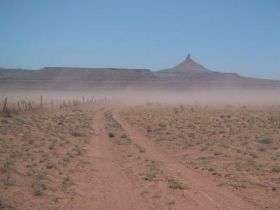
The West has become 500 percent dustier in the past two centuries due to westward U.S. expansion and accompanying human activity beginning in the 1800s, according to a new study led by the University of Colorado at Boulder.
Sediment records from dust blown into alpine lakes in southwest Colorado's San Juan Mountains over millennia indicates the sharp rise in dust deposits coincided with railroad, ranching and livestock activity in the middle of the last century, said geological sciences Assistant Professor Jason Neff, lead author on the study. The results have implications ranging from ecosystem alteration to human health, he said.
"From about 1860 to 1900, the dust deposition rates shot up so high that we initially thought there was a mistake in our data," said Neff. "But the evidence clearly shows the western U.S. had it's own Dust Bowl beginning in the 1800s when the railroads went in and cattle and sheep were introduced into the rangelands."
A paper on the research funded by the Andrew W. Mellon Foundation was published in the Feb. 24 issue of Nature Geoscience. Co-authors included CU-Boulder's Ashley Ballantyne, Lang Farmer and Corey Lawrence, Cornell University's Natalie Mahowald, the University of Arizona's Jessica Conroy and Jonathan Overpeck, Christopher Landry of the Center of Snow and Avalanche Studies in Silverton, Colo., the University of Utah's Tom Painter and the U.S. Geological Survey's Richard Reynolds.
The study indicates "dust fall" in the West over the past century was five to seven times heavier than at any time in the previous 5,000 years, said Neff, who is also a faculty member in CU-Boulder's Environmental Studies Program. While some fine-grained dust from Asia periodically falls on Colorado's San Juans, the abundance of larger-sized dust particles in the lake sediments there indicates most of the dust originated regionally in the Southwest, said the authors.
While droughts can trigger erosion and increased dust deposition, western U.S. droughts during the past two centuries have been relatively mild compared to droughts over the past 2,000 years, Neff said. Instead, the increased dustiness in the West coincides with intensive land use, primarily grazing, according to radiocarbon dating and lead isotope analysis of soil cores retrieved from lakebeds, he said.
"There were an estimated 40 million head of livestock on the western rangeland during the turn of the century, causing a massive and systematic degradation of the ecosystems," said Neff. The 1934 Taylor Grazing Act that imposed restrictions on western grazing lands coincided with a decrease in accumulation rates of the San Juan lake sediments in the study -- a decrease that continues to today, he said.
The study also shows more than a five-fold increase in nutrients and minerals in the lakebed sediments during the last 150 years, said Neff. Increases in nitrogen, phosphorus, potassium, calcium and magnesium -- byproducts of ranching, mining and agricultural activity - have been shown to change water alkalinity, aquatic productivity and nutrient cycling.
In the Niwot Ridge alpine region west of Boulder, for example, CU-Boulder researchers have observed increased algal growth in streams and lakes as a result of rising nitrogen deposition, as well as changes in the composition and diversity of wildflowers on the tundra. "Because these types of inputs have the potential to increase plant growth, the ultimate outcome of such depositions could change the fabric of our ecosystems," said Neff.
Excessive dust also can cause significant human health problems, including lung tissue damage, allergic reactions and respiratory problems, Neff said.
The San Juan lakes are located in an area dominated by rocky talus slopes with little soil and vegetation at about 13,000 feet in elevation and are located downwind of several major U.S. deserts like the Colorado Plateau and the Mojave. The site was chosen in part because the San Juans experience frequent wintertime dust deposition events -- usually between four to seven episodes annually, Neff said.
A study published in Geophysical Research Letters in 2007 involving co-authors of the Nature Geoscience paper, including Neff, showed wind-blown dust from disturbed lands in the Southwest shortened the duration of San Juan mountain snow cover by roughly a month. "The dust we see in these lakes is the same dust that causes earlier spring snowmelt here, so we can now definitively say that humans are in large part responsible for this melt," said Neff.
"There seems to be a perception that dusty conditions in the West are just the nature of the region," said Neff. "We have shown here that the increase in dust since the 1800s is a direct result of human activity and not part of the natural system."
Source: University of Colorado at Boulder


