Researchers demonstrate a new type of optical tweezer
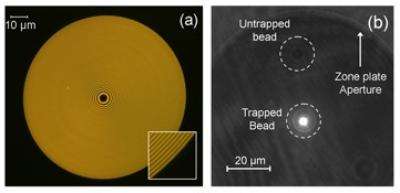
February 25, 2008 Microfabricated Fresnel Zone Plate Optical Tweezer

(a). Photograph of microfabricated Fresnel Zone Plate optical tweezer, consisting of concentric gold rings (50 nm thick) on a microscope slide. The Zone Plate outer diameter is 100¼m, and the focal length is 8¼m. (b). CCD camera image of fluorescent bead (2¼m diameter) trapped in Zone Plate focus. Credit: Ken Crozier, Harvard School of Engineering and Applied Sciences

Researchers at the Harvard School of Engineering and Applied Sciences (SEAS) demonstrated a new type of optical tweezer with the potential to make biological and microfluidic force measurements in integrated systems such as microfluidic chips. The tweezer, consisting of a Fresnel Zone Plate microfabricated on a glass slide, has the ability to trap particles without the need for high performance objective lenses.

The device was designed, fabricated, and tested by postdoctoral fellow Ethan Schonbrun and undergraduate researcher Charles Rinzler under the direction of Assistant Professor of Electrical Engineering Ken Crozier (all are affiliated with SEAS). The team's results were published in the February 18th edition of Applied Physics Letters and the researchers have filed a U.S. provisional patent covering this new device.

"The microfabricated nature of the new optical tweezer offers an important advantage over conventional optical tweezers based on microscope objective lenses," says Crozier. "High performance objective lenses usually have very short working distances -- the trap is often ~200 mm or less from the front surface of the lens. This prevents their use in many microfluidic chips since these frequently have glass walls that are thicker than this."

The researchers note that the Fresnel Zone Plate optical tweezers could be fabricated on the inner walls of microfluidic channels or even inside cylindrical or spherical chambers and could perform calibrated force measurements in a footprint of only 100x100μm.

Traditional tweezers, by contrast, would suffer from crippling aberrations in such locations. Moreover, in experimental trials, the optical tweezers exhibited trapping performance comparable to conventional optical tweezers when the diffraction efficiency was taken into account.

The researchers envision using their new tweezer inside microfluidic chips to carry out fluid velocity, refractive index, and local viscosity measurements. Additional applications include biological force measurements and sorting particles based on their size and refractive index. Particle-sorting chips based on large arrays of tweezers could be used to extract the components of interest of a biological sample in a high-throughput manner.

Source: Harvard University


print this article email this article download pdf blog this article bookmark this article     Stumble it Digg this share on Facebook retweet share on Reddit add to delicious
Rate this story - 3.8 /5 (11 votes)

Rank Filter

Move the slider to adjust rank threshold, so that you can hide some of the comments.


Display comments: newest first

  • superhuman - Feb 25, 2008
    • Rank: not rated yet
    >"High performance objective lenses usually have very short working distances -- the trap is often ~200 mm or less from the front surface of the lens. "
    micrometers i presume not millimeters

February 25, 2008 all stories

Comments: 1

3.8 /5 (11 votes)
  • Stumble this up

  • Digg this

  • share this

  • hide
  • Related Stories

  • New Nanochemistry Technique Encases Single Molecules in Microdroplets
    created Sep 22, 2009 | popularity not rated yet | comments 0
  • New holographic method could be used for lab-on-a-chip technologies
    created Dec 02, 2008 | popularity not rated yet | comments 0
  • Magnetic Computer Sensors May Help Study Biomolecules
    created May 10, 2007 | popularity not rated yet | comments 0
  • New 3D Magnetic Tweezers
    created Mar 27, 2006 | popularity not rated yet | comments 0
  • Optoelectronic tweezers to round up cells, microparticles
    created Jul 20, 2005 | popularity not rated yet | comments 0


  • hide
  • Relevant PhysicsForums posts

  • Question on Physics
    created 2 hours ago
  • Newton's Cradle office desk toy
    created 3 hours ago
  • Forces acting on pipe submerged in drying cement
    created 3 hours ago
  • Space in an atom
    created 4 hours ago
  • More from Physics Forums - General Physics

Other News

In the Brain, Seven Is A Magic Number

In the Brain, Seven Is A Magic Number

Physics / General Physics

created 9 minutes ago | popularity not rated yet | comments 0

Having a tough time recalling a phone number someone spoke a few minutes ago or forgetting items from a mental grocery list is not a sign of mental decline; in fact, it's natural.


Scientists react as they stand in front of a screen at CERN

First atoms reported smashed in Large Hadron Collider (Update)

Physics / General Physics

created 2 hours ago | popularity 4.8 / 5 (8) | comments 2

Two circulating beams on Monday produced the first particle collisions in the world's biggest atom smasher, the Large Hadron Collider (LHC), three days after its restart, scientists announced.


Big Bang atom smasher sends beams in 2 directions (AP)

Large Hadron Collider sends beams in 2 directions

Physics / General Physics

created 6 hours ago | popularity 5 / 5 (7) | comments 0

(AP) -- The world's largest atom smasher made another leap forward Monday by circulating beams of protons in opposite directions at the same time in the $10 billion machine after more than a year of repairs, ...


Visual assistance for cosmic blind spots

Visual assistance for cosmic blind spots

Physics / General Physics

created 3 hours ago | popularity not rated yet | comments 0

A bit of imagination on the part of a measuring instrument wouldn't be a bad thing. It could help to add data from areas where the instrument is unable to measure. However, it must do so constructively. In ...


Straightening messy correlations with a quantum comb

Straightening messy correlations with a quantum comb

Physics / Quantum Physics

created 2 hours ago | popularity 4.7 / 5 (3) | comments 0

Quantum computing promises ultra-fast communication, computation and more powerful ways to encrypt sensitive information. But trying to use quantum states as carriers of information is an extremely delicate ...