February 25, 2008 feature
Can Athletic Uniform Color Determine Winners and Losers?
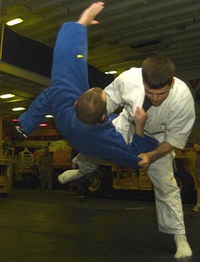
It’s not uncommon for some athletes to have good luck charms, including the superstition that wearing certain colors may give them an edge on the competition. While some studies have found that, indeed, certain colors may increase the likelihood of winning in combat sports, a recent study shows that researchers must take into account potentially confounding factors when associating color with winning probability.
Dutch researchers Peter Dijkstra of the University of Glasgow and Paul Preenen of the University of Amsterdam have investigated the claim of a previous study that judo athletes wearing blue uniforms were more likely to win compared with those in white uniforms during the 2004 Olympics. Supposedly, blue could have an intimidating effect on opponents, since it is brighter than white. Further, white uniforms might be easier to see than blue uniforms, giving the athlete in blue the advantage of anticipating the movements of an opponent in white.
However, Dijkstra and Preenen point out several confounding factors that the previous study did not account for. Taking these factors into consideration, the researchers found that athletes in blue and white uniforms had equal chances of winning a contest.
The researchers determined three confounding factors in the previous study. First, the top 11 percent of judo athletes in the 2004 Olympics were seeded, and all were given blue uniforms. Although the previous study tried to correct for the seeding by excluding first-round matches, Dijkstra and Preenen show that the seeding bias persists up through the third round of matches.
Second, the researchers explained that athletes competing in the “loser’s pool” also had a uniform color bias, since athletes in blue were more likely to have won their previous match. Further, in the loser’s pool, athletes in blue were also more likely to have competed in one fewer match than athletes in white. And third, athletes in blue had slightly longer periods of time between matches, giving them more time to rest than athletes in white.
When correcting for these three factors, the researchers found that pitting blue uniforms against white uniforms was actually a very fair match-up. They confirmed this result by analyzing 71 other major judo tournaments since 1996. Overall, they recommend that blue-white uniform pairings are an ideal match for ensuring equal play.
“Our paper emphasizes the need to carefully consider potential confounding factors,” Dijkstra told PhysOrg.com. “This holds, of course, for every single research project, no matter what it's about. Surely, our findings are important for sport policy makers; blue-white most likely ensures an equal level of play, in contrast to blue-red.”
However, the potential psychological effect of color in sport doesn’t end there. Numerous other studies have shown that other colors – notably red and orange – can signal aggression and dominance in a wide variety of organisms. Some research points out that, in fair-skinned humans, anger can cause the face to redden. Psychological research has also shown that color can impact an individual’s mood, behavior, brain activity, and even body posture.
Perhaps due to these reasons, one study found that athletes in red have a winning bias over athletes in blue in a variety of sports, including men’s Greco-Roman wrestling, freestyle wrestling, boxing, and tae kwon do. Another study found that football and hockey teams with black uniforms receive more penalties than other teams.
Some of these associations between color and performance may still very likely be true. Dijkstra and Preenan just advise that researchers be careful to account for all contributing factors when investigating color-associated winning biases in sports.
“We do believe in the effect of red,” said Dijkstra. “Red is associated with anger, fear and failure in human societies; in many animals red increases the likelihood of winning. Yet, the findings of Hill and Barton (in 2005) that athletes in red win more often in four combat sports requires a re-evaluation, because their analysis may also be confounded by similar factors as described in our study for judo. Ultimately, experimental work is needed (also for the presumed lack of an effect of blue-white) to determine whether color biases winning in human sport.”
More information: Dijkstra, Peter D. and Preenen, Paul T. Y. “No effect of blue on winning contests in judo.” Proceedings of the Royal Society B. doi:10.1098/rspb.2007.1700.
Copyright 2008 PhysOrg.com.
All rights reserved. This material may not be published, broadcast, rewritten or redistributed in whole or part without the express written permission of PhysOrg.com.


