Mechanism of blood clot elasticity revealed in high definition
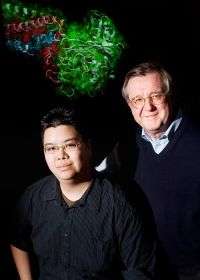
Blood clots can save lives, staunching blood loss after injury, but they can also kill. Let loose in the bloodstream, a clot can cause a heart attack, stroke or pulmonary embolism.
A new study reveals in atomic detail how a blood protein that is a fundamental building block of blood clots gives them their life-enhancing, or life-endangering, properties.
The study, conducted by researchers at the University of Illinois and the Mayo College of Medicine, appears in the journal Structure.
Fibrinogen molecules form elastic fibers, the main material of blood clots. When a blood vessel is ruptured, signaling proteins in the blood convert fibrinogen into its active form, called fibrin. Fibrin molecules link together in a scaffold of fibers that seals the vesicle. Cells in the blood, such as platelets, fill the gaps.
Fibrinogen is highly elastic, able to reversibly stretch to two or three times its original length.
“Once they’re formed, blood clots have to be elastic because they have a mechanical function to withstand blood pressure,” said Klaus Schulten, holder of the Swanlund Chair in Physics at Illinois.
Understanding what gives fibrinogen its flexibility could help in the design of drugs to enhance their function, he said.
“We investigated what makes blood clots elastic,” said Eric Lee, a graduate research assistant and student in the M.D./Ph.D. program at Illinois. “How do we make them easier to break up or make them less likely to rupture?”
Bernard Lim, a cardiologist at Mayo and an expert on the science of blood clots, contacted Schulten’s group in 2006 for help with a puzzling finding. Lim had conducted a series of experiments using atomic force microscopy to measure the amount of force required to stretch individual fibrinogen molecules.
After dozens of trials, Lim had come up with a “force extension curve” that showed how the fibrinogen molecule behaved when it was stretched. His data indicated that the fibrinogen molecule elongates in a sequential fashion, with three distinct phases. But he could not tell which parts of the fibrinogen molecule were involved.
Fibrinogen is a symmetrical molecule, containing a central region connected to two end regions by long, interweaving coiled chains, called alpha helices. These “coiled coils” were believed to give the molecule its elasticity. But how?
The Illinois team used a computational approach to tackle the mystery. Using steered molecular dynamics (SMD), they modeled the behavior of every atom of the fibrinogen molecule as it was stretched. The computation involved more than a million atoms, and required six months to complete.
The resulting simulation (see movie) generated a force extension curve that matched the one Lim had produced.
“This was an incredibly strong piece of evidence that what (Lim) saw wasn’t just in the eye of the beholder, but he saw really a property of the protein,” Schulten said.
The simulation also showed in molecular detail how the fibrinogen molecule responded to stretching. Each phase in the force extension curve corresponded directly with a distinct set of events in the elongation of the molecule.
“The simulations revealed that … the extension occurs in a specific and orderly pattern, with distinct regions within the coiled-coil unraveling before others,” the authors wrote.
Lim had also demonstrated that changes in calcium levels or in the pH (acidity) of a blood clot could alter fibrinogen elasticity, a finding that could influence the design of pharmaceutical agents.
“By understanding what happens at the molecular level, you can understand where to target drugs,” Lee said.
This study points to the efficacy of combining molecular dynamics simulations with experimental data on actual molecules, Schulten said. This is proving to be an effective way to get to the heart of molecular behavior, he said.
Simulations can test important, but potentially ambiguous, experimental findings, Schulten said. “And we can see (the behavior of the molecule) in chemical detail, in atomic detail. We see the full chemistry of this mechanical process.”
Source: University of Illinois at Urbana-Champaign


