Cambridge, Nokia introduce new stretchable and flexible mobile phone concept
February 25, 2008 Cambridge, Nokia introduce new stretchable and flexible mobile phone concept

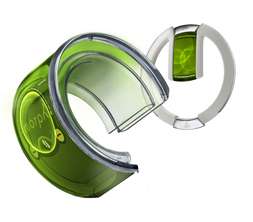
Morph Wrist Mode

The concept for a new stretchable and flexible mobile phone developed by the University of Cambridge and the Nokia Research Center (NRC) was unveiled today.

Morph, the joint nanotechnology concept, launches today alongside the new Design and the Elastic Mind exhibition at The Museum of Modern Art (MoMA) in New York City in which it is profiled. The exhibition will be on view from 24 February to 12 May 2008.

Cambridge, Nokia introduce new stretchable and flexible mobile phone concept

Morph Phone Mode

Morph is a concept that demonstrates how future mobile devices might be stretchable and flexible, allowing the user to transform their mobile device into radically different shapes. It demonstrates the ultimate functionality that nanotechnology might be capable of delivering: flexible materials, transparent electronics and self-cleaning surfaces.

Professor Mark Welland, Head of the Department of Engineering's Nanoscience Group at the University of Cambridge and University Director of Nokia-Cambridge collaboration, commented: "Developing the Morph concept with Nokia has provided us with a focus that is both artistically inspirational but, more importantly, sets the technology agenda for our joint nanoscience research that will stimulate our future work together."

Dr. Tapani Ryhanen, Head of the NRC Cambridge UK laboratory, Nokia, added: "We hope that this combination of art and science will showcase the potential of nanoscience to a wider audience. The techniques we are developing might one day mean new possibilities in terms of the design and function of mobile devices. The research we are carrying out is fundamental to this as we seek a safe and controlled way to develop and use new materials."

The partnership between the University of Cambridge and Nokia was announced in March, 2007 - an agreement to work together on an extensive and long term programme of joint research projects.

NRC has established a research facility at the University's West Cambridge site and collaborates with several departments initially the Department's Nanoscience Center and the Electrical Division of the Engineering Department on projects that, to begin with, are centered on nanotechnology.

A video on this new technology is available to watch the Nokia website: http://www.nokia.com/A4879144

Source: University of Cambridge


print this article email this article download pdf blog this article bookmark this article     Stumble it Digg this share on Facebook retweet share on Reddit add to delicious
Rate this story - 3.7 /5 (32 votes)


February 25, 2008 all stories

Comments: 0

3.7 /5 (32 votes)
  • Stumble this up

  • Digg this

  • share this

  • hide
  • Related Stories

  • 'Bringing together the best in Europe'
    created Mar 02, 2006 | popularity not rated yet | comments 0
  • Weather-sensitive architectural skins integrate form with function
    created Nov 06, 2009 | popularity not rated yet | comments 0
  • First impressions count when making personality judgments, new research shows
    created Nov 03, 2009 | popularity not rated yet | comments 0
  • Web site help for students applying to college
    created Nov 03, 2009 | popularity not rated yet | comments 0
  • Brain maps help guide you through large-scale space, researchers find
    created Nov 03, 2009 | popularity not rated yet | comments 0


  • hide
  • Relevant PhysicsForums posts

  • Fatigue Properties of Chinese steel
    created Nov 04, 2009
  • Finding Hardness values
    created Nov 04, 2009
  • Fluid flow, pressure drop simulation in Comsol
    created Nov 04, 2009
  • units of vickers,brinell and rockwell . . .
    created Nov 04, 2009
  • More from Physics Forums - Materials & Chemical Engineering

Other News

Findings show nanomedicine promising for treating spinal cord injuries

Findings show nanomedicine promising for treating spinal cord injuries

Nanotechnology / Bio & Medicine

created 4 hours ago | popularity 5 / 5 (1) | comments 0

(PhysOrg.com) -- Researchers at Purdue University have discovered a new approach for repairing damaged nerve fibers in spinal cord injuries using nano-spheres that could be injected into the blood shortly ...


New Digital 'Electronics' Concept May Continue Moore's Law

New Digital 'Electronics' Concept May Continue Moore's Law

Nanotechnology / Nanophysics

created Nov 05, 2009 | popularity 4.6 / 5 (51) | comments 9

(PhysOrg.com) -- Computers of the future could be operating not on electrons, but on tiny waves traveling through an electron "fluid," if a new proposal is successful. The new circuit design, recently introduced ...


Nanoparticles for gene therapy improve

Nanoparticles for gene therapy improve

Nanotechnology / Bio & Medicine

created Nov 06, 2009 | popularity 5 / 5 (4) | comments 3

(PhysOrg.com) -- About five years ago, Professor Janet Sawicki at the Lankenau Institute in Pennsylvania read an article about nanoparticles developed by MIT's Robert Langer for gene therapy, the insertion ...


Breakthrough in industrial-scale nanotube processing

Breakthrough in industrial-scale nanotube processing

Nanotechnology / Nanomaterials

created Nov 02, 2009 | popularity 4.9 / 5 (20) | comments 3

(PhysOrg.com) -- Rice University scientists today unveiled a method for the industrial-scale processing of pure carbon-nanotube fibers that could lead to revolutionary advances in materials science, power ...


Scientists witness nature's complexity unfold in self-assembling quasicrystals

Scientists witness nature's complexity unfold in self-assembling quasicrystals

Nanotechnology / Nanomaterials

created Oct 31, 2009 | popularity 4.9 / 5 (16) | comments 3

(PhysOrg.com) -- Just a few decades ago, scientists believed that all ordered matter consists of self-repeating building blocks -- atoms, ions or molecules. In this view, the ordinary solids of everyday life ...