And the Oscar Goes To... a Professor?
February 25, 2008
And the Oscar Goes To... a Professor?

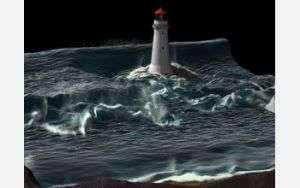
Simulations created for research in computational physics by researchers such as Ron Fedkiw also have applications in entertainment. This image is part of a simulation created by Fedkiw and his colleagues Nick Rasmussen and Frank Losasso Petterson, and it is an example of the work with fluids that earned the team a technical Academy Award this month. Credit: Credit: Frank Losasso, Jerry Talton, Nipun Kwatra, Ron Fedkiw / courtesy of Stanford University

Daniel Day-Lewis, Tilda Swinton and the Coen brothers weren't the only ones honored at last night's Academy Awards. Ron Fedkiw, an associate professor of computer science at Stanford University also received a coveted gold statuette this year for his groundbreaking work in liquid simulations. While people don't usually associate computational scientists with movie stars, Fedkiw's honor shows the impact of computer science on Hollywood and the rest of our lives.

You've probably never heard of Fedkiw, but if you've seen the roaring oceans waves crashing around Johnny Depp in the "Pirates of the Caribbean" movies or the splattering lava flows in the final duel in "Star Wars: Revenge of the Sith," you've enjoyed his handiwork.

From his time as a graduate student at UCLA, Fedkiw has conducted cutting-edge research into computational physics, a field that uses computers to simulate physical phenomena. These complex models and simulations are highly valued because they allow researchers to observe theoretical events or to predict how objects might behave under certain conditions.

Fedkiw's models are so accurate, however, that they can also transport moviegoers into another world. "A lot of my work was on computational methods for fluids and solids for computational physics applications," Fedkiw said last week. "It turns out to be quite useful for movies as well."

For much of the past decade Fedkiw has been working in films while continuing his academic research. His big break came in 1998 when he began working for a company that was producing 3-D water simulations using algorithms known as Navier-Stokes equations for a number of different customers, including Hollywood studios. A few years later. he accepted an offer to work for Industrial Light and Magic (ILM), the legendary special effects company founded by George Lucas, creator of the "Star Wars" trilogies.

While at ILM, Fedkiw teamed up with Nick Rasmussen and Frank Losasso Petterson to create a system to realistically simulate low-viscosity liquids such as water. The system has been so successful that Fedkiw, Rasmussen and Losasso were awarded a Scientific and Technical Academy Award at a ceremony earlier this month hosted by Jessica Alba.

Fedkiw has worked on approximately 20 films, including some of the "Harry Potter" series, as well as "Terminator 3" and "Poseidon," two films he cites as among his best work. Despite the success and recognition his work has received, Fedkiw says he is his toughest critic. "Unfortunately I see all the problems with it, and I almost always want to do parts over again," he said. "There's a shot in "Poseidon" that makes me cringe, but other people really liked it."

Fedkiw is now working on simulating human motion, research that is supported by the National Science Foundation. "My main focus these days has been on virtual humans and solid fluid coupling," he explained. "We'd like to do humans swimming, for example."

In addition to having many real-world applications, Fedkiw believes this work may end up on the silver screen someday as well. "If there was ever to be another Academy Award, I'd bet on the work funded [by NSF]," he said.

For now, Fedkiw and his colleagues can bask in the memory of their time in the Oscars spotlight. And despite his experience in the business, even he still gets star struck. "Getting an award from Jessica Alba was pretty cool," he said. "I've been a fan of hers for a long time."

More examples of Ron Fedkiw's work are available on his homepage at Stanford University: http://physbam.sta … edu/~fedkiw/

Source: NSF

4.8 /5 (4 votes)  

Rank 4.8 /5 (4 votes)
Tags

Relevant PhysicsForums posts

More news stories

Iran blocks email, restricts net access: reports

Iran has further restricted access to the Internet and blocked popular email services for the past few days, in a move a top lawmaker said could "cost the regime dearly," media reports said on Sunday.

Technology / Internet

created 31 minutes ago | popularity 5 / 5 (1) | comments 2

Google might launch Drive for cloud storage soon

(PhysOrg.com) -- Google's next big move, according to the Wall Street Journal, is a cloud storage service called Drive. Hardly first to the plate, Google is simply catching up to introducing its cloud reposi ...

Technology / Internet

created 7 hours ago | popularity 4.8 / 5 (4) | comments 3 | with audio podcast report

Love a click away in Indonesia's Twitter Republic

He was a geeky kid from Yogyakarta, she a glamorous city girl in Jakarta. In a country with one of the world's most vibrant social networking scenes they fell in love on Twitter.

Technology / Internet

created 8 hours ago | popularity 4 / 5 (1) | comments 0

Walney offshore wind farm is world's biggest (for now)

(PhysOrg.com) -- The Walney wind farm on the Irish Sea--characterized by high tides, waves and windy weather--officially opened this week. The farm is treated in the press as a very big deal as the Walney ...

Technology / Energy & Green Tech

created Feb 11, 2012 | popularity 4 / 5 (11) | comments 35 | with audio podcast weblog

Navy to begin tests on electromagnetic railgun prototype launcher

The Office of Naval Research (ONR)'s Electromagnetic (EM) Railgun program will take an important step forward in the coming weeks when the first industry railgun prototype launcher is tested at a facility ...

Technology / Engineering

created Feb 06, 2012 | popularity 4.7 / 5 (16) | comments 93 | with audio podcast


Scientists discover molecular secrets of 2,000-year-old Chinese herbal remedy

For roughly two thousand years, Chinese herbalists have treated Malaria using a root extract, commonly known as Chang Shan, from a type of hydrangea that grows in Tibet and Nepal. More recent studies suggest that halofuginone, ...

New method to examine batteries -- MRI from the inside

There is an ever-increasing need for advanced batteries for portable electronics, such as phones, cameras, and music players, but also to power electric vehicles and to facilitate the distribution and storage of energy derived ...

A mitosis mystery solved: How chromosomes align perfectly in a dividing cell

Although the process of mitotic cell division has been studied intensely for more than 50 years, Whitehead Institute researchers have only now solved the mystery of how cells correctly align their chromosomes during symmetric ...

Starve a virus, feed a cure? Findings show how some cells protect themselves against HIV

A protein that protects some of our immune cells from the most common and virulent form of HIV works by starving the virus of the molecular building blocks that it needs to replicate, according to research published online ...

Researchers find extensive RNA editing in human transcriptome

In a new study published online in Nature Biotechnology, researchers from BGI, the world's largest genomics organization, reported the evidence of extensive RNA editing in a human cell line by analysis of RNA-seq data, demons ...

The proteins ensuring genome protection

Researchers from the University of Geneva (UNIGE), Switzerland, have discovered the crucial role of two proteins in developing a cell 'anti-enzyme shield'. This protection system, which operates at the level of molecular ...