Rats on islands disrupt ecosystems from land to sea, researchers find
Seabird colonies on islands are highly vulnerable to introduced rats, which find the ground-nesting birds to be easy prey. But the ecological impacts of rats on islands extend far beyond seabird nesting colonies, according to a new study by researchers at the University of California, Santa Cruz.
The study, which will be published the week of February 25, 2008, in the Proceedings of the National Academy of Sciences, has already helped make the case for the first major rat eradication effort in the Aleutian Islands. Planned to begin this summer, the project will target rats on the appropriately named Rat Island.
The UCSC researchers found that the presence of rats on islands in the Aleutian Archipelago dramatically alters the intertidal zone, reducing the amount of seaweed and increasing the numbers of snails, barnacles, and other invertebrates. These changes result from the decimation of seabird populations by the rats, according to graduate student Carolyn Kurle, who led the study.
"When you're on an island with rats, there are so few birds it's silent, in contrast to the cacophony on the islands without rats," Kurle said.
Some of the affected birds--sea gulls and oystercatchers, in particular--are major predators of invertebrates in the intertidal zone. In their absence, the snails, limpets, and other grazers increase in abundance, eat more algae, and clear more space for other invertebrates to settle and grow. The result is a shoreline practically stripped bare of the usual cover of fleshy algae (i.e., seaweed).
"Where there are no rats, we found plenty of birds, fewer invertebrates, and a lot more algal cover," Kurle said.
Kurle's coauthors are associate professor Donald Croll and assistant adjunct professor Bernie Tershy of UCSC's Department of Ecology and Evolutionary Biology. Croll and Tershy are also the cofounders of Island Conservation, a nonprofit organization dedicated to the protection and restoration of island ecosystems. For the Aleutian Island rat eradication project, Island Conservation has teamed up with the Nature Conservancy and the U.S. Fish and Wildlife Service.
"Our research is giving us a better understanding of the impacts of introduced rats, and by working directly with government agencies and nongovernmental organizations we're able to do something about it," Croll said.
The study describes an elegant example of an ecological phenomenon known as a trophic cascade. "In a trophic cascade, you have an apex predator--in this case, the rat--and because of what that predator eats, you get a cascade of effects that go down through lower levels of the food chain," Kurle said. "This is a clear example of a trophic cascade that crosses between terrestrial and marine ecosystems."
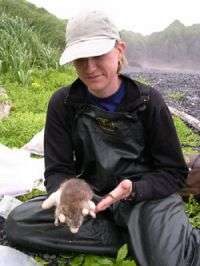
Kurle spent three summers conducting intertidal surveys on 32 islands in the Aleutian Archipelago--17 with rats and 15 without. At first, camping on rat-infested islands was disconcerting, she said. She had to wear ear plugs the first few nights because the sound of rats rustling around outside the tent was keeping her awake. But she soon got used to it.
"We had to be careful with food and trash, but they never got into the tent or anything," Kurle said. "They come out as soon as it starts to get dark, and we would see them running around everywhere. We spent several nights watching them through night-vision binoculars."
The researchers found large numbers of dead birds partially eaten by rats on the islands. The rats mainly attack the chicks, but may also go after adults, Kurle said. Very few birds manage to breed successfully on the rat-infested islands.
Another recent paper from Croll and Tershy's group provides a global overview of the direct effects of invasive rats on seabirds. Published in the February issue of Conservation Biology, the paper reviews the findings of 94 published studies. First author Holly Jones was an intern with Island Conservation as an undergraduate at UCSC and is now a graduate student at Yale University. Coauthors include Croll, Tershy, and Erika Zavaleta, assistant professor of environmental studies at UCSC.
"This is a large-scale analysis showing that rats have preyed on 75 species of seabirds in 10 families on islands throughout the world. The hardest hit seabirds are the small, hole-nesting species like petrels and auklets," Croll said.
The good news is that rats can be eradicated from islands. Island Conservation has led successful eradication efforts on islands off the coast of Mexico and on Anacapa Island, one of the Channel Islands off southern California, Croll said. Worldwide, rats have been removed from more than 274 islands, according to the Nature Conservancy.
"It's been done many times," Croll said. "What's interesting is the synergy between the research and the conservation efforts. Academic researchers tend to do studies and publish them, and then nothing happens. So it's very exciting for our students to see that their research can tie in directly with the conservation mission of a large organization like the Nature Conservancy."
Source: University of California - Santa Cruz


