Two oxygenation events in ancient oceans sparked spread of complex life
February 25, 2008
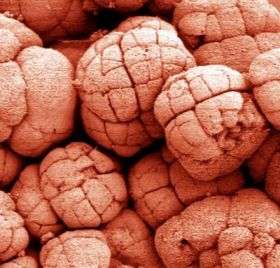
The photo (field of view about 0.15 millimeter in width) is of an exceptionally preserved eukaryotic fossil from the Doushantuo Formation (635–551 million years old) in South China. High-resolution geochemical data from the Doushantuo Formation indicate that the early diversification of eukaryotes may have coupled with episodic oxygenation of Ediacaran oceans. Photograph by Shuhai Xiao
The rise of oxygen and the oxidation of deep oceans between 635 and 551 million years ago may have had an impact on the increase and spread of the earliest complex life, including animals, according to a study reported in the Proceedings of the National Academy of Sciences online Early Edition during the week of February 25 – 29.
Today, we take oxygen for granted. But the atmosphere had almost no oxygen until 2.5 billion years ago, and it was not until about 600 million years ago when the atmospheric oxygen level rose to a fraction of modern levels. For a long time, geologists and evolutionary biologists have speculated that the rise of the breathing gas and subsequent oxygenation of the deep oceans are intimately tied to the evolution of modern biological systems.
To test the interaction between biological evolution and environmental change, an international team of scientists from Virginia Tech, the University of Maryland, University of Nevada at Las Vegas, and Chinese Academy of Sciences, examined changes in the geochemistry and fossil distribution of 635- to 551-million-year old sediments preserved in the Doushantuo Formation in the Yangtze Gorges area of South China.
Millions of years ago, the Yangtze Gorges area was an ancient sea, said Kathleen A. McFadden, a Ph.D. candidate in geobiology at Virginia Tech and the lead author of the PNAS article.
To determine when there was enough oxygen to support animal life in the ocean, the researchers asked, “What kind of geochemical evidence would there be in the rock record?” said Shuhai Xiao, associate professor of geosciences at Virginia Tech.
Scientists hypothesized that there was a lot of dissolved organic carbon in the ocean when oxygen levels were low. If oxygen levels rose, some of this organic carbon would be oxidized into inorganic forms, some of which can be preserved as calcium carbonate in the rock record. “We measured the carbon isotope signatures of organic and inorganic carbon in the ancient rocks to infer oxidation events,” said co-author Ganqing Jiang, assistant professor of geology at the University of Nevada at Las Vegas.
The layers of sediment exposed by the Three Gorges Dam represent millions of years of deposits. “We went through road cuts, bed by bed, measuring and describing the exposed rock, then took small rock samples every few feet or so,,” said McFadden. She collected about 200 samples; hundreds of samples were taken to three labs.
The researchers cleaned and crushed the small samples to powder, which they reacted with acid to release carbon dioxide from carbonate minerals, and then burned the residue to get carbon dioxide from organic matter. “The CO2 that is released was measured with mass spectrometers to gives us the isotopic signature of the carbonate and organic carbon that was present in the rock,” said McFadden.
“The relative abundances of the carbon-12 and carbon-13 isotopes, which are stable and do not decay with time, provide a snapshot of the environmental processes taking place in the ocean at the different times recorded in the layers of rock,” McFadden said.
The stratigraphic pattern of carbon isotope abundances suggested to these researchers that the ocean, which largely lacked oxygen before animals arrived on the scene, was aerated by two discrete pulses of oxygen.
“The first pulse apparently had little impact on a large organic carbon reservoir in the deep ocean, but did spark changes in microscopic life forms,” McFadden said. “The second event, which occurred around 550 million years ago, however, resulted in the reduction of the organic carbon reservoir, indicating that the ocean became fully oxidizing just before the evolution and diversification of many of Earth’s earliest animals,” she said.
“The Doushantuo Formation has a wonderful fossil record,” McFadden said. “It allows us to look at major fossil groups, when they appear and when they disappear, and to see a relationship between oxidation events and biological groups.”
“This study supports the growing view that life and environment co-evolved through this tumultuous period of Earth history,” said geochemist Alan J. Kaufman, a co-author of the study from the University of Maryland.
The researchers analyzed the fossils in the Doushantuo Formation, from microscopic life forms of 635 million years ago to large algae around 551 million years ago. Looking at data from four locations with very similar isotopic records, they report that the first oxygen spike resulted in a rise in microscopic organisms, some of which are thought to be the earliest animal embryos. The second spike in oxygen coincides with a dramatic increase in species of large complex algae.
“Both oxidation events appear to coincide with increased diversity of fossils assemblages in the Doushantuo basin, with the number of species nearly doubling,” McFadden said.
Following this second oxidation event, between 550 and 542 million years ago, there was a worldwide increase of Ediacara organisms, complex macroscopic life forms, an event recently dubbed as the Avalon Explosion. “This was when we see the first burrowing animals and biomineralizing animals in the fossil record,” McFadden said. Biomineralizing animals are the first animals to form external skeletons, or shells.
The triggers for the oxidation events remain elusive, however. “These events recorded in the ocean were probably related to oxygen in the atmosphere reacting with sediments on land,” McFadden said. “Weathering of rocks and soils on the continents would result in the release of certain dissolved ions, such as sulfate, into rivers. These would then be transported to the sea where they might be used by bacteria to oxidize the organic carbon pool in the deep oceans,” she said.
The URL for the paper is http://www.pnas.or … 0708336105v1 .
Source: Virginia Tech
-
Building mountains in a bottle
15 hours ago |
4.5 / 5 (2) |
1
-
Global extinction: Gradual doom is just as bad as abrupt
Feb 03, 2012 |
4.2 / 5 (20) |
0
-
Study supports role of quantum effects in photosynthesis
Jan 25, 2012 |
4.9 / 5 (13) |
7
-
New study sheds light on evolutionary origin of oxygen-based cellular respiration
Jan 22, 2012 |
4.9 / 5 (7) |
0
-
Why silicon-based aliens would rather eat our cities than us: Thoughts on non-carbon astrobiology
Dec 21, 2011 |
5 / 5 (15) |
152
-
Engineers build first sub-10-nm carbon nanotube transistor
Feb 01, 2012 |
4.9 / 5 (31) |
30
-
Something old, something new: Evolution and the structural divergence of duplicate genes
Jan 31, 2012 |
4.6 / 5 (7) |
1
-
The hidden nanoworld of ice crystals: Revealing the dynamic behavior of quasi-liquid layers
Jan 30, 2012 |
5 / 5 (3) |
1
-
Stock market network reveals investor clustering
Jan 27, 2012 |
3.9 / 5 (23) |
8
-
Of microchemistry and molecules: Electronic microfluidic device synthesizes biocompatible probes
Jan 26, 2012 |
5 / 5 (1) |
0
-
Do some geologists actually act a lot like Randy Marsh?
22 hours ago
-
Discrepancy between oxygen and carbon-dioxide levels
Feb 09, 2012
-
where gems are found in the world
Feb 09, 2012
-
Wind Waves in Reservoir ~ Wind run-up and Wind set-up
Feb 08, 2012
-
Balance of oxygen in the atmosphere
Feb 01, 2012
-
The case for a methanol-based economy
Jan 30, 2012
- More from Physics Forums - Earth
More news stories
Latin America mining boom clashes with conservation
Latin America is experiencing a mining boom as prices rise fuelled by a hike in global demand, but the region is also being hit by a wave of violent protests, strikes and rallies by environmentalists.
1 hour ago |
not rated yet |
0
Europe stakes billion-dollar bet on new rocket
A pencil-slim rocket is scheduled to lift into space from South America on Monday, carrying a billion-dollar bet that Europe can grab a juicy slice of the market to place satellites in low orbit.
Space & Earth / Space Exploration
20 hours ago |
4 / 5 (3) |
0
Political leaders play key role in how worried Americans are by climate change: study
More than extreme weather events and the work of scientists, it is national political leaders who influence how much Americans worry about the threat of climate change, new research finds.
Feb 06, 2012 |
5 / 5 (6) |
72
NASA budget will axe Mars deal with Europe: scientists
US President Barack Obama's budget proposal to be submitted next week for 2013 will cut NASA's budget by 20 percent and eliminate a major partnership with Europe on Mars exploration, scientists said Thursday.
Space & Earth / Space Exploration
Feb 10, 2012 |
5 / 5 (3) |
54
Humans may have helped the decline of African rainforests 3000 years ago
(PhysOrg.com) -- Large areas of rainforests in Central Africa mysteriously disappeared over three thousand years ago, to be replaced by savannas. The prevailing theory has been that the cause was a change ...
Google might launch Drive for cloud storage soon
(PhysOrg.com) -- Google's next big move, according to the Wall Street Journal, is a cloud storage service called Drive. Hardly first to the plate, Google is simply catching up to introducing its cloud reposi ...
Love a click away in Indonesia's Twitter Republic
He was a geeky kid from Yogyakarta, she a glamorous city girl in Jakarta. In a country with one of the world's most vibrant social networking scenes they fell in love on Twitter.
Walney offshore wind farm is world's biggest (for now)
(PhysOrg.com) -- The Walney wind farm on the Irish Sea--characterized by high tides, waves and windy weather--officially opened this week. The farm is treated in the press as a very big deal as the Walney ...
GPS court ruling leaves US phone tracking unclear
A US Supreme Court decision requiring a warrant to place a GPS device on the car of a criminal suspect leaves unresolved the bigger issue of police tracking using mobile phones, legal experts say.
Europeans protest controversial Internet pact
Tens of thousands of people marched in protests in more than a dozen European cities Saturday against a controversial anti-online piracy pact that critics say could curtail Internet freedom.
Study finds that anti-diabetic medication can prevent the long-term effects of maternal obesity
In a study to be presented today at the Society for Maternal-Fetal Medicine's annual meeting, The Pregnancy Meeting, in Dallas, Texas, researchers will report findings that show that short therapy with the anti-diabetic medication ...
Feb 26, 2008
Rank: 1.7 / 5 (3)
Oceans are being oxygenated constantly from the grid system and fish were propagated into the oceans to remove the excess that weakens the electrolyte needed for grid energy propagation.
Most oxygens de-couple from the aether that brings that gas into the planet sphere.But not all. Plants do not make oxygen,that assumption has no basis in logic, NONE.
Need an explanation for carbohydrate genesis through a plant and the interaction through the stomata?? I think you do.
Now how do you boys and girls feel about them there apples??
Crickets and grasshoppers open the stomata at night,just as was designed into the eco-system.
And how do you boys and girls feel about that also??
Our oxygenation begins as that ozone that comes down the nodes and is gobbled up partially and de-couples into the simple O2 for needed for life with the rest of the oxygens.
We could remove every plant on this Earth and breathe just great,we just could not eat!!
Grid Science,that missing link needed for science folks so they do the right thing,and so so,needed in this paradigm.