Scripps expedition provides new baseline for coral reef conservation
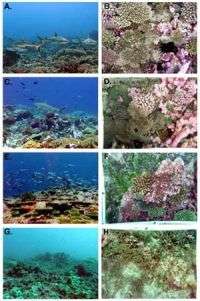
An ambitious expedition led by scientists at Scripps Institution of Oceanography at UC San Diego to a chain of little-known islands in the central Pacific Ocean has yielded an unprecedented wealth of information about coral reefs and threats from human activities.
The exploration of four atolls in the Line Islands, part of a chain approximately a thousand miles south of Hawaii, has produced the first study of coral reefs comprehensively spanning organisms from microbes to sharks. This in-depth description was replicated across a gradient of human impacts, from uninhabited Kingman Reef to Kiritimati, also called Christmas Island, with a population of 5,000 people.
The results are published in two papers in the Public Library of Science (PLoS) ONE (Feb. 27) journal and a companion essay in PLoS Biology (Feb. 26).
At Kingman, the researchers described one of the planet’s most pristine coral reefs, a resource they say provides a much-needed baseline for the conservation of coral reefs. In one paper, the scientists describe Kingman’s atypical food web, where predators such as sharks accounted for 85 percent of the total fish biomass (the weight of all fish together). This inverted pyramid, they say, runs contrary to the bottom-heavy pyramids seen in other parts of the world where top predators have been fished out. Kingman also exhibited healthy coral populations and was nearly absent of seaweed and had low microbe concentrations, unlike evidence found elsewhere on disturbed reefs.
A comparison of Kingman with other reefs in the Line Islands revealed increasing levels of human impacts, including declining coral health, fewer and smaller fish and an increase in microbes.
The Kingman baseline, the researchers say, will be essential for comparisons against degraded reefs elsewhere and for evaluating the efficacy of current conservation actions. They say the data will stimulate new ideas for conserving reefs against threats such as pollution, global warming and overfishing.
“This is the first study in which an entire coral reef community, from the smallest to the largest organisms, is described across a gradient of human habitation,” said Enric Sala, who led the 2005 expedition and is a coauthor of the PLoS ONE papers. Sala, an adjunct professor at Scripps and a National Geographic emerging explorer and fellow, is based at the National Council of Scientific Research of Spain. “We use Kingman as a window into the past, a time machine that allows us to understand what we have lost and how we lost it.”
“One of the major surprising findings from this study, with direct conservation relevance, is that the healthier reefs showed the capacity to recover from climate change events,” said Scripps Oceanography scientist Stuart Sandin, lead author of the PLoS paper covering large organisms and coordinator of the Line Islands Expedition. “When the ecosystem structure is intact, the corals appear to bounce back better from previous warm water events that have killed coral.”
The second PLoS ONE paper describes the ecology of microbes across the four atolls. The researchers, led by Elizabeth Dinsdale and Forest Rohwer of San Diego State University, found 10 times more microbial cells and virus-like particles in the Kiritimati water column compared with Kingman. The microbes around Kiritimati’s reefs, which had the highest percentage of coral disease and smallest coverage of corals, contained a large percentage of potential pathogens.
“Obtaining this microbial data set is particularly important given the association of microbes in the ongoing degradation of coral reef ecosystems worldwide,” the authors noted.
A PLoS Biology essay authored by Nancy Knowlton, adjunct professor at Scripps Oceanography and currently with the Smithsonian Institution, and Jeremy Jackson, professor, Center for Marine Biodiversity and Conservation, Scripps Oceanography, analyzes the importance of establishing baselines for understanding reef ecology in the face of global threats.
They argue that so-called “shifting baselines,” when ecosystems degrade and baselines are downgraded from one generation to the next, is at the root of understanding the factors driving coral reef decline and what, if anything, can be done to stop it.
In the essay, titled “Shifting Baselines, Local Impacts and Global Change on Coral Reefs,” they write: “How to manage coral reefs locally in a globally changing world so that they retain or regain the critical ecosystem attributes of uninhabited reefs and still meet human needs is the central challenge facing reef conservation today.”
Source: University of California - San Diego


