Scientists create artificial 'cells' that boost the immune response to cancer
February 26, 2008
Scientists create artificial 'cells' that boost the immune response to cancer

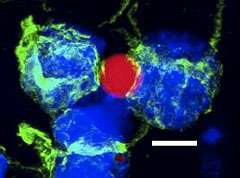
Stimulatory particles (red) bound to activated T-cells (blue) as seen by scanning electron microscopy. Scale bar = 10 μm. Credit: Yale University

Using artificial cell-like particles, Yale biomedical engineers have devised a rapid and efficient way to produce a 45-fold enhancement of T cell activation and expansion, an immune response important for a patient’s ability to fight cancer and infectious diseases, according to an advance on line report in Molecular Therapy.

The artificial cells, developed by Tarek Fahmy, assistant professor of biomedical engineering at Yale and his graduate student Erin Steenblock, are made of a material commonly used for biodegradable sutures. The authors say that the new method is the first “off-the-shelf” antigen-presenting artificial cell that can be tuned to target a specific disease or infection.

“This procedure is likely to make it to the clinic rapidly,” said senior author Fahmy. “All of the materials we use are natural, biodegradable already have FDA approval.”

Cancer, viral infections and autoimmune diseases have responded to immunotherapy that boosts a patient’s own antigen-specific T cells. In those previous procedures, a patient’s immune cells were harvested and then exposed to cells that stimulate the activation and proliferation of antigen-specific T-cells. The “boosted” immune cells were then infused back into the patient to attack the disease.

Limitations of these procedures include costly and tedious custom isolation of cells for individual patients and the risk of adverse reaction to foreign cells, according to the Yale researchers. They also pointed to difficulty in obtaining and maintaining sufficient numbers of activated T-cells for effective therapeutic response.

In the new system, the outer surface of each particle is covered in universal adaptor molecules that serve as attachment points for antigens — molecules that activate the patient’s T-cells to recognize and fight off the targeted disease — and for stimulatory molecules. Inside of each particle, there are slowly released cytokines that further stimulate the activated T-cells to proliferate to as much as 45 times their original number.

“Our process introduces several important improvements,” said lead author Steenblock. “First, the universal surface adaptors allow us to add a span of targeting antigen and co-stimulatory molecules. We can also create a sustained release of encapsulated cytokines. These enhancements mimic the natural binding and signaling events that lead to T-cell proliferation in the body. It also causes a fast and effective stimulation of the patient’s T-cells — particularly T-cells of the cytotoxic type important for eradicating cancer.”

“Safe and efficient T-cell stimulation and proliferation in response to specific antigens is a goal of immunotherapy against infectious disease and cancer,” said Fahmy. “Our ability to manipulate this response so rapidly and naturally with an “off the shelf” reproducible biomaterial is a big step forward.”

Fahmy was recently awarded a five-year National Science Foundation (NSF) Career Award for work on this process and ways of engineering biomaterials to manipulate immune responses to fight cancer and other diseases. His approach incorporates signals important for T-cell stimulation in biocompatible polymer particulates, and integrates all the signals needed for efficient T-cell stimulation.

According to the NSF, devices as such these offer ease and flexibility in targeting different types of T-cells, and is expected to lead to state of the art improvements in the preparation of a new generation of therapeutic systems.

Citation: Molecular Therapy (advance online February 26, 2008)

Source: Yale University

4.5 /5 (28 votes)  

Filter


Move the slider to adjust rank threshold, so that you can hide some of the comments.


Display comments: newest first

SDMike
Feb 28, 2008

Rank: not rated yet
They've invented the "Biobus"!
Rank 4.5 /5 (28 votes)
Tags

Related Stories
Relevant PhysicsForums posts
  • Is Everyday Technology Killing Us?
    createdFeb 08, 2012
  • Exercise and weight loss
    createdFeb 08, 2012
  • Why do we have head aches? Our brains can't feel anything.
    createdFeb 07, 2012
  • "The end of diseases" by David Agus, interview from Daily Show with Jon Stewart
    createdFeb 04, 2012
  • Oncolytic adenovirus
    createdFeb 04, 2012
  • Nutrition label stuffs and diets
    createdFeb 02, 2012
  • More from Physics Forums - Medical Sciences

More news stories

Overeating may double risk of memory loss

New research suggests that consuming between 2,100 and 6,000 calories per day may double the risk of memory loss, or mild cognitive impairment (MCI), among people age 70 and older. The study was released today and will be ...

Medicine & Health / Neuroscience

created 35 minutes ago | popularity not rated yet | comments 0 | with audio podcast

Injured boomers beware: Know when to see doctor

(AP) -- It happened to nurse Jane Byron years after an in-line skating fall, business owner Haralee Weintraub while doing "men's" push-ups, and avid cyclist Gene Wilberg while lifting a heavy box.

Medicine & Health / Health

created 5 hours ago | popularity 5 / 5 (1) | comments 0

Starve a virus, feed a cure? Findings show how some cells protect themselves against HIV

A protein that protects some of our immune cells from the most common and virulent form of HIV works by starving the virus of the molecular building blocks that it needs to replicate, according to research published online ...

Medicine & Health / Research

created 4 hours ago | popularity 5 / 5 (1) | comments 0 | with audio podcast

FDA-approved drug rapidly clears amyloid from the brain, reverses Alzheimer's symptoms in mice

Neuroscientists at Case Western Reserve University School of Medicine have made a dramatic breakthrough in their efforts to find a cure for Alzheimer's disease. The researchers' findings, published in the journal Science, show t ...

Medicine & Health / Neuroscience

created Feb 09, 2012 | popularity 4.9 / 5 (57) | comments 15 | with audio podcast

Green tea found to reduce disability in the elderly

(Medical Xpress) -- A lot of research has been done over the past several years looking into the health benefits of green tea. As a result, scientists have found that regular consumption of the beverage leads ...

Medicine & Health / Health

created Feb 07, 2012 | popularity 4.4 / 5 (15) | comments 10 | with audio podcast report


Google might launch Drive for cloud storage soon

(PhysOrg.com) -- Google's next big move, according to the Wall Street Journal, is a cloud storage service called Drive. Hardly first to the plate, Google is simply catching up to introducing its cloud reposi ...

Scientists discover molecular secrets of 2,000-year-old Chinese herbal remedy

For roughly two thousand years, Chinese herbalists have treated Malaria using a root extract, commonly known as Chang Shan, from a type of hydrangea that grows in Tibet and Nepal. More recent studies suggest that halofuginone, ...

New method to examine batteries -- MRI from the inside

There is an ever-increasing need for advanced batteries for portable electronics, such as phones, cameras, and music players, but also to power electric vehicles and to facilitate the distribution and storage of energy derived ...

Lab study raises questions over nano-particle impact

Tests involving chickens have raised questions about the impact on health from engineered nano-particles, the ultra-fine grains commonly used in drugs and processed foods, scientists said on Sunday.

A mitosis mystery solved: How chromosomes align perfectly in a dividing cell

Although the process of mitotic cell division has been studied intensely for more than 50 years, Whitehead Institute researchers have only now solved the mystery of how cells correctly align their chromosomes during symmetric ...

Researchers find extensive RNA editing in human transcriptome

In a new study published online in Nature Biotechnology, researchers from BGI, the world's largest genomics organization, reported the evidence of extensive RNA editing in a human cell line by analysis of RNA-seq data, demons ...