Swift satellite images a galaxy ablaze with starbirth
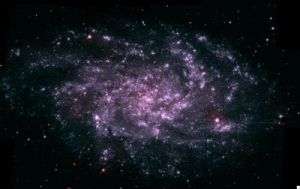
February 26, 2008 Swift satellite images a galaxy ablaze with starbirth

Image credit: NASA/Swift Science Team/Stefan Immler

Combining 39 individual frames taken over 11 hours of exposure time, NASA astronomers have created this ultraviolet mosaic of the nearby "Triangulum Galaxy." "This is the most detailed ultraviolet image of an entire galaxy ever taken," says Stefan Immler of NASA's Goddard Space Flight Center in Greenbelt, Md. Immler used NASA's Swift satellite to take the images, and he then assembled them into a mosaic that seamlessly covers the entire galaxy.

The Triangulum Galaxy is also called M33 for being the 33rd object in Charles Messier's sky catalog. It is located about 2.9 million light-years from Earth in the constellation Triangulum. It is a member of our Local Group, the small cluster of galaxies that includes our Milky Way Galaxy and the Andromeda Galaxy (M31). Despite sharing our Milky Way's spiral shape, M33 has only about one-tenth the mass. M33's visible disk is about 50,000 light-years across, half the diameter of our galaxy.

Swift's Ultraviolet/Optical Telescope (UVOT) took the images through three separate ultraviolet filters from December 23, 2007 to January 4, 2008. The mosaic showcases UVOT's high spatial resolution. Individual star clusters and star-forming gas clouds are clearly resolved, even in the crowded nucleus of the galaxy. The image also includes Milky Way foreground stars and much more distant galaxies shining through M33.

Young, hot stars are prodigious producers of ultraviolet light, which heat up the surrounding gas clouds to such high temperatures that they radiate brightly in ultraviolet light. The image shows the giant star-forming region NGC 604 as a bright spot to the lower left of the galaxy's nucleus. With a diameter of 1,500 light-years (40 times that of the Orion Nebula), NGC 604 is the largest stellar nursery in the Local Group.

"The ultraviolet colors of star clusters tell us their ages and compositions," says Swift team member Stephen Holland of NASA Goddard. "With Swift's high spatial resolution, we can zero in on the clusters themselves and separate out nearby stars and gas clouds. This will enable us to trace the star-forming history of the entire galaxy."

"The entire galaxy is ablaze with starbirth," adds Immler. "Despite M33's small size, it has a much higher star-formation rate than either the Milky Way or Andromeda. All of this starbirth lights up the galaxy in the ultraviolet."

Larger image: http://www.nasa.gov/images/content/214434main_M33_UVOT.jpg

Source: Goddard Space Flight Center, by Robert Naeye


print this article email this article download pdf blog this article bookmark this article     Stumble it Digg this share on Facebook retweet share on Reddit add to delicious
Rate this story - 4.4 /5 (22 votes)

Rank Filter

Move the slider to adjust rank threshold, so that you can hide some of the comments.


Display comments: newest first

  • Nikola - Feb 26, 2008
    • Rank: 5 / 5 (1)
    I can't wait until the James Webb Telescope goes into orbit in 2013. Hubble is scheduled for major upgrades this fall which will hold us over until then.
  • gopher65 - Feb 26, 2008
    • Rank: 5 / 5 (1)
    JWST will image a different section of the spectrum that either Hubble or Swift. So it's not a replacement for either of them, it's a complementary telescope. Herschel will also be up this year (3.5 metre mirror) for sub-millimetre and far infrared stuff.

    http://en.wikiped...ervatory

    There are many different wavelengths to observe, and one telescope can't do them all. You need many different telescopes to see in every wavelength.

February 26, 2008 all stories

Comments: 2

4.4 /5 (22 votes)
  • Stumble this up

  • Digg this

  • share this

  • hide
  • Related Stories

  • Hubble Image Showcases Star Birth in M83, the Southern Pinwheel
    created Nov 05, 2009 | popularity not rated yet | comments 0
  • Active galaxies flare and fade in Fermi telescope all-sky movie (w/Video)
    created Apr 24, 2009 | popularity not rated yet | comments 0
  • Astronomers hit a telescopic jackpot
    created Jan 12, 2009 | popularity not rated yet | comments 0
  • Active galaxies are different near and far
    created Jan 06, 2009 | popularity not rated yet | comments 0
  • Submillimeter Eagle Eyes on Mauna Kea
    created Nov 20, 2008 | popularity not rated yet | comments 0


  • hide
  • Relevant PhysicsForums posts

  • The shape of our solar system's orbits.
    created Nov 07, 2009
  • Above or Below the Line of Nodes
    created Nov 07, 2009
  • Supernova vs. Nova?
    created Nov 07, 2009
  • Supernova's Gamma Rays and Comets
    created Nov 06, 2009
  • More from Physics Forums - General Astronomy

Other News

Deep creep means milder, more frequent earthquakes along Southern California's San Jacinto fault

Deep creep means milder, more frequent earthquakes along Southern California's San Jacinto fault

Space & Earth / Earth Sciences

created 20 hours ago | popularity 4.5 / 5 (4) | comments 0

With an average of four mini-earthquakes per day, Southern California's San Jacinto fault constantly adjusts to make it a less likely candidate for a major earthquake than its quiet neighbor to the east, the ...


Success in 'space elevator' competition (AP)

Success in 'space elevator' competition (Update 3)

Space & Earth / Space Exploration

created Nov 05, 2009 | popularity 4.3 / 5 (33) | comments 50

(AP) -- A robot powered by a ground-based laser beam climbed a long cable dangling from a helicopter on Wednesday to qualify for prize money in a $2 million competition to test the potential reality of the ...


In a Galaxy Far, Far Away...

In a Galaxy Far, Far Away...

Space & Earth / Astronomy

created Nov 06, 2009 | popularity 4.8 / 5 (5) | comments 17

(PhysOrg.com) -- Astronomers have published the discovery of the farthest known object in the cosmos: a star that exploded when the universe was only 630 million years old -- only 4.6% of its current age. ...


'Dropouts' pinpoint earliest galaxies

'Dropouts' pinpoint earliest galaxies

Space & Earth / Astronomy

created Nov 06, 2009 | popularity 4.2 / 5 (10) | comments 13

Astronomers, conducting the broadest survey to date of galaxies from about 800 million years after the Big Bang, have found 22 early galaxies and confirmed the age of one by its characteristic hydrogen signature ...


Space hotel taking bookings for 2012 opening

Space hotel taking bookings for 2012 opening

Space & Earth / Space Exploration

created Nov 05, 2009 | popularity 4.4 / 5 (21) | comments 11

(PhysOrg.com) -- The first orbiting space hotel is on track to open for its first customers in 2012, but hurry, as bookings are filling fast.