Killer Electrons Surf Celestial Tsunamis
February 26, 2008
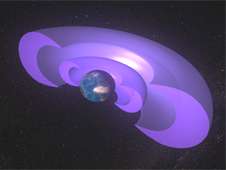
This is an artist's concept of the Van Allen radiation belts surrounding Earth. The blue, concentric shells represent the inner and outer belts. They completely encircle Earth, but have been cut away in this image to show detail. Credit: NASA Scientific Visualization Studio/Walt Feimer
It's as if we took a trip into space with our best friends, and they turned into mutants and attacked us. Electrons are the best friends we've ever had from the subatomic world. We harness their flow as electricity to power all of modern life -- everything from cell phones and laptops to light bulbs. In space, however, electrons can turn against us. Boosted to almost the speed of light, "killer electrons" can knock out computers, pierce spacesuits, and damage the tissues of astronauts. New research using NASA's STEREO spacecraft is discovering exactly how this happens.
Killer electrons lurk in the radiation belts surrounding Earth, called the Van Allen Belts after their discoverer, James Van Allen. Shaped like two concentric pumpkin shells around the Earth, the Van Allen Belts are areas where electrons and other electrically charged particles get trapped by Earth's magnetic field. Something happens there that turns ordinary electrons into high-speed demons.
Professor Cynthia Cattell of the University of Minnesota led a team that has found a likely culprit -- the most powerful radio waves of their kind ever detected in the Belts. "No one has ever seen waves this big," says Cattell. "They're more than 10 times bigger than what we knew about."
The waves studied by Cattell and her colleagues are known as whistlers, a special type of radio-frequency wave that has been known since World War I, when they were discovered to be generated by lightning.
The newly found whistlers have a lot in common with the ocean waves off Waikiki Beach. Both pick up surfers--whether people or electrons--and transfer energy to them. Electrons that absorb enough energy from whistlers can hurtle along at up to 99 percent the speed of light, which translates to 184,000 miles per second.
The most startling revelation was how fast it happens. It had been thought that multiple interactions between whistlers and electrons, taking place over a span of minutes or even tens of hours, were necessary.
"But we saw that electrons can be energized in a tenth of a second," says Cattell.
The key to the discovery lay in a couple of identical instruments designed by Keith Goetz, a physicist at the University of Minnesota. They are aboard the twin spacecraft of NASA's STEREO (Solar TErrestrial RElations Observatory) mission, one orbiting the sun ahead of Earth and the other orbiting behind. The idea is to use the widely separated spacecraft to study the sun in 3-D.
The focus of Goetz's instrument -- called TDS, for time-domain sampler--is waves in the solar wind, a stream of charged particles flowing from the sun. The TDS's were intended to collect data after the two STEREO spacecraft had settled into their respective orbits. But that didn't stop Goetz from insisting that they be turned on early, when the two orbiters were still near Earth.
And so they were. And thus the antennas of the TDS were ready on December 12, 2006, when the big break came.
On that day the two spacecraft sailed through the Outer Van Allen Belt in tandem, one about 84 minutes behind the other. During that short interval, the Outer Belt was hit by a "magnetospheric substorm," an explosive release of energy from Earth's magnetic field. The substorm stirred up the massive whistlers, which were detected by the second STEREO spacecraft.
STEREO was launched in October 2006. STEREO is sponsored by NASA’s Science Mission Directorate, Washington, D.C. NASA Goddard Space Flight Center’s Solar Terrestrial Probes Program Office, in Greenbelt, Md., manages the mission, instruments and science center. The Johns Hopkins University Applied Physics Laboratory, in Laurel, Md., designed, built and operates the twin observatories for NASA during the 2-year mission.
Source: by Deane Morrison / Bill Steigerwald, University of Minnesota / NASA's Goddard Space Flight Center
-
THEMIS satellite sees a great electron escape
Jan 31, 2012 |
5 / 5 (1) |
1
-
A new way to measure Earth's magnetosphere
Jan 04, 2012 |
5 / 5 (2) |
1
-
MARSIS completes measurement campaign over Martian North Pole
Dec 20, 2011 |
2 / 5 (2) |
3
-
Mystery of the Lunar Ionosphere
Nov 15, 2011 |
4.8 / 5 (9) |
4
-
STEREO mission celebrates five incredible years of science
Oct 27, 2011 |
not rated yet |
1
-
Engineers build first sub-10-nm carbon nanotube transistor
Feb 01, 2012 |
4.9 / 5 (31) |
30
-
Something old, something new: Evolution and the structural divergence of duplicate genes
Jan 31, 2012 |
4.6 / 5 (7) |
1
-
The hidden nanoworld of ice crystals: Revealing the dynamic behavior of quasi-liquid layers
Jan 30, 2012 |
5 / 5 (3) |
1
-
Stock market network reveals investor clustering
Jan 27, 2012 |
3.9 / 5 (23) |
8
-
Of microchemistry and molecules: Electronic microfluidic device synthesizes biocompatible probes
Jan 26, 2012 |
5 / 5 (1) |
0
-
Scale of the Universe
5 hours ago
-
Titan's lack of impact craters
Feb 09, 2012
-
Real pictures of black hole eating a star?
Feb 08, 2012
-
Hypothetical way to travel faster than light, but not technically exceed lightspeed
Feb 06, 2012
-
How do scientists monitor the Sun's activity?
Feb 05, 2012
-
Search patterns in observational studies
Feb 05, 2012
- More from Physics Forums - General Astronomy
More news stories
Humans may have helped the decline of African rainforests 3000 years ago
(PhysOrg.com) -- Large areas of rainforests in Central Africa mysteriously disappeared over three thousand years ago, to be replaced by savannas. The prevailing theory has been that the cause was a change ...
NASA sees wide-eyed cyclone Jasmine
Cyclone Jasmine's eye has opened wider on NASA satellite imagery, as it moves through the Southern Pacific Ocean.
Space & Earth / Earth Sciences
4 hours ago |
2 / 5 (1) |
1
Could Venus be shifting gear?
(PhysOrg.com) -- ESAs Venus Express spacecraft has discovered that our cloud-covered neighbour spins a little slower than previously measured. Peering through the dense atmosphere in the infrared, the ...
Space & Earth / Space Exploration
12 hours ago |
5 / 5 (7) |
7
|
NASA sees Giovanna reach cyclone strength, threaten Madagascar
Tropical Storm 12S built up steam and became a cyclone on February 10, 2012 as NASA's Terra satellite passed overhead. Residents of east-central Madagascar should prepare for this cyclone to make landfall ...
Space & Earth / Earth Sciences
4 hours ago |
not rated yet |
0
Mars Science Laboratory computer issue resolved
(PhysOrg.com) -- Engineers have found the root cause of a computer reset that occurred two months ago on NASA's Mars Science Laboratory and have determined how to correct it.
Space & Earth / Space Exploration
13 hours ago |
4.7 / 5 (6) |
3
|
Google users warned of threat to smartphone wallets
Users of Google smartphone wallets were being warned on Friday that there is a way to crack pass codes intended to thwart thieves from going on illicit shopping sprees.
Anonymous knocks CIA website offline (Update)
The website of the Central Intelligence Agency was inaccessible on Friday after the hacker group Anonymous claimed to have knocked it offline.
Complex wiring of the nervous system may rely on a just a handful of genes and proteins
Researchers at the Salk Institute have discovered a startling feature of early brain development that helps to explain how complex neuron wiring patterns are programmed using just a handful of critical genes. ...
New error-correcting codes guarantee the fastest possible rate of data transmission
Error-correcting codes are one of the triumphs of the digital age. Theyre a way of encoding information so that it can be transmitted across a communication channel such as an optical fiber o ...
The power of estrogen -- male snakes attract other males
A new study has shown that boosting the estrogen levels of male garter snakes causes them to secrete the same pheromones that females use to attract suitors, and turned the males into just about the sexiest ...
Putting the squeeze on planets outside our solar system
(PhysOrg.com) -- Using high-powered lasers, scientists at Lawrence Livermore National Laboratory and collaborators discovered that molten magnesium silicate undergoes a phase change in the liquid state, abruptly ...
Feb 26, 2008
Rank: 3 / 5 (1)
z
Feb 27, 2008
Rank: not rated yet
Check this out. Paper published at AIAA and AAAF
conferences on future propulsion.
Electron Linear Porpulsion
http://nlspropuls...cept.pdf