Voyage to Southern Ocean aims to study air-sea fluxes of greenhouse gases
February 26, 2008 Voyage to Southern Ocean aims to study air-sea fluxes of greenhouse gases

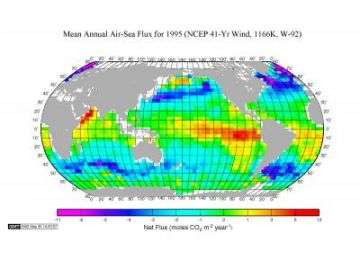
Mean annual carbon dioxide flux between oceans and air, 1995. Cool-colored ocean areas absorb CO2; hot-colored areas emit it. Credit: Courtesy Taro Takahashi, Lamont-Doherty Earth Observatory

Scientists will embark this week from Punta Arenas, Chile, on the tip of South America, to spend 42 days amid the high winds and waves of the Southern Ocean. Here they hope to make groundbreaking measurements to explain how huge fluxes of climate-affecting gases move between atmosphere and sea, and vice-versa.

The cruise, which departs Feb. 28, should provide important information on how the greenhouse gas carbon dioxide moves between the ocean and atmosphere, said the cruise’s chief scientist, David Ho of Columbia University’s Lamont-Doherty Earth Observatory. Comprising 30 percent of global seas, “the Southern Ocean is a source of great uncertainty,” he said. “So it’s potentially important to our understanding of the global system.”

Humans put about 6 billion metric tons of CO2 into the air each year, mainly by fossil-fuel burning and deforestation. About a third is thought to be absorbed by oceans, and a third by plants or other components of land. The rest stays in the air—much of the reason why atmospheric CO2 is now building and climate is warming. However, there are huge uncertainties in the calculations—made so far mostly through indirect means--and fluxes seem highly variable from year to year, with some parts of the oceans habitually giving up CO2 while others absorb it. (The Southern Ocean usually absorbs it.) "Understanding how atmospheric carbon dioxide reacts with these cold surface waters is important for determining how the ocean uptake of carbon dioxide will respond to future climate change,” said Christopher Sabine, an oceanographer at the U.S. National Oceanic and Atmospheric Administration (NOAA). NOAA, NASA and the National Science Foundation are cosponsoring the cruise.

About 30 scientists from over a dozen institutions will traverse an area above Antarctica more than 1,000 miles east of Punta Arenas, aboard the 274-foot NOAA ship Ronald Brown. Here high, freezing winds unimpeded by landmasses roar much of the time, and waves can routinely top 30 feet. “The conditions are a little grim, but it’s ideal for study,” said Ho. He said that higher wind speeds correlate with faster exchange of gases, but there have been few studies aimed at directly measuring these exchanges under real-world conditions. The scientists say that wind speed itself probably does not drive gas exchange; the drivers are hard-to-observe phenomena driven by the wind, including turbulence and bubbles created by cresting waves. Another factor is the amount of phytoplankton taking CO2 from the water, which is usually measured by color. To figure out what is going on, the crew will dangle arrays of complicated instruments just above the water surface, and in the water column. “That will be a challenge, since the bow will be plunging off those big waves,” noted Sabine.

“NASA’s ongoing effort to understand the global carbon cycle will benefit from the data this cruise will produce,” said Paula Bontempi, manager of NASA’s ocean biology and biogeochemistry research program. "NASA's global satellite observations of ocean color will be improved, as we validate what our space-based sensors see with direct measurements taken at sea."

Source: Columbia University


print this article email this article download pdf blog this article bookmark this article     Stumble it Digg this share on Facebook retweet share on Reddit add to delicious
Rate this story - 5 /5 (1 vote)


February 26, 2008 all stories

Comments: 0

5 /5 (1 vote)
  • Stumble this up

  • Digg this

  • share this

  • hide
  • Related Stories

  • From Greenhouse to Icehouse
    created 2 hours ago | popularity not rated yet | comments 0
  • Iron and biological production in the high-latitude North Atlantic
    created Jul 07, 2009 | popularity not rated yet | comments 0
  • Ozone hole reduces atmospheric CO2 uptake in the Southern Ocean
    created Jun 24, 2009 | popularity not rated yet | comments 0
  • Wind shifts may stir CO2 from Antarctic depths
    created Mar 12, 2009 | popularity not rated yet | comments 0
  • CO2 drop and global cooling caused Antarctic glacier to form
    created Feb 26, 2009 | popularity not rated yet | comments 0


  • hide
  • Relevant PhysicsForums posts

  • The IPCC and the term "most"
    created 17 hours ago
  • Is global warming a fact?
    created 19 hours ago
  • Random variability of wind patterns
    created Nov 23, 2009
  • Record precipitation in the UK
    created Nov 22, 2009
  • More from Physics Forums - Earth

Other News

From Greenhouse to Icehouse

From Greenhouse to Icehouse

Space & Earth / Earth Sciences

created 2 hours ago | popularity 4 / 5 (2) | comments 4

A new study that reconstructed ocean temperatures from millions of years ago could provide new insight into how the Earth responds to climate change.


'Cosmic fruit machine' matches collisions

'Cosmic fruit machine' matches collisions

Space & Earth / Astronomy

created 4 hours ago | popularity 5 / 5 (1) | comments 1

(PhysOrg.com) -- A new website will give everyone the chance to contribute to science by playing a 'cosmic fruit machine' and compare images of colliding galaxies with millions of simulated images of galactic ...


Humanity would need five Earths to create the resources needed if everyone lived as like Americans, a report has stated

Mankind using Earth's resources at alarming rate

Space & Earth / Environment

created 2 hours ago | popularity 3 / 5 (4) | comments 5

Humanity would need five Earths to produce the resources needed if everyone lived as profligately as Americans, according to a report issued Tuesday.


Supervolcano eruption -- in Sumatra -- deforested India 73,000 years ago

Supervolcano eruption -- in Sumatra -- deforested India 73,000 years ago

Space & Earth / Earth Sciences

created 19 hours ago | popularity 4.4 / 5 (12) | comments 2

A new study provides "incontrovertible evidence" that the volcanic super-eruption of Toba on the island of Sumatra about 73,000 years ago deforested much of central India, some 3,000 miles from the epicenter, ...


New computer-developed map shows more extensive valley network on Mars

New computer-developed map shows more extensive valley network on Mars

Space & Earth / Space Exploration

created 18 hours ago | popularity 4.5 / 5 (8) | comments 0

New research adds to the growing body of evidence suggesting the Red Planet once had an ocean.