Researchers catch rats' twitchy whiskers in action
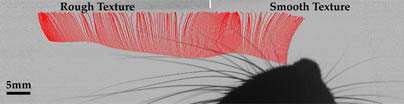
Rats use their whiskers in a way that is closely related to the human sense of touch: Just as humans move their fingertips across a surface to perceive shapes and textures, rats twitch their whiskers to achieve the same goal. Now, in a finding that could help further understanding of perception across species, MIT neuroscientists have used high-speed video to reveal rat whiskers in action and show the tiny movements that underlie the rat's perception of its tactile environment.
Rats rely on whiskers to find their way in the dark, and they devote large areas of their brains to decoding the incoming signals, explains Christopher Moore, a member of the McGovern Institute for Brain Research at MIT and senior author of a study in the February 28th issue of Neuron. Neuroscientists interested in perception have studied the whisker system intensively, but the information conveyed to the brain by whisker motions has remained a mystery-until now.
Click here to play a high-speed videography, developed by MIT researchers. An automated algorithm is used to analyze the whisker micromotions, which are thought to underlie rats’ highly developed abilities to perceive tactile objects and distinguish textures. This video was captured at 3202 frames per second, so on most computers the playback will be slowed down by about 100x.
"Now that we can see what the rat's whiskers are telling the brain, we can start to understand better how this amazing perceptual system works," says Moore, who is also an assistant professor in MIT's Department of Brain and Cognitive Sciences. "This understanding is relevant not only to the human sense of touch, but to all forms of perception, because every sensory organ is an interface between the mind and the external world."
What might a whisker-based sensation feel like? Imagine sweeping a stick across a picket fence. The frequency of vibrations depends on the spacing between the pickets, but the sensation in the hand is also affected by the length and flexibility of the stick and the speed of its movement.
Likewise, Moore reasoned, the whiskers' movements and mechanical properties must influence the information that they relay to the brain. The whiskers are arranged in a pattern on the snout, with the shortest ones at the front. Experiments with isolated whiskers had demonstrated that, like harp strings, shorter whiskers are 'tuned' to resonate at higher frequencies, creating a map of frequency information within the brain. But until now, no one had managed to see the detailed pattern of whisker movements in freely behaving animals.
Like the famous images MIT's Harold "Doc" Edgerton made of bullets going through apples, the slow-motion version of these new movies provides the first glimpse of the micromotions that the whiskers transmit to the rat brain.
For the experiments, the researchers trained rats to choose either a smooth or a rough surface using their whiskers. Correct choices were rewarded with chocolate milk, and the whisker movements were captured on video. Analysis of the video revealed an unexpectedly complex pattern of movements, including periodic 'waves' of motion when the rat touched a smooth surface, and irregular, large and high-velocity movements when contacting a rough surface.
"These patterns are larger and more complex than anything previously observed in anesthetized animals or plucked whiskers, but they are the key to a rat's perceptions and behavior," comments Moore.
Source: Massachusetts Institute of Technology


