First look: Princeton researchers peek into deepest recesses of human brain
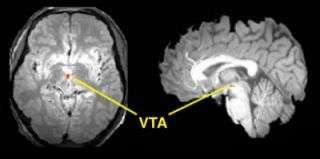
A team of scientists from Princeton University has devised a new experimental technique that produces some of the best functional images ever taken of the human brainstem, the most primitive area of the brain.
The scientists believe they may be opening the door to inquiries into a region that acts as the staging area for the brain chemicals whose overabundance or absence in other parts of the brain are at the root of many neuropsychiatric disorders, like addiction, schizophrenia and Parkinson's disease.
Reporting in the Feb. 28 edition of Science, the scientists describe using functional magnetic resonance imaging to study brainstem activity in dehydrated humans. The scanning technique allows researchers to watch the brain in action.
The subjects were participating in classical conditioning experiments in which they were presented with a visual clue, then, at varying intervals, given a drink. The researchers were able to track changes in blood flow in areas of the brainstem associated with enhanced activity of the brain chemical dopamine -- as the person experienced either pleasure or disappointment at receiving or not receiving the reward.
"For a long time, scientists have tried looking at this area of the brain and have been unsuccessful -- it's just too small," said Kimberlee D'Ardenne, the lead author on the paper. Until now, scientists wanting to use brain scans to study brain chemicals like dopamine were relegated to watching its effects in other more accessible parts of the brain, like the prefrontal cortex and ventral striatum. However, this was downstream of its source, and therefore possibly much less accurate, D'Ardenne said.
"We wanted to try because the brainstem is so important to activities in the rest of the brain," said D'Ardenne, a postdoctoral student in the Department of Chemistry. "We believe it could be a key to understanding all kinds of important behavior."
For the research, D'Ardenne collaborated with Jonathan Cohen, co-director of the Princeton Neuroscience Institute, and Samuel McClure and Leigh Nystrom, other institute scientists. They conducted the studies on the University's own brain scanner located on campus in Green Hall.
Cohen noted that these findings provide a critical link between studies in non-human animals that have looked directly at the activity of dopamine cells in the brainstem and studies in humans of behaviors thought to be related to dopamine. "It could also open up entirely new avenues of study," he said.
The team was able to develop high-resolution images that tracked the activity of tiny clusters of dopamine neurons. They weeded out distortions caused by many pulsing blood vessels in the brainstem. They also employed computerized rules of thumb known as algorithms and imaging techniques to reduce the effects of head movement and combine images from different subjects.
The MRI device produces three-dimensional images that show what portions of the brain engage during actions and thought processes. This allows the investigators to correlate physical processes with mental activities with unprecedented precision.
The brain stem, a tiny, root-shaped structure, is the lower part of the brain and sits atop the spinal cord. The area controls brain functions necessary for survival, such as breathing, digestion, heart rate, blood pressure and arousal. The brain structure also serves as the home base for the brain chemicals, also known as neuromodulators, such as dopamine, serotonin and norepinephrine. The chemicals spring forth into other brain regions from there, zipping along routes called axons.
The team's experiments confirmed results already seen in animal studies. Blood flow increased in dopamine centers of the brainstem when test subjects were happily surprised with a reward. However, there was no activity when participants received less than what they expected, a finding that is different from the results of previous studies looking farther downstream.
"We are just at the beginning of understanding these crucial pathways," D'Ardenne said. "But it gives us a hint about what is possible to know."
The tiny clumps of cells containing neuromodulator chemicals in the brainstem, called nuclei, have long been known to play a critical role in the regulation of brain function, and disturbances of these systems have been implicated in most psychiatric disorders, from addiction to schizophrenia, D'Ardenne said.
The Princeton group wants to understand how the brain's physical structures give rise to the functions of the mind, a field known as cognitive neuroscience.
For years, neuroscientists focused on the brain while psychologists dealt with the mind. The new field combines both and is being powered by scientific advances in brain imaging and gene manipulation that allows researchers to record and measure the activity of brain cells as humans or animals perform mental tasks.
Source: Princeton University


