NASA Views Landing Site Through Eyes of Future Moon Crew
February 27, 2008 NASA Views Landing Site Through Eyes of Future Moon Crew

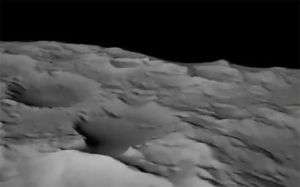
NASA has obtained the highest resolution terrain mapping to date of the moon’s rugged south polar region. Credit: NASA

NASA has obtained the highest resolution terrain mapping to date of the moon's rugged south polar region, with a resolution to 20 meters per pixel. Scientists at NASA's Jet Propulsion Laboratory in Pasadena, Calif., collected the data using the facility's Goldstone Solar System Radar located in California's Mojave Desert. The imagery generated by the data has been incorporated into animation depicting the descent to the lunar surface of a future human lunar lander and a flyover of Shackleton Crater.

The mapping data collected indicate that the region of the moon's south pole near Shackleton Crater is much more rugged than previously understood. The Shackleton rim area is considered a candidate landing site for a future human mission to the moon.

"The south pole of the moon certainly would be a beautiful place to explore," said Doug Cooke, deputy associate administrator for the Exploration Systems Mission Directorate at NASA Headquarters, Washington. "We now know the south pole has peaks as high as Mt. McKinley and crater floors four times deeper than the Grand Canyon. There are challenges that come with such rugged terrain, and these data will be an invaluable tool for advance planning of lunar missions."

Three times during a six-month period in 2006, scientists targeted the moon's south polar region using Goldstone's 70-meter radar dish. The antenna, three-quarters the size of a football field, sent a 500-kilowatt strong, 90-minute long radar stream 231,800 miles to the moon. The radar bounced off the rough-hewn lunar terrain over an area measuring about 400 miles by 250 miles. Signals were reflected back to two of Goldstone's 34-meter antennas on Earth. The roundtrip time, from the antenna to the moon and back, was about two-and-a-half seconds.

"I have not been to the moon, but this imagery is the next best thing," said Scott Hensley, a scientist at JPL and lead investigator for the study. "With these data we can see terrain features as small as a house without even leaving the office."

Previously, the best resolution of the moon's south pole was generated by the Clementine spacecraft, which could resolve lunar terrain features near the south pole at 1 kilometer per pixel. The new resolution generated by JPL is 50 times more detailed.

NASA's Lunar Reconnaissance Orbiter will provide the next generation of lunar imaging and data. The spacecraft is scheduled to launch in late 2008. The Lunar Reconnaissance Orbiter Camera will retrieve high resolution images of the moon's surface and lunar poles with resolutions to 1 meter.

These images will provide knowledge of polar illumination conditions, identify potential resources and hazards, and enable safe landing site selection. Other instruments aboard the orbiter will return data such as temperature maps, ultraviolet images, characterization of radiation on the moon and a high resolution 3-D map. NASA's quest for up-to-date imagery of the moon also will benefit from international missions such as Japan's Selene robotic probe.

Source: NASA


print this article email this article download pdf blog this article bookmark this article     Stumble it Digg this share on Facebook retweet share on Reddit add to delicious
Rate this story - 4 /5 (11 votes)

Rank Filter

Move the slider to adjust rank threshold, so that you can hide some of the comments.


Display comments: newest first

  • holoman - Feb 27, 2008
    • Rank: not rated yet
    The Moon in my opinion is a bad first choice for our rare research dollars and feel Mars would give taxpayers more bang for our buck. Yielding higher future returns for humanity.

February 27, 2008 all stories

Comments: 1

4 /5 (11 votes)
  • Stumble this up

  • Digg this

  • share this

  • hide
  • Related Stories

  • Cooking Up Water From the Moon? NASA Studies Water Extraction With Microwaves
    created Oct 19, 2009 | popularity not rated yet | comments 0
  • Astronomers Detect Sodium Gas Ejected by Lunar Impact
    created Oct 12, 2009 | popularity not rated yet | comments 0
  • Hubble observes LCROSS impact: Preliminary analysis shows no clear evidence for hydroxyl
    created Oct 12, 2009 | popularity not rated yet | comments 0
  • Diviner Observes LCROSS Impact
    created Oct 12, 2009 | popularity not rated yet | comments 0
  • Moon crash: Public yawns, scientists celebrate
    created Oct 10, 2009 | popularity not rated yet | comments 0


  • hide
  • Relevant PhysicsForums posts

  • The shape of our solar system's orbits.
    created 20 hours ago
  • Above or Below the Line of Nodes
    created Nov 07, 2009
  • Supernova vs. Nova?
    created Nov 07, 2009
  • Supernova's Gamma Rays and Comets
    created Nov 06, 2009
  • More from Physics Forums - General Astronomy

Other News

Deep creep means milder, more frequent earthquakes along Southern California's San Jacinto fault

Deep creep means milder, more frequent earthquakes along Southern California's San Jacinto fault

Space & Earth / Earth Sciences

created 5 hours ago | popularity 4.7 / 5 (3) | comments 0

With an average of four mini-earthquakes per day, Southern California's San Jacinto fault constantly adjusts to make it a less likely candidate for a major earthquake than its quiet neighbor to the east, the ...


Success in 'space elevator' competition (AP)

Success in 'space elevator' competition (Update 3)

Space & Earth / Space Exploration

created Nov 05, 2009 | popularity 4.3 / 5 (33) | comments 50

(AP) -- A robot powered by a ground-based laser beam climbed a long cable dangling from a helicopter on Wednesday to qualify for prize money in a $2 million competition to test the potential reality of the ...


'Dropouts' pinpoint earliest galaxies

'Dropouts' pinpoint earliest galaxies

Space & Earth / Astronomy

created Nov 06, 2009 | popularity 4.2 / 5 (10) | comments 12

Astronomers, conducting the broadest survey to date of galaxies from about 800 million years after the Big Bang, have found 22 early galaxies and confirmed the age of one by its characteristic hydrogen signature ...


Space hotel taking bookings for 2012 opening

Space hotel taking bookings for 2012 opening

Space & Earth / Space Exploration

created Nov 05, 2009 | popularity 4.4 / 5 (20) | comments 11

(PhysOrg.com) -- The first orbiting space hotel is on track to open for its first customers in 2012, but hurry, as bookings are filling fast.


In a Galaxy Far, Far Away...

In a Galaxy Far, Far Away...

Space & Earth / Astronomy

created Nov 06, 2009 | popularity 4.8 / 5 (5) | comments 13

(PhysOrg.com) -- Astronomers have published the discovery of the farthest known object in the cosmos: a star that exploded when the universe was only 630 million years old -- only 4.6% of its current age. ...