UT Southwestern surgeons complete North Texas' first single-incision gallbladder removal
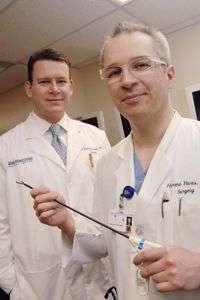
UT Southwestern Medical Center surgeons have removed a gallbladder through a unique operation requiring only a single incision in the bellybutton rather than the traditional four incisions in the abdomen. It is the first such operation in North Texas.
“It went better than we expected,” said Dr. Homero Rivas, assistant professor of surgery, who completed the 80-minute procedure with Dr. J. Esteban Varela, assistant professor of surgery. “Through a single hole, we were able to introduce more than one instrument into the patient’s abdomen at once, and we were able to remove her gallbladder very safely, just like we do routinely through four incisions.”
Melanie Willhite, a 28-year-old professional golfer, said she had suffered for more than a decade with gallbladder attacks that caused recurring abdominal pain, sometimes so intense she could not stand.
“I wasn’t eating. I had lost about 12 pounds in the past two months. It came on when I was under stress, so I got attacks after almost every tournament round,” said Ms. Willhite, a Farmers Branch resident who has been on the professional circuit for five years.
She said she opted for the single-incision cholecystectomy in January to reduce scarring afterwards and have less down time.
“There were a lot of advantages to doing it through one hole, including less scarring and the possibility for quicker healing,” she said. “I’m young. I also wanted to get back on the golf course as soon as possible. The season technically starts in March. I was a little worried, but not too concerned. I trust Dr. Rivas.”
A day after the surgery she was already feeling better and the next day she was eating spaghetti, a meal previously off-limits due to the gallbladder problems. Within a week, she was back on the course putting and two weeks out was able to go through the full range of golf swings.
“I’ve been really pleased,” she said. “I’m looking forward to the start of the season.”
Surgeons inserted specialized tools developed for single-incision surgery through a 1/2-inch incision in the bellybutton. The tools included a flexible camera and an instrument to cut and suture. Minimally invasive laparoscopic procedures such as this usually require four small incisions for separate insertion of the instrumentation.
“It is certainly more difficult than a regular operation because there’s a learning curve for the instrumentation and the camera,” said Dr. Varela. “But gallbladder removal is one of the most common operations for general surgeons, so this would be a breakthrough if we could standardize a technique like this.”
Patients are generally attracted by the aesthetic appeal of having fewer post-operative scars. Doctors say the fewer incisions can also mean faster recovery times, less risk for infection, less risk for bleeding, less pain and potentially the opportunity to eventually reduce costs due to less instrumentation being needed.
Eventually, the technique could be used for other common gastrointestinal surgeries, such as appendectomies, some colon resections, weight-loss surgeries and gastrectomies, in which part of the stomach is removed.
Surgeons at UT Southwestern’s Center for Minimally Invasive Surgery, under director Dr. Daniel Scott, associate professor of surgery in the division of GI/endocrine surgery, have pioneered new techniques for single-incision surgery. Dr. Jeffrey Cadeddu, associate professor of urology, performed the nation’s first single-incision surgery to remove a kidney.
UT Southwestern surgeons are part of a national group evaluating the feasibility and safety of single-incision surgeries and have a joint academic venture with surgeons in Shanghai, China, to develop the techniques.
“There’s a worldwide trend to use less and less invasive techniques,” said Dr. Rivas. “One of the goals we have is to recruit more patients who could benefit from this.”
Dr. Rivas recently performed the first reported single-incision laparoscopic hysterectomy in Durango, Mexico. He has a visiting faculty appointment at the Hospital de la Paz, in Durango, where he frequently teaches other surgeons advanced techniques in minimal-access surgery. Dr. Rivas has also successfully performed another single-incision cholecystectomy and a single-incision appendectomy. Dr. Varela has since performed a single-incision laparoscopic colectomy.
Source: UT Southwestern Medical Center


