Study finds future 'battlegrounds' for conservation very different to those in past
February 28th, 2008 Study finds future 'battlegrounds' for conservation very different to those in past

Enlarge

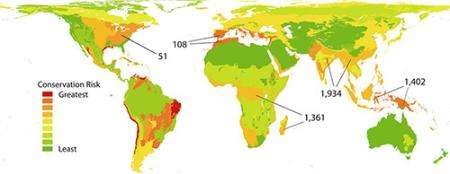
In the face of impending global change, some regions are more in need of protected lands than others. Credit: University of California - San Diego

Biologists at the University of California, San Diego have developed a series of global maps that show where projected habitat loss and climate change are expected to drive the need for future reserves to prevent biodiversity loss.

Their study, published online today in the journal Proceedings of the Royal Society B, provides a guide for conservationists of the areas of our planet where conservation investments would have the most impact in the future to limit extinctions and damage to ecosystems due to rapid human-driven climate and land-use change.

The researchers found that many of the regions that face the greatest habitat change in relation to the amount of land currently protected —such as Indonesia and Madagascar—are in globally threatened and endemic species-rich, developing tropical nations that have the fewest resources for conservation. Conversely, many of the temperate regions of the planet with an already expansive network of reserves are in countries—such as Austria, Germany and Switzerland—with the greatest financial resources for conservation efforts, but comparatively less biodiversity under threat.

“There’s a huge discrepancy between where the world’s conservation resources are concentrated and where the greatest threats to biodiversity are projected to come from future global change,” said Walter Jetz, an assistant professor of biological sciences at UC San Diego, who headed the study. “The developed nations are where the world’s wealth is concentrated, but they are not the future battlegrounds for conservation.”

“While many details still have to be worked out, our study is a first baseline attempt on a global scale to quantitatively demonstrate the urgent need to plan reserves and other conservation efforts in view of future global change impacts,” he added. “Reserves have often been set up haphazardly, following some national goal, such as to preserve 10 percent of a country’s area, or in response to past threats. But little consideration has been given to the actual geography of future threats in relation to biodiversity. Yet it’s those future threats that expose biodiversity to extinction.”

To conduct their study, the researchers examined the impact of climate and land use changes on networks of biological reserves around the world and contrasted them to four projections of future global warming, agricultural expansion and human population growth from the global Millennium Ecosystem Assessment. They discovered that past human impacts on the land poorly predicted the future impacts of climate change, revealing the inadequacy of current global conservation plans.

“The past can only guide you so much in the future,” said Tien Ming Lee, a graduate student and the first author of the study. “This is why we may have to change our future conservation priorities if we want to be effective in conserving biodiversity in the long run.”

Lee said the study also confirmed the longstanding argument that wealthy countries with few threats to future biodiversity loss would do better to spent their conservation dollars on underdeveloped countries with greater threats of future extinctions than in their own backyards.

“Tropical countries are currently sitting on vast tracts of forests that are substantial carbon sinks and if they can get adequate financial help to protect these habitats, both global climate change and biodiversity loss could be mitigated,” he said.

Source: University of California - San Diego


print this article email this article download pdf blog this article bookmark this article     Digg this Stumble it share on Facebook share on Reddit add to delicious save to Yahoo! bookmarks
4.7/5 after 3 votes


February 28th, 2008 all stories
Biology /

Comments: 0
Rank: 4.7/5 after 3 votes

  • Stumble this up

  • Digg this

  • Share it:
  • share on Facebook
  • share on MySpace
  • share on Slashdot
  • rss-newsfeed
  • share on Google
  • share on Reddit
  • add to delicious
  • save to Yahoo! bookmarks
  • share on Windows Live
  • Add to Mixx!
Rating: 4.7/5 after 3 votes

  • Related Stories

  • Water webs connect spiders, residents in Southwest
    created Jun 25, 2009 | popularity not rated yet | comments 0
  • Want to Start a Cleantech Company? Consider These 5 U.S. Cities
    created Jun 10, 2009 | popularity not rated yet | comments 0
  • Nature parks can save species as climate changes
    created Jun 01, 2009 | popularity not rated yet | comments 0
  • Islands top a global list of places to protect
    created May 11, 2009 | popularity not rated yet | comments 0
  • NM farmers work to preserve native chile varieties
    created May 11, 2009 | popularity not rated yet | comments 0

Tags


  • Physicists Demonstrate Quantum Memory with Matter Qubits
    Physicists Demonstrate Quantum Memory with Matter Qubits
    Physics / General Physics
    created Jul 03, 2009 | popularity 4.4 / 5 (17) | comments 1
  • 'Holey' Nanosheets for Wastewater Dye Removal
    Nanotechnology / Nanomaterials
    created Jul 01, 2009 | popularity 5 / 5 (5) | comments 1
  • Jellyfish Robot Swims Like its Biological Counterpart
    Jellyfish Robot Swims Like its Biological Counterpart
    Electronics / Robotics
    created Jun 26, 2009 | popularity 4.4 / 5 (8) | comments 1
  • Could Maxwell's Demon Exist in Nanoscale Systems?
    Could Maxwell's Demon Exist in Nanoscale Systems?
    Physics / General Physics
    created Jun 24, 2009 | popularity 4.4 / 5 (18) | comments 29
  • Living Safely with Robots, Beyond Asimov's Laws
    Living Safely with Robots, Beyond Asimov's Laws
    Electronics / Robotics
    created Jun 22, 2009 | popularity 4.6 / 5 (54) | comments 40
  • Other News

    Scientists are learning more about big birds from feathers

    Scientists are learning more about big birds from feathers

    Biology / Plants & Animals

    created 1minute ago | popularity not rated yet | comments 0

    (PhysOrg.com) -- Catching adult eagles for research purposes is no easy task, but a Purdue University researcher has found a way around the problem, and, in the process, gathered even more information about ...


    Battle of the sexes benefits offspring, says research

    Battle of the sexes benefits offspring, says research

    Biology / Plants & Animals

    created 5 hours ago | popularity 5 / 5 (1) | comments 0

    Parents compensate for a lazy partner by working harder to bring up their offspring, but not enough to completely make up for the lack of parenting, says research by bird biologists at the University of Bath.


    Hormone clue to root growth

    Biology / Plants & Animals

    created 1hour ago | popularity not rated yet | comments 0

    (PhysOrg.com) -- Plant roots provide the crops we eat with water, nutrients and anchorage. Understanding how roots grow and how hormones control that growth is crucial to improving crop yields, which will be necessary to ...


    Final rules out for government stem cell research

    Biology / Other

    created 2 hours ago | popularity not rated yet | comments 0

    (AP) -- The government is creating a master list of which embryonic stem cells qualify for taxpayer-funded research, now that President Barack Obama has lifted restrictions on the field.


    Researchers uncover the potential for super-sized abalone

    Biology / Microbiology

    created 9 hours ago | popularity 4 / 5 (1) | comments 0

    (PhysOrg.com) -- Designer abalone could be an option in the foreseeable future, thanks to a project conducted at UQ's Heron Island Research Station and the St Lucia campus.