Sandia Lab weighs in on new definition for kilogram
February 28th, 2008 Sandia weighs in on new definition for kilogram

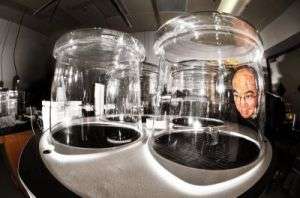
Hy Tran examines a kilogram sample in a mass comparator at Sandia’s Primary Standards Laboratory. Credit: Randy Montoya

The kilogram is losing weight and many international scientists, including some at Sandia National Laboratories, agree that it’s time to redefine it. Scientists are hoping to redefine the kilogram by basing it on standards of universal constants rather than on an artifact standard.

The International Prototype Kilogram (IPK) or “Le Grand K,” made in the 1880s, is a bar of platinum-iridium alloy kept in a vault near Paris.

“The idea is to replace the single master kilogram with something based on physical constants, rather than an artifact that could be damaged accidentally,” says mechanical engineer Hy Tran, a project leader at the Primary Standards Laboratory (PSL) at Sandia.

Of the seven units of measurement in the International System, or SI, the kilogram is the only base still defined by a physical object. In addition, copies of the kilogram have changed over time by either gaining or losing weight as compared to the standard kilogram.

The purpose of redefining the kilogram is based on risk reduction, says Tran.

“In the long term, the redefinition — especially if performed correctly — is beneficial because of risk reduction and because it may enable better measurements in the future,” he says.

By replacing the master kilogram — Le Grand K —with a unit based on physical constants, researchers at multiple laboratories and at national measurement institutes could establish traceability, he says.

Tran says the kilogram will remain the kilogram; it’s only the way it will be defined that will change. He says the earliest the kilogram would be redefined is 2011.

“If and when the redefinition takes place, it will be done in such a fashion as to have minimal or no practical impact with other measured quantities,” Tran says. “In other words, if it is redefined so as to ensure better than 10 parts per billion agreement — rather than 20 parts per billion agreement — then we will see no major changes immediately.”

Based on the current formal definition of the kilogram (the mass of the 1 kilogram prototype) and experimental dissemination to standards labs, the uncertainty (95 percent confidence) in PSL’s kilogram is about 40 parts per billion, compared to the IPK.

One part per billion is about the ratio of the area of a square 3/32 inch on a side, with respect to the area of a regulation NFL football field (including the endzones, or 120 yards by 53-1/3 yards), Tran says.

The target originally proposed by the Bureau International des Poids et Mesures (International Bureau of Weights & Measures) was to get one of the alternative kilogram definitions, such as the experimental measurement of force on the watt balance (or counting atoms on the silicon sphere), and deriving the kilogram, matched to experimental measurements of the prototype kilogram to within 20 parts per billion.

Sandia physicist Harold Parks agrees that the redefinition of the kilogram is inevitable and says there are a couple of issues that need to be resolved before it’s redefined.

“The watt balance method of defining the kilogram makes the most sense for those of us in electrical metrology and so far it is the most accurate,” he says. “But other proposals, such as those based on counting the number of atoms in a silicon crystal, are being considered.”

The watt balance is based on an idea that compares electrical and mechanical power with a high degree of accuracy, he says.

Conflicts between the results of the watt balance and the atom counting experiments will also need to be resolved, Parks says.

“The NIST (National Institute of Standards and Technology) watt balance experiment has achieved the accuracy needed to redefine the kilogram, but the experiment will need to be confirmed by other groups in order for the results to be fully accepted,” he says.

Tran says redefining the kilogram will have little impact on the Primary Standards Lab or the broader nuclear weapons complex. The lab develops and maintains primary standards traceable to national standards and calibrates and certifies customer reference standards.

“It should not affect PSL or the complex if the international metrology community ensures that they fully consider the uncertainties, the necessary experimental apparatus to realize the kilogram, and implementation issues prior to agreeing to the redefinition,” Tran says.

In preparation for the change, PSL staff members are staying up to date in research in metrology and standards practices. Staff also participate in standards activities in order to ensure that any transition would be smooth.

Source: Sandia National Laboratories


print this article email this article download pdf blog this article bookmark this article     Digg this Stumble it share on Facebook share on Reddit add to delicious save to Yahoo! bookmarks
3.8/5 after 15 votes

Rank Filter

Move the slider to adjust rank threshold, so that you can hide some of the comments.


Display comments: newest first

  • zbarlici - Feb 28, 2008
    • Rank: 1 / 5 (1)
    i remember reading an article months ago, which stated that the official kilogram is "losing mass"... is it possible that somehow the Earth`s gravitational force is slowly decreasing? Considerig the traditional gravity model where the mass of the earth is what produces its gravity, could the oil/mineral extraction actually impact the force of gravity by the re-distribution of mass from within the earth to its atmosphere?
  • gopher65 - Feb 29, 2008
    • Rank: not rated yet
    zbarlici: They originally defined the kilogram with a mass, stuck in a vault, kept a constant temperature. Then they made copies, and put them in other vaults. They then made periodic measurements of the various copies and the original. They found that the mass between the copies and the original varied.

    If the gravitational field of the Earth was changing, then all the copies would be going down (and so would everything else, so our measurements would be constant, since the reference masses would go down by the same ratio). And what makes you think that the amount of oil being extracted is significant when measured up against the Earth's total mass? Cause it isn't. The Earth has a mass of something like 6 sextillion tonnes. That's.... enormous is the only word I can think of. If enough mass was moved for gravity to be affected you'd sure as heck notice.

February 28th, 2008 all stories
Physics / General Physics

Comments: 2
Rank: 3.8/5 after 15 votes

  • Stumble this up

  • Digg this

  • Share it:
  • share on Facebook
  • share on MySpace
  • share on Slashdot
  • rss-newsfeed
  • share on Google
  • share on Reddit
  • add to delicious
  • save to Yahoo! bookmarks
  • share on Windows Live
  • Add to Mixx!
Rating: 3.8/5 after 15 votes


Tags


  • Physicists Demonstrate Quantum Memory with Matter Qubits
    Physicists Demonstrate Quantum Memory with Matter Qubits
    Physics / General Physics
    created Jul 03, 2009 | popularity 4.4 / 5 (17) | comments 1
  • 'Holey' Nanosheets for Wastewater Dye Removal
    Nanotechnology / Nanomaterials
    created Jul 01, 2009 | popularity 5 / 5 (5) | comments 1
  • Jellyfish Robot Swims Like its Biological Counterpart
    Jellyfish Robot Swims Like its Biological Counterpart
    Electronics / Robotics
    created Jun 26, 2009 | popularity 4.4 / 5 (8) | comments 1
  • Could Maxwell's Demon Exist in Nanoscale Systems?
    Could Maxwell's Demon Exist in Nanoscale Systems?
    Physics / General Physics
    created Jun 24, 2009 | popularity 4.4 / 5 (18) | comments 29
  • Living Safely with Robots, Beyond Asimov's Laws
    Living Safely with Robots, Beyond Asimov's Laws
    Electronics / Robotics
    created Jun 22, 2009 | popularity 4.6 / 5 (54) | comments 40
  • Other News

    Physical reality of string theory demonstrated

    Physics / General Physics

    created 3 hours ago | popularity 4.7 / 5 (17) | comments 11

    String theory has come under fire in recent years. Promises have been made that have not been lived up to. Leiden (The Netherlands) theoretical physicists have now for the first time used string theory to describe a physical ...


    UQ researchers break the law -- of physics

    UQ researchers break the law -- of physics

    Physics / General Physics

    created 9 hours ago | popularity 4.6 / 5 (14) | comments 4

    (PhysOrg.com) -- Two UQ Science researchers have proved two famous physical laws that have been widely used for the past 25 years do not always work.


    Scientists create first electronic quantum processor

    Scientists create first electronic quantum processor

    Physics / General Physics

    created Jun 28, 2009 | popularity 4.8 / 5 (55) | comments 45

    A team led by Yale University researchers has created the first rudimentary solid-state quantum processor, taking another step toward the ultimate dream of building a quantum computer.


    Science journals

    How to Spot an Influential Paper Based on its Citations

    Physics / General Physics

    created Jul 04, 2009 | popularity 4 / 5 (11) | comments 6

    (PhysOrg.com) -- At first it may seem that the number of citations received by a published scientific paper is directly related to that paper's quality of content. The higher the quality, the more people read ...


    Fermilab's CDF observes Omega-sub-b baryon

    Fermilab's CDF observes Omega-sub-b baryon

    Physics / General Physics

    created Jun 29, 2009 | popularity 4.6 / 5 (19) | comments 7

    (PhysOrg.com) -- At a recent physics seminar at the Department of Energy’s Fermi National Accelerator Laboratory, Fermilab physicist Pat Lukens of the CDF experiment announced the observation of a new particle, ...