Seafloor cores show tight bond between dust and past climates
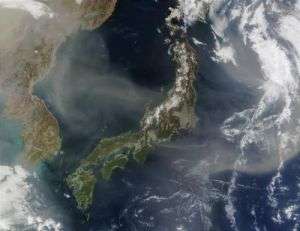
Each year, long-distance winds drop up to 900 million tons of dust from deserts and other parts of the land into the oceans. Scientists suspect this phenomenon connects to global climate—but exactly how, remains a question. Now a big piece of the puzzle has fallen into place, with a study showing that the amount of dust entering the equatorial Pacific peaks sharply during repeated ice ages, then declines when climate warms.
The researchers say it cements the theory that atmospheric moisture, and thus dust, move in close step with temperature on a global scale; the finding may in turn help inform current ideas to seed oceans with iron-rich dust in order to mitigate global warming. The study appears in the Feb. 28 edition of Science Express, the advance online edition of the leading journal Science.
In the past decade, scientists have documented similar dust peaks in polar ice cores, and in sediments from the Atlantic and Indian oceans, but records from Pacific were contradictory. Now that all the records have been shown to coincide, “it suggests that the whole world hydrologic cycle varies in unison, on a pretty rapid time scale,” said Gisela Winckler, a geochemist at Columbia University’s Lamont-Doherty Earth Observatory and lead author of the paper. “It gives us the information from where it matters—where people live, and where the real engine of climate probably lies.” Changes in the atmosphere over the Pacific, and the tropics in general, are thought to affect huge areas of the world.
The researchers studied cores of seafloor sediment representing 500,000 years of deposition, spanning about 6,000 miles of the Pacific equator, from near Papua New Guinea to near Ecuador’s Galápagos Islands—nearly a quarter of the globe’s girth. In each, they found the same thing: at the height of each of five known ice ages, accumulation of the isotope thorium 232, a tracer for land dust, shot up 2.5 times over the level of warmer “interglacial” times. The peaks appear about every 100,000 years, with the last one at 20,000 years ago—culmination of the last glacial age. Through other isotopes, the scientists traced the dust on the western side to Asia, and that on the eastern side to South America. The reasons for the lockstep peaks are probably complex, but in general scientists say that colder air holds less moisture than warmer air, and that cold periods tend to be windier; this means both dustier land, and more dust getting blown away.
The dust probably helped make climate even colder for a while, and this has implications for the current day, said Robert F. Anderson, head of Lamont-Doherty’s geochemistry division and a coauthor. Many types of dust transported at high altitudes tend to reflect sunlight, thus lowering the energy reaching earth, said Anderson. And, when it settles into the ocean, there could be an intriguing further effect. Rich in the plant nutrient iron, the dust could have fertilized near-surface plankton on a massive scale. Like other plants, plankton uses the greenhouse gas carbon dioxide for photosynthesis; thus, theoretically, fertilization could have caused the ocean to take larger amounts of CO2 from the air, and entomb it in the ocean. Lowering of atmospheric CO2 in turn would reduce the air’s capacity to hold heat—the opposite of what is currently happening, as the globe warms due to elevated CO2 levels from burning of fossil fuels and other human activities.
Lately, a growing number of scientists have been advocating research to see if massive, manmade iron fertilization of the oceans might induce such blooms, and thus mitigate warming. A dozen early experiments in different regions have shown that plankton growth increases when iron is artificially added, but scientists have yet to show that this could lock significant amounts of CO2 into the ocean; carbon from the plants would have to sink to the bottom for this to happen. “The new data gives us a natural experiment to see what might have happened in the past,” said Winckler. The researchers’ next step will be to analyze their cores for signs of such sunken carbon during the ice ages; they hope to do this within a year or two.
Anderson and Winckler caution that the idea of iron fertilization remains deeply complex and controversial. “Assessing the past response to natural variability of iron will enable scientists to develop more quantitative predictions about the possible efficacy of adding it ourselves in the future,” said Winckler.
Source: The Earth Institute at Columbia University


