Leading edge vortex allows bats to stay aloft
Honey bees and hummingbirds can hover like helicopters for minutes at a time, sucking the juice from their favorite blossoms while staying aloft in a swirl of vortices.
But the unsteady air flows they create for mid-air suspension – which hold the secrets to tiny robotic flying machines -- have also been observed for the first time in the flight of larger and heavier animals, according to aerodynamicist Geoffrey Spedding of the University of Southern California and his colleagues at Lund University, Sweden.
In a follow-up study of bat aerodynamics, appearing in the February 29, 2008 issue of Science, Spedding and co-authors F. T. Muijres, L.C. Johansson, R. Barfield, M. Wolf and A. Hedenstrom were able to measure the velocity field immediately above the flapping wings of a small, nectar-feeding bat as it fed freely from a feeder in a low-turbulence wind tunnel.
“Thanks to a very reliable behavior pattern where bats learned to feed at a thin, sugar-filled tube in the wind tunnel, using the same flight path to get there every time, and the construction of side flaps on the feeder tube, we could make observations with bright laser flashes right at mid-wing without harming the bats,” Spedding reported in a commentary about the study. “Before this, we had no direct evidence of how the air moved over the wing itself in these small vertebrates.”
The researchers’ findings challenge quasi-steady state aerodynamic theory, which suggests that slow-flying vertebrates should not be able to generate enough lift to stay above ground, said Spedding, a professor of aerospace and mechanical engineering in the USC Viterbi School of Engineering.
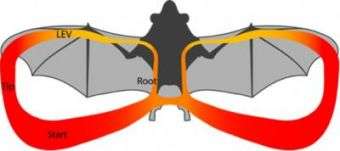
Using digital particle image velocimetry, the researchers discovered that Pallas’ long-tongued bat, Glossophaga soricina, increased its lift by as much as 40 percent using a giant and apparently stable, re-circulating zone, known as a leading-edge vortex (LEV), which completely changed the effective airfoil shape.
“The air flow passing over the LEV of a flapping wing left an amazingly smooth and ordered laminar disturbance at the trailing edge of the wing, and the LEV itself accounted for at least a 40 percent increment in lift,” Spedding noted in his commentary, “Leading Edge Vortex Improves Lift in Slow-Flying Bats.” The LEV makes a strong lift force, but it may be equally important that the smooth flow behind it may be associated with low, or at least not increased, drag.
“The sharp leading edge of the bat wing generates the LEV,” Spedding said, “while the bat’s ability to actively change its wing shape and wing curvatures may contribute to control and stability in the leading-edge vortex.”
Spedding and his colleagues believe observations of LEVs in active, unrestricted bat flight have important implications for overall aerodynamic theory and for the design of miniature robotic flight vehicles, which have been undergoing dramatic modifications in recent years.
“There’s much to be learned from bat flight about unsteady flows and forces on small bodies,” Spedding said. “We have suspected for a while that insects weren’t the only creatures affected by highly unsteady viscous air flows, but now we know that larger animals adapted for slow and hovering flight, such as these nectar-feeding bats, can – and perhaps must – use LEVs to enhance flight performance. So, if we wish to build a highly maneuverable, slow-flying surveillance plane, maybe it should flap its wings like a bat?”
Source: University of Southern California


