Tuatara evolving faster than any other species
February 29, 2008
Tuatara evolving faster than any other species

New DNA research has questioned previous notions about the evolution of the tuatara.

In a study of New Zealand’s “living dinosaur” the tuatara, evolutionary biologist Professor David Lambert and a team from the Allan Wilson Centre for Molecular Ecology and Evolution have recovered DNA (deoxyribonucleic acid) sequences from the bones of ancient tuatara up to 8000 years old.

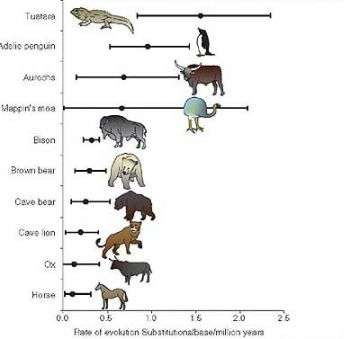
They found that although tuatara, have remained largely physically unchanged over very long periods of evolution, they are evolving - at a DNA level - faster than any other animal yet examined. The research has just been published in the prestigious international journal Trends in Genetics and features on the cover of the issue.

“What we found is that the tuatara has the highest molecular evolutionary rate that anyone has measured,” Professor Lambert says.

The rate of evolution for Adélie penguins, which Professor Lambert and his team have studied in the Antarctic for many years, is slightly slower than that of the tuatara. The tuatara rate is significantly faster than for animals including the cave bear, lion, ox and horse.

“Of course we would have expected that the tuatara, which does everything slowly – they grow slowly, reproduce slowly and have a very slow metabolism – would have evolved slowly. In fact, at the DNA level, they evolve extremely quickly, which supports a hypothesis proposed by the evolutionary biologist Allan Wilson, who suggested that the rate of molecular evolution was uncoupled from the rate of morphological evolution.”

Allan Wilson, who died of leukaemia in 1991, was a pioneer of molecular evolution. His ideas were controversial when introduced 40 years ago, but this new research supports them.

Professor Lambert says the finding will be helpful in terms of future study and conservation of the tuatara, and the team now hopes to extend the work to look at the evolution of other animal species.

“We want to go on and measure the rate of molecular evolution for humans, as well as doing more work with moa and Antarctic fish, to see if rates of DNA change are uncoupled in these species. There are human mummies in the Andes and some very good samples in Siberia where we have some collaborators, so we are hopeful we will be able to measure the rate of human evolution in these too.”

The tuatara, Sphendon punctatus, is found only in New Zealand and is the only surviving member of a distinct reptilian order, Sphehodontia, that lived alongside early dinosaurs and separated from other reptiles 200 million years ago in the Upper Triassic period.

Source: Massey University

4.1 /5 (41 votes)  

Filter


Move the slider to adjust rank threshold, so that you can hide some of the comments.


Display comments: newest first

mabarker
Mar 10, 2008

Rank: 1 / 5 (2)
Are darwinists now saying that DNA can evolve without the animal evolving? This reminds me (zoologist)of a paper in a recent issue of Science by Wong et al. It reveals systematic uncertainty in the way genomes are compared, leading to bias that makes genetic comparisons essentially useless. Antonis Rokas, in the same issue, began his commentary on this problem thus:
"Darwin relied on fossils, morphology, and geographical distribution to glean important clues about the history of life. Today, natural historians can study organisms%u2019 history of change and adaptation by probing the DNA record. Whether to elucidate evolutionary relationships of genes and species or spot the amino acid changes driven by selection, we need to be able to generate accurate alignments of DNA sequences." On page 473 of this issue, Wong et al. provide some important caveats on how this can go awry and how to avoid alignment bias. Is it any wonder Rokas said, "As in any scientific field, molecular evolution has a long tradition of dramatic transformation. The development of a powerful computational and statistical arsenal to account for the uncertainty stemming from sequence alignments is heralding the first paradigm shift in the era of genome-scale analysis."
Rank 4.1 /5 (41 votes)
Tags

Related Stories
Relevant PhysicsForums posts

More news stories

The power of estrogen -- male snakes attract other males

A new study has shown that boosting the estrogen levels of male garter snakes causes them to secrete the same pheromones that females use to attract suitors, and turned the males into just about the sexiest ...

Biology / Plants & Animals

created 14 hours ago | popularity 4.8 / 5 (6) | comments 1 | with audio podcast

Grass to gas: Researchers' genome map speeds biofuel development

Researchers at the University of Georgia have taken a major step in the ongoing effort to find sources of cleaner, renewable energy by mapping the genomes of two originator cells of Miscanthus x giganteus, a large perenn ...

Biology / Biotechnology

created 11 hours ago | popularity 3.8 / 5 (5) | comments 0 | with audio podcast

Experts reveal how plants don't get sunburn

(PhysOrg.com) -- Experts at the University of Glasgow have discovered how plants survive the harmful rays of the sun.

Biology / Cell & Microbiology

created 14 hours ago | popularity 4.8 / 5 (5) | comments 0 | with audio podcast

Miami battling invasion of giant African snails

No one knows how they got there. But an invasion of African giant snails has southern Florida in a panic over potential crop damage, disease and general yuckiness surrounding the slimy gastropods.

Biology / Ecology

created 18 hours ago | popularity 4 / 5 (1) | comments 4

Protein libraries in a snap

(PhysOrg.com) -- A Rice University undergraduate will depart with not only a degree but also a possible patent for his invention of an efficient way to create protein libraries, an important component of biomolecular ...

Biology / Cell & Microbiology

created 17 hours ago | popularity 4.8 / 5 (4) | comments 0 | with audio podcast


Google users warned of threat to smartphone wallets

Users of Google smartphone wallets were being warned on Friday that there is a way to crack pass codes intended to thwart thieves from going on illicit shopping sprees.

Anonymous knocks CIA website offline (Update)

The website of the Central Intelligence Agency was inaccessible on Friday after the hacker group Anonymous claimed to have knocked it offline.

New error-correcting codes guarantee the fastest possible rate of data transmission

Error-correcting codes are one of the triumphs of the digital age. They’re a way of encoding information so that it can be transmitted across a communication channel — such as an optical fiber o ...

Complex wiring of the nervous system may rely on a just a handful of genes and proteins

Researchers at the Salk Institute have discovered a startling feature of early brain development that helps to explain how complex neuron wiring patterns are programmed using just a handful of critical genes. ...

Humans may have helped the decline of African rainforests 3000 years ago

(PhysOrg.com) -- Large areas of rainforests in Central Africa mysteriously disappeared over three thousand years ago, to be replaced by savannas. The prevailing theory has been that the cause was a change ...

New power source discovered

(PhysOrg.com) -- Researchers at the Massachusetts Institute of Technology (MIT) and RMIT University have made a breakthrough in energy storage and power generation.