ATLAS completes world's largest jigsaw puzzle
February 29, 2008
ATLAS detector
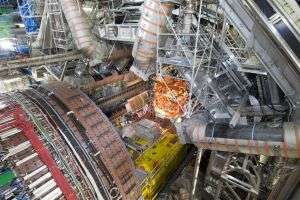
Today the ATLAS collaboration at CERN celebrates the lowering of its last large detector element. The ATLAS detector is the world’s largest general-purpose particle detector, measuring 46 metres long, 25 metres high and 25 metres wide; it weighs 7000 tonnes and consists of 100 million sensors that measure particles produced in proton-proton collisions in CERN’s Large Hadron Collider (LHC).
The first piece of ATLAS was installed in 2003 and since then many detector elements have journeyed down the 100 metre shaft into the ATLAS underground cavern. This last piece completes this gigantic puzzle.
“This is an exciting day for us,” said Marzio Nessi, ATLAS technical coordinator. “The installation process is coming to its conclusion and we are gearing up to start a new programme of physics research.”
Known as the small wheel, this is the final element to complete the ATLAS muon spectrometer, and will be journeying 100 metres into its underground experimental cavern. There are two ATLAS small wheels; though small in comparison to the rest of the ATLAS detector, they are each 9.3 metres in diameter and weigh 100 tonnes including massive shielding elements. They are covered with sensitive detectors to identify and measure the momentum of particles that will be created in the LHC collisions. The entire muon spectrometer system contains an area equal to three football fields, including 1.2 million independent electronic channels. As particles pass through a magnetic field produced by superconducting magnets, this detector has the ability to accurately track them to the width of a human hair.
“These fragile detectors comprise the largest measuring device ever constructed for high energy physics,” said George Mikenberg, ATLAS muon project leader.
“One of the major challenges is lowering the small wheel in a slow motion zigzag down the shaft,” explained Ariella Cattai, leader of the small wheel team, “and performing precision alignment of the detector within a millimetre of the other detectors already in the cavern.”
Comprising 450 physicists from 48 institutions, the ATLAS muon spectrometer group includes members from China, France, Germany, Greece, Israel, Italy, Japan, Netherlands, Russia and the United States of America. For them, this event marks the end of more than a decade of development, planning and construction of the muon spectrometer system. The shielding elements of the small wheels have been constructed in Armenia and Serbia.
The ATLAS collaboration will focus now on commissioning work in preparation for the start-up of the LHC this summer. Experiments at the LHC will allow physicists to take a big leap on a journey that started with Newton's description of gravity. Gravity is ubiquitous since it acts on mass, but so far science is unable to explain why particles have the masses they have.
Experiments such as ATLAS may provide the answer. LHC experiments will also probe the mysterious dark matter and energy of the Universe, they will investigate the reason for nature's preference for matter over antimatter, probe matter as it existed close to the beginning of time and look for extra dimensions of spacetime.
Source: CERN
-
Hints fade of elusive physics 'God particle'
Aug 22, 2011 |
5 / 5 (5) |
31
-
A hint of Higgs: An update from the LHC
Aug 16, 2011 |
4.6 / 5 (36) |
57
-
Large Hadron Collider powers up to unravel mysteries of nature
Feb 24, 2011 |
4.7 / 5 (13) |
18
-
The Year of the Higgs?
Feb 21, 2011 |
4.2 / 5 (13) |
83
-
Hunt for dark matter closes in at Large Hadron Collider
Jan 26, 2011 |
4.6 / 5 (36) |
216
-
Engineers build first sub-10-nm carbon nanotube transistor
Feb 01, 2012 |
4.9 / 5 (31) |
30
-
Something old, something new: Evolution and the structural divergence of duplicate genes
Jan 31, 2012 |
4.6 / 5 (7) |
1
-
The hidden nanoworld of ice crystals: Revealing the dynamic behavior of quasi-liquid layers
Jan 30, 2012 |
5 / 5 (3) |
1
-
Stock market network reveals investor clustering
Jan 27, 2012 |
3.9 / 5 (23) |
8
-
Of microchemistry and molecules: Electronic microfluidic device synthesizes biocompatible probes
Jan 26, 2012 |
5 / 5 (1) |
0
-
What would happen when a jet travelling at Mach 10 experiences engine failure
1 hour ago
-
Rust from my microwave ruined a nice bowl of soup and also my day
3 hours ago
-
gas leaks in space
7 hours ago
-
Weight required to balance a boom stand?
8 hours ago
-
Questions about Equivalence principle & Einstein Elevator?
10 hours ago
-
Kinetic energy of gas
11 hours ago
- More from Physics Forums - General Physics
More news stories
Explained: Sigma
It's a question that arises with virtually every major new finding in science or medicine: What makes a result reliable enough to be taken seriously? The answer has to do with statistical significance -- but ...
Feb 09, 2012 |
5 / 5 (19) |
76
Quantum physicist explains $100K offer for proof scaled-up quantum computing is impossible
(PhysOrg.com) -- MIT researcher Scott Aaronson has certainly riled the physics community with his offer this past Friday, of $100,000 to anyone who can prove that scaled-up quantum computing is impossible. ...
Diamond light, brighter than the sun
Its the size of five football pitches and generates light 10 billion times brighter than the sun. As the Diamond Light Source celebrates its tenth anniversary this year, Penny Bailey visits one of the ...
Feb 07, 2012 |
4.3 / 5 (7) |
18
|
Physicists 'record' magnetic breakthrough
An international team of scientists has demonstrated a revolutionary new way of magnetic recording which will allow information to be processed hundreds of times faster than by current hard drive technology.
Feb 07, 2012 |
4.5 / 5 (41) |
14
|
Hints of the Higgs - papers are submitted
Back in December 2011, the ATLAS and CMS experiments at CERN presented some exciting results that provided tantalising hints of the Higgs boson.
Feb 08, 2012 |
4.1 / 5 (7) |
10
Google might launch Drive for cloud storage soon
(PhysOrg.com) -- Google's next big move, according to the Wall Street Journal, is a cloud storage service called Drive. Hardly first to the plate, Google is simply catching up to introducing its cloud reposi ...
Latin America mining boom clashes with conservation
Latin America is experiencing a mining boom as prices rise fuelled by a hike in global demand, but the region is also being hit by a wave of violent protests, strikes and rallies by environmentalists.
Love a click away in Indonesia's Twitter Republic
He was a geeky kid from Yogyakarta, she a glamorous city girl in Jakarta. In a country with one of the world's most vibrant social networking scenes they fell in love on Twitter.
Europeans protest controversial Internet pact
Tens of thousands of people marched in protests in more than a dozen European cities Saturday against a controversial anti-online piracy pact that critics say could curtail Internet freedom.
Walney offshore wind farm is world's biggest (for now)
(PhysOrg.com) -- The Walney wind farm on the Irish Sea--characterized by high tides, waves and windy weather--officially opened this week. The farm is treated in the press as a very big deal as the Walney ...
Navy to begin tests on electromagnetic railgun prototype launcher
The Office of Naval Research (ONR)'s Electromagnetic (EM) Railgun program will take an important step forward in the coming weeks when the first industry railgun prototype launcher is tested at a facility ...
Feb 29, 2008
Rank: not rated yet
I do have this feeling that it has turned into a runaway gravy train like the fusion projects.
Of course proving a theory wrong is very powerful. However building a big expensive machine only to watch a blank screen output feels wrong.
Feb 29, 2008
Rank: 1.3 / 5 (3)
I hardly believe they're "wrong" but they're "X" amount right and "Y" amount wrong. The problem is when they're wrong they're slow to or NEVER admit it. And bogus, incomprehensible theories continue to exist (gravity powered nuke fusion = sun). Lies. Lies. Lies. Gravity is a consequence, not a driving force.
Please mark 1 out of 5.
Mar 01, 2008
Rank: 5 / 5 (1)