Technology uses live cells to detect food-borne pathogens, toxins
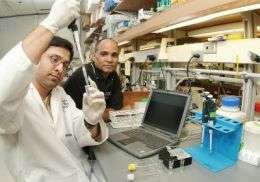
Researchers have developed a new technology that can simultaneously screen thousands of samples of food or water for several dangerous food-borne pathogens in one to two hours.
The technique, which has potential biosecurity and food safety applications, also can estimate the amount of microbes present and whether they pose an active health risk. This could help neutralize potential threats and improve food processing techniques, said Arun Bhunia, a professor of food science at Purdue University.
"For food safety and biosecurity purposes, you need a quick test - a first line of defense - to be able to tell if there is something pathogenic in the food or water," Bhunia said.
The technology utilizes live mammalian cells that release a measurable amount of a signaling chemical when harmed. Optical equipment and computer software can then analyze this quantity to estimate the amount of harmful microbes present, Bhunia said.
"This is very important," he said. "With many toxins or pathogens, there is an effective dose or threshold you must pass before you have to worry. By providing information on quantity, this technology gives you a higher degree of confidence in the test and what steps must be taken to alleviate the problem."
The technology can recognize very small amounts of Listeria monocytogenes, a bacterium that kills one in five infected and is the leading cause of food-borne illness. It also recognizes several species of Bacillus, a non-fatal but common cause of food-poisoning, said Pratik Banerjee, a Purdue researcher and first author of a study detailing the technology that is published in the February issue of the journal Laboratory Investigation.
The cells are suspended in collagen gel, a useful substance for capturing particles of a desired size, and put into small wells within multi-well plates. Each well can test one sample, so tests can be expanded to quickly analyze as many samples as desired.
By using live cells, called biosensors, this technology can identify actively harmful pathogens but ignore those that are inactive, or harmless. Some analogous tests lack this capability, making them prone to false alarms and entailing a relatively lengthy incubation period to grow out any living microbes, Banerjee said. The new technology's discerning power also could help optimize processes to kill harmful microbes or deactivate toxins, he said.
Another advantage to the technique is its mobility and versatility, Bhunia said. The multi-well plates and their contents of gel-suspended mammalian cells could be efficiently prepared in a central location. When desired, the plates could then be shipped to the test location, like a food processing plant, so that analysis could take place on-site, he said.
This technology tests for bacteria and toxins that attack cell membranes. For this reason, researchers employed cells with high amounts of alkaline phosphatase, the signaling chemical released upon damage to the cell membrane. Researchers could conceivably employ other types of cells within this framework to detect additional types of pathogens, Bhunia said.
Samples of food and water are added to biosensor wells before being incubated for one to two hours. To each well a chemical is added that reacts with the biosensor's alkaline phosphatase, yielding a yellow product quantified by a special camera and a computer. A precise calculation may be unnecessary sometimes, however.
"When a large amount of pathogen is present, you can literally see the color change taking place before your eyes," Banerjee said.
The suspension of live mammalian cells within a collagen gel is unique, according to the researchers.
"This is the first time that anybody has trapped these kinds of cells alive in a collagen framework," Bhunia said.
Researchers are trying to get these cells to live within the gel beyond four to six days, a current limitation. But Bhunia said this time-span could be expanded to two weeks, the shelf-life he deems necessary for the technique to have commercial value.
The study was funded by the U.S. Department of Agriculture and Purdue's Center for Food Safety Engineering.
"This paper outlines two key accomplishments: one, we found a way to immobilize cells, which is a necessary and difficult prerequisite for further study. Two, we are able to simultaneously perform multiple tests on a large number of samples," Bhunia said.
Source: Purdue University


