Saturn dominates during March, while Jupiter moves onto the stage
February 29th, 2008 Saturn

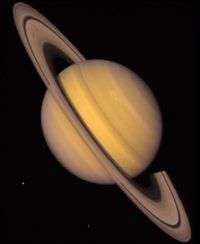
Saturn. Photo by: NASA

Saturn will be easily visible almost all night during March, glowing bright yellow among the stars of the constellation Leo the Lion. Saturn will outshine Leo's brightest star, Regulus, nearby to the right (west) of the planet. By month's end, Saturn and Regulus will appear high in the southeast as the evening sky darkens.

Saturn has at least 60 moons, and the largest one, the planet-sized Titan, can be seen with any telescope. Titan will be due north of Saturn on March 9 and 25, and due south of the planet on March 1 and 17.

See http://saturn.jpl.nasa.gov/home/index.cfm for the latest news and images from the Cassini spacecraft orbiting Saturn.

As Saturn drops toward the western horizon each night, Jupiter will be climbing upward in the southeast. The brilliant white planet will rise around 4 a.m. local time at the beginning of the month and about 90 minutes earlier by month's end. It will dominate the stars of the constellation Sagittarius the Archer.

Venus and Mercury will be very close in morning twilight in early March, but you'll need a clear view of the east-southeastern horizon to see them. The pair of planets will rise an hour before the sun. Venus will be easy to see in the brightening sky, but you may need binoculars to find much fainter Mercury slightly to the upper right (south). The two will remain close throughout March, with Mercury passing south of Venus on March 23.

Mars will be nearly overhead as soon as the evening sky darkens. On March 1, the bright orange planet will be directly north of the bright orange star Betelgeuse, which marks one shoulder of the constellation Orion the Hunter. Mars will dim slightly during March as it falls farther behind Earth in its larger orbit.

Zodiacal light

If you live in an area that is dark enough for you to see the Milky Way sprawling across the night sky, you also have a chance of seeing the interplanetary dust in the plane of our solar system. Find an open area away from light pollution. After sunset as darkness falls, look for a faint pyramid of light in the west spreading upward over a large area of the sky. Near its base at the horizon it can be as broad as two hand-widths. This triangle of light is the zodiacal light, which is sunlight reflected from interplanetary dust particles that orbit the sun in the same plane as the planets -- the ecliptic. At this time of year in the northern hemisphere, the ecliptic plane extends upright from the western horizon. (In the southern hemisphere, watch the eastern horizon before dawn after new moon.) The zodiacal light is masked by either moonlight or light pollution.

Equinox

The sun will cross the celestial equator (an extension of Earth's equator onto the sky) on March 20 at 1:48 a.m. EDT (5:48 Universal Time) heading north. This will be the earliest that the March equinox has happened since 1896. It marks the start of spring in the Northern Hemisphere and fall in the Southern Hemisphere. For the next six months in the Northern Hemisphere, the days will be longer than the nights.

Day and night are not precisely the same length at the time of the equinox. That happens on different dates for different latitudes. At higher latitudes in the Northern Hemisphere, the date of equal day and night occurs before the March equinox. In the Southern Hemisphere, this happens after the March equinox. Information about the exact time of the equinox at different places on Earth's surface is provided by the U.S. Naval Observatory at http://aa.usno.navy.mil/faq/docs/equinoxes.php.

Moon phases

The moon will be new on March 7, at first quarter on March 14, full on March 21 and at third quarter on March 29.

Source: Indiana University


print this article email this article download pdf blog this article bookmark this article     Digg this Stumble it share on Facebook share on Reddit add to delicious save to Yahoo! bookmarks
5/5 after 3 votes


February 29th, 2008 all stories
Space & Earth / Space Exploration

Comments: 0
Rank: 5/5 after 3 votes

  • Stumble this up

  • Digg this

  • Share it:
  • share on Facebook
  • share on MySpace
  • share on Slashdot
  • rss-newsfeed
  • share on Google
  • share on Reddit
  • add to delicious
  • save to Yahoo! bookmarks
  • share on Windows Live
  • Add to Mixx!
Rating: 5/5 after 3 votes

  • Related Stories

  • Venus Disappears during Meteor Shower
    created Apr 17, 2009 | popularity not rated yet | comments 0
  • Clemson astronomers to study mysterious antimatter in the Milky Way
    created Feb 16, 2009 | popularity not rated yet | comments 0
  • December: Ursid meteor shower out-performs the Geminids
    created Dec 01, 2008 | popularity not rated yet | comments 0
  • Early warning of dangerous asteroids and comets
    created Nov 18, 2008 | popularity not rated yet | comments 0
  • Star Count Goes Global
    created Oct 15, 2008 | popularity not rated yet | comments 0

Tags


  • Physicists Demonstrate Quantum Memory with Matter Qubits
    Physicists Demonstrate Quantum Memory with Matter Qubits
    Physics / General Physics
    created Jul 03, 2009 | popularity 4.4 / 5 (17) | comments 1
  • 'Holey' Nanosheets for Wastewater Dye Removal
    Nanotechnology / Nanomaterials
    created Jul 01, 2009 | popularity 5 / 5 (5) | comments 1
  • Jellyfish Robot Swims Like its Biological Counterpart
    Jellyfish Robot Swims Like its Biological Counterpart
    Electronics / Robotics
    created Jun 26, 2009 | popularity 4.4 / 5 (8) | comments 1
  • Could Maxwell's Demon Exist in Nanoscale Systems?
    Could Maxwell's Demon Exist in Nanoscale Systems?
    Physics / General Physics
    created Jun 24, 2009 | popularity 4.4 / 5 (18) | comments 29
  • Living Safely with Robots, Beyond Asimov's Laws
    Living Safely with Robots, Beyond Asimov's Laws
    Electronics / Robotics
    created Jun 22, 2009 | popularity 4.6 / 5 (52) | comments 40
  • Other News

    Forty years ago man first walked on the moon

    Space & Earth / Space Exploration

    created 6 hours ago | popularity 5 / 5 (2) | comments 0

    Forty years ago on July 20, 1969, American astronaut Neil Armstrong realized the oldest dream of human civilizations when he became the first man to walk on the moon.


    The least sea ice in 800 years

    The least sea ice in 800 years

    Space & Earth / Earth Sciences

    created Jul 01, 2009 | popularity 4.3 / 5 (59) | comments 52

    New research, which reconstructs the extent of ice in the sea between Greenland and Svalbard from the 13th century to the present indicates that there has never been so little sea ice as there is now. The ...


    Gas around young galaxy

    Intense heat killed the Universe's would-be galaxies, researchers say

    Space & Earth / Astronomy

    created Jul 01, 2009 | popularity 3.2 / 5 (19) | comments 25

    (PhysOrg.com) -- Our Milky Way galaxy only survived because it was already immersed in a large clump of dark matter which trapped gases inside it, scientists led by Durham University's Institute for Computational ...


    Scientists' Drill Hits Magma: Only Third Time on Record

    Scientists' Drill Hits Magma: Only Third Time on Record

    Space & Earth / Earth Sciences

    created Jun 29, 2009 | popularity 4.7 / 5 (20) | comments 19

    (PhysOrg.com) -- Scientists drilling a borehole deep into Iceland’s rocky crust to explore new methods of using geothermal energy hit a major roadblock on Thursday: Their drill ran into molten rock at a depth ...


    NASA manager pitches a cheaper return-to-moon plan

    Space & Earth / Space Exploration

    created Jun 30, 2009 | popularity 4 / 5 (7) | comments 18

    (AP) -- Like a car salesman pushing a luxury vehicle that the customer no longer can afford, NASA has pulled out of its back pocket a deal for a cheaper ride to the moon.