SSRL Beamline 13 Achieves First Light
February 29, 2008
SSRL Beamline 13 Achieves First Light

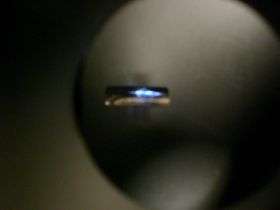
Light shines into Beamline 13.

On February 14, the first light shone into the Stanford Synchrotron Radiation Laboratory's newest beamline. Beamline 13, which has been under construction for the past two years, will allow new types of soft X-ray material science studies at SSRL.

"Beamline 13 is especially exciting because it has an elliptical polarizing undulator," said Beamline Development Engineer Michael Rowen, who has been working on this project for nearly five years. "With this new tool we can learn more about the magnetic properties of materials and the nature and orientation of chemical bonds."

When finished, the Department of Energy-funded beamline will be configured with three experimental stations: Beamline 13-1 for scanning transmission X-ray microscopy, which will allow the study of condensed matter and surface science and magnetism at the nanometer scale; Beamline 13-2 for photoemission and X-ray absorption spectroscopy, which shows the angles and lengths of bonds both inside materials and at their surfaces; and Beamline 13-3 for resonant coherent scattering and diffraction imaging experiments, which can reveal structure at the nanometer scale.

Commissioning experiments on Beamline 13-2 and Beamline 13-3 are expected to begin later this spring, with commissioning on Beamline 13-1 in the fall of 2008. User experiments on these new experimental stations will commence during the 2009 user run.

Source: SLAC, by Kelen Tuttle

3.6 /5 (5 votes)  

Rank 3.6 /5 (5 votes)
Tags

Relevant PhysicsForums posts
  • Can Plasma Be Solid
    created2 hours ago
  • What is delta Δ ?
    created3 hours ago
  • Need some help understanding HertzĀ–Knudsen formula
    created3 hours ago
  • Anatomy of Fat man: implosion-critical bomb
    created5 hours ago
  • what makes two sounds similar???
    created6 hours ago
  • What would happen when a jet travelling at Mach 10 experiences engine failure
    created12 hours ago
  • More from Physics Forums - General Physics

More news stories

Explained: Sigma

It's a question that arises with virtually every major new finding in science or medicine: What makes a result reliable enough to be taken seriously? The answer has to do with statistical significance -- but ...

Physics / General Physics

created Feb 09, 2012 | popularity 5 / 5 (20) | comments 76

Quantum physicist explains $100K offer for proof scaled-up quantum computing is impossible

(PhysOrg.com) -- MIT researcher Scott Aaronson has certainly riled the physics community with his offer this past Friday, of $100,000 to anyone who can prove that scaled-up quantum computing is impossible. ...

Physics / Quantum Physics

created Feb 08, 2012 | popularity 4.3 / 5 (15) | comments 37 | with audio podcast weblog

Diamond light, brighter than the sun

It’s the size of five football pitches and generates light 10 billion times brighter than the sun. As the Diamond Light Source celebrates its tenth anniversary this year, Penny Bailey visits one of the ...

Physics / General Physics

created Feb 07, 2012 | popularity 4.1 / 5 (10) | comments 18 | with audio podcast

Physicists 'record' magnetic breakthrough

An international team of scientists has demonstrated a revolutionary new way of magnetic recording which will allow information to be processed hundreds of times faster than by current hard drive technology.

Physics / General Physics

created Feb 07, 2012 | popularity 4.6 / 5 (43) | comments 15 | with audio podcast

Hints of the Higgs - papers are submitted

Back in December 2011, the ATLAS and CMS experiments at CERN presented some exciting results that provided tantalising hints of the Higgs boson.

Physics / General Physics

created Feb 08, 2012 | popularity 4.3 / 5 (8) | comments 10


Scientists discover molecular secrets of 2,000-year-old Chinese herbal remedy

For roughly two thousand years, Chinese herbalists have treated Malaria using a root extract, commonly known as Chang Shan, from a type of hydrangea that grows in Tibet and Nepal. More recent studies suggest that halofuginone, ...

New method to examine batteries -- MRI from the inside

There is an ever-increasing need for advanced batteries for portable electronics, such as phones, cameras, and music players, but also to power electric vehicles and to facilitate the distribution and storage of energy derived ...

A mitosis mystery solved: How chromosomes align perfectly in a dividing cell

Although the process of mitotic cell division has been studied intensely for more than 50 years, Whitehead Institute researchers have only now solved the mystery of how cells correctly align their chromosomes during symmetric ...

Google might launch Drive for cloud storage soon

(PhysOrg.com) -- Google's next big move, according to the Wall Street Journal, is a cloud storage service called Drive. Hardly first to the plate, Google is simply catching up to introducing its cloud reposi ...

Lab study raises questions over nano-particle impact

Tests involving chickens have raised questions about the impact on health from engineered nano-particles, the ultra-fine grains commonly used in drugs and processed foods, scientists said on Sunday.

Overeating may double risk of memory loss

New research suggests that consuming between 2,100 and 6,000 calories per day may double the risk of memory loss, or mild cognitive impairment (MCI), among people age 70 and older. The study was released today and will be ...