Killer freeze of '07 illustrates paradoxes of warming climate
March 3, 2008 Killer freeze of '07 illustrates paradoxes of warming climate

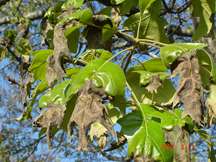
Oak leaves show damage from the "Easter freeze" of 2007. Some tree species were more affected by the freeze than others.

Widespread damage to plants from a sudden freeze that occurred across the Eastern United States from 5 April to 9 April 2007 was made worse because it had been preceded by two weeks of unusual warmth, according to an analysis published in the March 2008 issue of BioScience.

A destructive spring freeze that chilled the eastern United States almost a year ago illustrates the threat a warming climate poses to plants and crops, according to a paper just published in the journal BioScience. The study was led by a team from the Department of Energy's Oak Ridge National Laboratory.

The "Easter freeze" of April 5-9, 2007, blew in on an ill wind. Plants had been sending out young and tender sprouts two to three weeks earlier than normal during an unusually warm March. Plant ecologists, as well as farmers and gardeners, took note of the particularly harsh turn of the weather in early April.

"The warm weather was as much a culprit for the damage as the cold," said lead author Lianhong Gu of ORNL's Environmental Sciences Division.

"We see the paradox in that mild winters and warm, early springs make the plants particularly vulnerable to late-season frosts," Gu said. Gu's team observed satellite images and field data to establish the extent of the 2007 spring freeze. They also assessed the long-term and short-term effects on the terrestrial carbon cycle with respect to plant activity in normal years. Short-term effects were "profound," Gu said.

"In the period just after the freeze we saw a large reduction in the fraction of absorbed photosynthetically active radiation, which is a sensitive indicator of plant growth," he said. "We also noted that the regrowth in the following weeks and months did not result in the levels of plant development in previous years."

Gu's team hypothesized that the freeze could have long-term effects on forest carbon uptake because of damage the cold did to the prematurely developed plant tissues, which could affect future growing seasons. The associated carbon and nutrient losses may affect growth in future years.

Beyond devastated horticultural crops, the study noted that some species suffered more than others. Yellow poplar trees were "surprisingly" slow to put out flushes of new leaves, and white oaks were particularly hard hit with freeze damage to both new leaves and flowers. On the other hand, trees located along shorelines--where the water stores heat--and underneath dense canopies seemed to be protected from the cold.

Compounding the stress on plants, as noted in the International Panel on Climate Change's fourth assessment report, is the prospect of prolonged droughts, which also occurred in the region last summer.

"This freeze should not be viewed as an isolated event; rather, it represents a realistic climate change scenario that has long concerned plant ecologists," Gu said.

Authors on the paper include Gu, Paul Hanson, Dale Kaiser, Mac Post and Bai Yang of ORNL; Ramakrishna Nemani of NASA's Ames Research Center; Stephen G. Pallardy of the University of Missouri at Columbia, and Tilden Meyers of the National Oceanic and Atmospheric Administration's Air Resources Laboratory in Oak Ridge. The DOE Office of Science's Biological and Environmental Research program funded the studies.

Source: ORNL


print this article email this article download pdf blog this article bookmark this article     Stumble it Digg this share on Facebook retweet share on Reddit add to delicious
Rate this story - 3 /5 (2 votes)

Rank Filter

Move the slider to adjust rank threshold, so that you can hide some of the comments.


Display comments: newest first

  • bigwheel - Mar 03, 2008
    • Rank: not rated yet
    I knew these global warming idiots would find a way to blame
    cold weather on warm weather, makes perfect sense. Somebody
    please neuter them before they breed.
  • DrPhysics - Mar 04, 2008
    • Rank: not rated yet
    They use o be aptly called 'ecochondriacs'. As they read more of their own press clippings, they will evolve into eco-fascists.

March 3, 2008 all stories

Comments: 2

3 /5 (2 votes)
  • Stumble this up

  • Digg this

  • share this

  • hide
  • Related Stories

  • Plants Save the Earth from an Icy Doom (w/ Podcast)
    created Jul 01, 2009 | popularity not rated yet | comments 0
  • 53 million-year-old high Arctic mammals wintered in darkness
    created Jun 01, 2009 | popularity not rated yet | comments 0
  • US scientists plan greenhouses on the Moon
    created Apr 15, 2009 | popularity not rated yet | comments 0
  • Researchers identify a process that regulates seed germination
    created Mar 11, 2009 | popularity not rated yet | comments 0
  • Climate change enhances grassland productivity
    created Jan 26, 2009 | popularity not rated yet | comments 0


  • hide
  • Relevant PhysicsForums posts

  • cycles
    created Nov 08, 2009
  • The Origin of the term 'fossil' fuels
    created Nov 05, 2009
  • co2
    created Nov 03, 2009
  • Early Earths Sulfidic Ocean Conditions
    created Oct 30, 2009
  • More from Physics Forums - Earth

Other News

Earth

Atomic Particles Help Solve Planetary Puzzle

Space & Earth / Earth Sciences

created 4 hours ago | popularity 4.6 / 5 (5) | comments 0

(PhysOrg.com) -- A University of Arkansas professor and his colleagues have shown that the Earth's mantle contains the same isotopic signatures from magnesium as meteorites do, suggesting that the planet formed ...


Controversial new climate change results

Controversial new climate change results

Space & Earth / Environment

created 14 hours ago | popularity 4.4 / 5 (14) | comments 19

(PhysOrg.com) -- New data show that the balance between the airborne and the absorbed fraction of CO2 has stayed approximately constant since 1850, despite emissions of CO2 having risen from about 2 billion ...


The Stars My Destination

The Stars My Destination

Space & Earth / Space Exploration

created 5 hours ago | popularity 5 / 5 (7) | comments 0

The Voyager spacecraft are now in the outermost layer of the heliosphere, traveling toward interstellar space - the first man-made spacecraft to travel such a vast distance from Earth.


Cave study links climate change to California droughts

Space & Earth / Earth Sciences

created 7 hours ago | popularity 3 / 5 (2) | comments 0

California experienced centuries-long droughts in the past 20,000 years that coincided with the thawing of ice caps in the Arctic, according to a new study by UC Davis doctoral student Jessica Oster and geology professor ...


Scientists prepare the Mini-Research Module 2 (MRM 2) "Poisk"

Rocket with new module for space station blasts off

Space & Earth / Space Exploration

created 8 hours ago | popularity 5 / 5 (1) | comments 0

A Soyuz rocket carrying a new Russian-made module for the International Space Station blasted off on Tuesday from the Baikonur space base in Kazakhstan, television pictures showed.