From 2-D pictures to 3 dimensions
March 3, 2008
From 2-D pictures to 3 dimensions

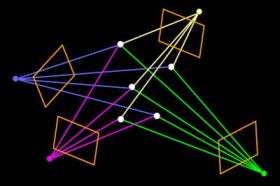
Your pictures of the Grand Canyon, Times Square or other destinations may be pretty good, but wouldn't it be nice to show them off in three dimensions? An award-winning 3-D reconstruction algorithm designed by a team of computer science researchers from UC-San Diego brings this dream within the grasp of reality. Credit: Manmohan Chandraker / UC San Diego

Your pictures of the Grand Canyon, Times Square or other destinations may be pretty good, but wouldn’t it be nice to show them off in three dimensions?

An award-winning 3D reconstruction algorithm designed by a team of computer science researchers from UC San Diego brings this dream within the grasp of reality.

This research gets at the heart of “autocalibration,” a well-studied, fundamental problem in computer vision. Autocalibration aims to recover the three dimensional structure of a scene using only its images, acquired from cameras whose internal settings and spatial orientations are unknown.

Autocalibraton is part of a larger 3D image reconstruction challenge that has caught the attention of Google, Microsoft and others.

Manmohan Chandraker, a fifth-year PhD student in the Department of Computer Science and Engineering at UCSD’s Jacobs School of Engineering led the work. He, Sameer Agarwal – a computer science UCSD alumnus now at the University of Washington, and their respective Ph.D. advisors, David Kriegman and Serge Belongie presented their research at the International Conference on Computer Vision (ICCV), held in Rio de Janeiro, Brazil in October 2007. ICCV is the premier conference in the field of computer vision. For this work, Chandraker took home one of three honorable mentions for ICCV’s prestigious David Marr prize.

This technology could be put to use in a wide variety of applications. For example, someone selling shoes online could take pictures of their shoes and create 3D reconstructions of their inventory. Such reconstructions would provide more information about what the shoes actually look like than images or video footage can.

The algorithm could also be used to automatically align security camera networks used in casinos and airports. Coupled with existing technology for immersive media, the algorithm could be used to create augmented-reality walkthroughs of cities, supermarkets or any other places of interest.

In the ICCV paper, the UCSD computer scientists propose the first practically scalable algorithm for 3D reconstruction which provides “a theoretical certificate of optimality.” In other words, the technique computes the best possible 3D reconstruction obtainable from the input data and does not slow down drastically for a large number of photographs.

“Our algorithm is guaranteed to provide the best 3D reconstruction,” said Chandraker. “It is very much a practical algorithm. In fact, the significance of the paper lies in our approaches for designing a theoretically correct algorithm that also works well in practice. Our approach utilizes modern convex optimization techniques to globally minimize the involved cost functions in a branch and bound framework,” explained Chandraker.

The paper, titled “Globally Optimal Affine and Metric Upgrades in Stratified Autocalibration” is available at http://vision.ucsd … /iccv07a.pdf . MATLAB prototype code for the implementation will be available online when it is ready.

Source: University of California - San Diego

4.4 /5 (20 votes)  

Rank 4.4 /5 (20 votes)
Tags

Relevant PhysicsForums posts

More news stories

Google might launch Drive for cloud storage soon

(PhysOrg.com) -- Google's next big move, according to the Wall Street Journal, is a cloud storage service called Drive. Hardly first to the plate, Google is simply catching up to introducing its cloud reposi ...

Technology / Internet

created 15 hours ago | popularity 4.8 / 5 (5) | comments 5 | with audio podcast report

Iran blocks email, restricts net access: reports

Iran has further restricted access to the Internet and blocked popular email services for the past few days, in a move a top lawmaker said could "cost the regime dearly," media reports said on Sunday.

Technology / Internet

created 8 hours ago | popularity 5 / 5 (2) | comments 5

Love a click away in Indonesia's Twitter Republic

He was a geeky kid from Yogyakarta, she a glamorous city girl in Jakarta. In a country with one of the world's most vibrant social networking scenes they fell in love on Twitter.

Technology / Internet

created 16 hours ago | popularity 4 / 5 (1) | comments 0

Walney offshore wind farm is world's biggest (for now)

(PhysOrg.com) -- The Walney wind farm on the Irish Sea--characterized by high tides, waves and windy weather--officially opened this week. The farm is treated in the press as a very big deal as the Walney ...

Technology / Energy & Green Tech

created Feb 11, 2012 | popularity 4.1 / 5 (14) | comments 52 | with audio podcast weblog

Navy to begin tests on electromagnetic railgun prototype launcher

The Office of Naval Research (ONR)'s Electromagnetic (EM) Railgun program will take an important step forward in the coming weeks when the first industry railgun prototype launcher is tested at a facility ...

Technology / Engineering

created Feb 06, 2012 | popularity 4.5 / 5 (19) | comments 95 | with audio podcast


Scientists discover molecular secrets of 2,000-year-old Chinese herbal remedy

For roughly two thousand years, Chinese herbalists have treated Malaria using a root extract, commonly known as Chang Shan, from a type of hydrangea that grows in Tibet and Nepal. More recent studies suggest that halofuginone, ...

New method to examine batteries -- MRI from the inside

There is an ever-increasing need for advanced batteries for portable electronics, such as phones, cameras, and music players, but also to power electric vehicles and to facilitate the distribution and storage of energy derived ...

A mitosis mystery solved: How chromosomes align perfectly in a dividing cell

Although the process of mitotic cell division has been studied intensely for more than 50 years, Whitehead Institute researchers have only now solved the mystery of how cells correctly align their chromosomes during symmetric ...

Lab study raises questions over nano-particle impact

Tests involving chickens have raised questions about the impact on health from engineered nano-particles, the ultra-fine grains commonly used in drugs and processed foods, scientists said on Sunday.

Starve a virus, feed a cure? Findings show how some cells protect themselves against HIV

A protein that protects some of our immune cells from the most common and virulent form of HIV works by starving the virus of the molecular building blocks that it needs to replicate, according to research published online ...

Overeating may double risk of memory loss

New research suggests that consuming between 2,100 and 6,000 calories per day may double the risk of memory loss, or mild cognitive impairment (MCI), among people age 70 and older. The study was released today and will be ...