Are wolves the pronghorn's best friend?
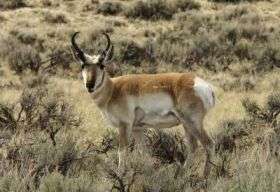
March 3, 2008 Yellowstone Pronghorn

Yellowstone pronghorn populations directly benefit from the presence of wolves, a new Wildlife Conservation Society study says. Credit: Julie Larsen Maher/Wildlife Conservation Society

As western states debate removing the gray wolf from protection under the Endangered Species Act, a new study by the Wildlife Conservation Society cautions that doing so may result in an unintended decline in another species: the pronghorn, a uniquely North American animal that resembles an African antelope.

The study, appearing in the latest issue of the journal Ecology, says that fewer wolves mean more coyotes, which can prey heavily on pronghorn fawns if the delicate balance between predators and their prey is altered. According to the study, healthy wolf packs keep coyote numbers in check, while rarely feeding on pronghorn fawns themselves. As a result, fawns have higher survival rates when wolves are present in an ecosystem.

“People tend to think that more wolves always mean fewer prey,” said WCS researcher Dr. Kim Berger, lead author of the study. “But in this case, wolves are so much bigger than coyotes that it doesn’t make sense for them to waste time searching for pronghorn fawns. It would be like trying to feed an entire family on a single Big Mac.”

Over a three-year period, researchers radio-collared more than 100 fawns in wolf-free and wolf-abundant areas of Grand Teton National Park and monitored their survival throughout the summer. The results showed that only 10 percent of fawns survived in areas lacking wolves, but where coyote densities were higher. In areas where wolves were abundant, 34 percent of pronghorn fawns survived. Wolves reduce coyote numbers by killing them outright or by causing them to shift to safer areas of the Park not utilized by wolves.

While pronghorn are not endangered, the population that summers in Grand Teton National Park, part of the Greater Yellowstone Ecosystem, had been reduced to fewer than 200 animals in recent years. Since wolves were reintroduced in 1995, the pronghorn population in Grand Teton has increased by approximately 50 percent. These pronghorn have the longest migration – more than 200 miles roundtrip – of any land mammal in the lower 48 states. The Wildlife Conservation Society has called for permanent protection of their migration corridor, known as “Path of the Pronghorn,” to prevent the animals from going extinct in the Park. Representatives from the National Park Service, U.S. Fish and Wildlife Service, and U.S. Forest Service recently pledged support for protecting the corridor.

If delisting occurs, Wyoming and Idaho have announced their intention to reduce wolf number by 50percent and 80 percent, respectively. At present, there are an estimated 300 wolves in Wyoming and 700 in Idaho.

“This study shows just how complex relationships between predators and their prey can be,” said Berger. “It’s an important reminder that we often don’t understand ecosystems nearly as well as we think we do, and that our efforts to manipulate them can have unexpected consequences.”

Source: Wildlife Conservation Society


print this article email this article download pdf blog this article bookmark this article     Stumble it Digg this share on Facebook retweet share on Reddit add to delicious
Rate this story - 4.1 /5 (7 votes)

Rank Filter

Move the slider to adjust rank threshold, so that you can hide some of the comments.


Display comments: newest first

  • bigwheel - Mar 03, 2008
    • Rank: 2 / 5 (1)
    Wolves can't catch antelope, which are a goat in reality. Antelope
    will not jump a fence. They always stop and go under. Wolves
    will eventually learn to ambush hunt them and being wolves they
    kill anything they can catch, hungry or not. There are films of
    them dropping complete elk herds and not eating a single animal.
    You think your favorite tv station will run that video. Our forefathers did away with them for good reason, don't sit in
    your cozy offices and think you know anything of what goes
    on in the wild.
  • ofidiofile - Mar 05, 2008
    • Rank: not rated yet
    ah, bigwheel -- and what wilderness are YOU commenting from? why not pretend i'm from missouri and Show Me this so-called film evidence? any links? or just hot air?

    and pronghorn -- if you do the research -- are a unique species/family of ruminants, and are in reality no closer to goats than to antelope or cows.

March 3, 2008 all stories

Comments: 2

4.1 /5 (7 votes)
  • Stumble this up

  • Digg this

  • share this

  • hide
  • Related Stories

  • Loss of top predators causing surge in smaller predators, ecosystem collapse
    created Oct 01, 2009 | popularity not rated yet | comments 0
  • Hareless: Yellowstone's rabbits have vanished, study says
    created Feb 14, 2008 | popularity not rated yet | comments 0
  • New clues to the Falklands wolf mystery
    created Nov 02, 2009 | popularity not rated yet | comments 0
  • Wolves, moose and biodiversity: An unexpected connection
    created Nov 02, 2009 | popularity not rated yet | comments 0
  • Wolves lose their predatory edge in mid-life, study shows
    created Oct 26, 2009 | popularity not rated yet | comments 0


Other News

Study shows that some malignant tumors can be shut down after all

Biology / Cell & Microbiology

created 28 minutes ago | popularity not rated yet | comments 0

Oncologists have had their hands tied because more than half of all human cancers have mutations that disable a protein called p53. As a critical anti-cancer watchdog, p53 masterminds several cancer-fighting operations within ...


What is the meaning of 'one'? Evolutionary biologists argue for new meaning of 'organismality'

Biology / Evolution

created 59 minutes ago | popularity not rated yet | comments 0

Rice University evolutionary biologists David Queller and Joan Strassmann argue in a new paper that high cooperation and low conflict between components, from the genetic level on up, give a living thing its "organismality," ...


Drought resistance explained

Drought resistance explained

Biology / Cell & Microbiology

created 6 minutes ago | popularity not rated yet | comments 0

Much as adrenaline coursing through our veins drives our body's reactions to stress, the plant hormone abscisic acid (ABA) is behind plants' responses to stressful situations such as drought, but how it does ...


Researchers complete draft genome sequence for cassava

Biology / Biotechnology

created 35 minutes ago | popularity not rated yet | comments 0

A team of academic, government and industry researchers has completed a first draft of the cassava (Manihot esculenta) genome. The project is an important first step in accelerating the pace of research on this subsistence ...


Researchers show how to divide and conquer 'social network' of cells

Researchers show how to divide and conquer 'social network' of cells

Biology / Biotechnology

created 2 hours ago | popularity not rated yet | comments 0

On Noah's Ark animals came in twos: male and female. In human bodies trillions of cells are coupled, too, and so are the molecules from which they are composed. Yet these don't come in twos, they are regrouped ...