From opals to optical chips
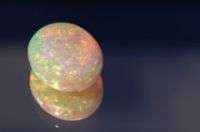
Materials known as photonic crystals could form the building blocks of future optical computers and micro-scale communications devices. Scientists have developed a low-cost and versatile way to make photonic crystals, and combined them in ways that bring optical ‘transistors’ a step closer.
European research on materials known as photonic crystals has made important progress in the race to build all-optical chips for computers and communications systems. The scientists developed a relatively inexpensive way to make high-quality photonic crystals, and showed how these can be integrated into conventional silicon chips.
Photonic crystals are materials whose optical properties vary in a regular, repeating way on a scale of a few hundred nanometres. An ideal photonic crystal can be designed to transmit light of one particular wavelength, and to block all other wavelengths. This gives photonic crystals some very useful properties.
The simplest material of this kind has a layered structure, like a film of oil on water. ‘One-dimensional’ structures like this are used as mirrors, non-reflective coatings, and paints whose colours change with the viewing angle. The gemstone opal, with its shimmering colour, is a natural photonic crystal.
The PHAT project worked with more complex structures whose optical properties vary in two and three dimensions (2D and 3D). Two-dimensional photonic crystals can act as waveguides, channelling light to where it is needed, and as filters to separate different wavelengths – a valuable property in optical communications. Three-dimensional photonic crystals can even trap light within their structures, potentially allowing them to act as optical switches.
Shrinking silicon
As electronic devices shrink and operating speeds increase, silicon chips are running out of room. Photons – light particles – are an obvious replacement for electrons, because they can carry more information in the same space.
Communications technology has been revolutionised by electro-optical devices based on the semiconductors gallium arsenide (GaAs) and indium phosphide (InP), optical fibres, and even all-optical amplifiers. But as PHAT spokesperson Gudrun Kocher points out, these devices tend to be much larger than the components needed to make computer chips. GaAs and InP are also expensive materials, and integrating them with silicon brings extra complexities. As a result, she says, most researchers agree that it will be 10-15 years before we see all-optical chips based on conventional (silicon) technology.
This is where photonic crystals come in. A combination of 3D photonic crystal optical switches and 2D waveguides could yield devices that are 10 or even 100 times smaller than those made at the moment. These could be used to assemble all-optical chips made entirely from silicon.
Mix and pour
Since the late 1980s researchers have developed several ways to make 2D and 3D photonic crystals. Many of these are based on expensive techniques developed from those used in the electronics industry, but the EU-funded PHAT, which stands for ‘Photonic Hybrid Architectures based on Two- and Three-Dimensional Silicon Photonic Crystals’, concentrated on a simpler self-assembly process.
Beads of plastic (PMMA) or silica, 250-900 nm in diameter, are first mixed with water to form a colloidal suspension. Then a solid surface is drawn slowly out of the water, and the beads stick to it in a regular lattice structure. The PHAT team assembled their ‘artificial opals’ by allowing capillary forces to draw the beads along microscopic channels cut in sheets of silicon or silica. In a single dip, they were able to form layers up to 10 mm long and more than 10 beads deep – the minimum practical thickness for a 3D photonic crystal.
The resulting structure of beads separated by air is known as a ‘direct opal’. The resulting refractive index is too low for many applications, so a subcontractor in St. Petersburg used chemical vapour deposition (CVD) to fill the empty spaces with silicon, after which the beads themselves are removed, leaving holes.
A further task was to use electron beam lithography to create a defect layer in the 3D crystals. “That’s because if the crystal is perfect, there’s no way to get light into or out of it,” Kocher explains. Finally, the plan is to sandwich two 3D crystals around a 2D crystal to act as a waveguide.
PHAT was coordinated at the Tyndall National Institute in Cork, Ireland, and had four other partners: the French Atomic Energy Commission (CEA) and University of Montpellier II, Mainz University, Germany, and the Technical Research Centre of Finland (VTT). “This was an ambitious project, and we didn’t manage everything that we set out to do,” says Kocher.
But by the time the project ended, in February 2007, it had two really big achievements under its belt. “We had developed a spatially-selective method of growing photonic crystals, and we had managed to integrate 3D photonic crystals with waveguides, which was a first,” says Kocher.
The crystal fabrication method was patented by two of the project partners, Tyndall and VTT. “This was a significant advance in photonic crystals, and it brings us a step closer to a practical optical computer, ” concludes Kocher.
Source: ICT Results


