Student Develops First Polarized LED
March 3, 2008 Student Develops First Polarized LED

In recent years, light emitting diodes (LEDs) have begun to change the way we see the world. Now, a Rensselaer Polytechnic Institute student has developed a new type of LED that could allow for their widespread use as light sources for liquid crystal displays (LCDs) on everything from televisions and computers to cell phones and cameras.

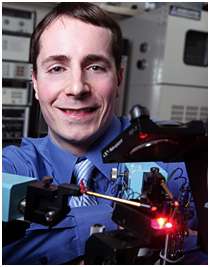
Martin Schubert, a doctoral student in electrical, computer, and systems engineering, has developed the first polarized LED, an innovation that could vastly improve LCD screens, conserve energy, and usher in the next generation of ultra-efficient LEDs. Schubert’s innovation has earned him the $30,000 Lemelson-Rensselaer Student Prize.

Schubert’s polarized LED advances current LED technology in its ability to better control the direction and polarization of the light being emitted. With better control over the light, less energy is wasted producing scattered light, allowing more light to reach its desired location. This makes the polarized LED perfectly suited as a backlighting unit for any kind of LCD, according to Schubert. Its focused light will produce images on the display that are more colorful, vibrant, and lifelike, with no motion artifacts.

Schubert first discovered that traditional LEDs actually produce polarized light, but existing LEDs did not capitalize on the light’s polarization. Armed with this information, he devised an optics setup around the LED chip to enhance the polarization, creating the first polarized LED.

The invention could advance the effort to combine the power and environmental soundness of LEDs with the beauty and clarity of LCDs. Schubert expects that his polarized LED could quickly become commonplace in televisions and monitors around the world, replacing widely used fluorescent lights that are less efficient and laden with mercury. His innovation also could be used for street lighting, high-contrast imaging, sensing, and free-space optics, he said.

Source: Rensselaer Polytechnic Institute


print this article email this article download pdf blog this article bookmark this article     Stumble it Digg this share on Facebook retweet share on Reddit add to delicious
Rate this story - 4.6 /5 (42 votes)

Rank Filter

Move the slider to adjust rank threshold, so that you can hide some of the comments.


Display comments: newest first

  • COCO - Mar 04, 2008
    • Rank: 4.3 / 5 (3)
    WELL done Martin!!
  • Nikola - Mar 04, 2008
    • Rank: 5 / 5 (4)
    LEDs are the future lighting of all types of applications. It seems that there is almost nothing they cannot be engineered to do. CFLs will be a passing fad. I think it's safe to say that Martin Schubert will earn his PhD.
  • superhuman - Mar 05, 2008
    • Rank: 5 / 5 (1)
    Yeah good work, but some more info about that optic setup of his would be nice.

    >His innovation also could be used for street lighting, high-contrast imaging, sensing, and free-space optics, he said.
    Why on earth would street lighting need polarized leds?
  • andy_o - Jun 27, 2008
    • Rank: 5 / 5 (2)
    If street lights are polarized, it would reduce the glare to the driver's eyes, if properly set up. This would reduce the halos and stars that many people see when driving at night, even without using polarized sunglasses, or polarized glass for your windshield.

March 3, 2008 all stories

Comments: 4

4.6 /5 (42 votes)
  • Stumble this up

  • Digg this

  • share this

  • hide
  • Related Stories


  • hide
  • Relevant PhysicsForums posts

  • moment of inertia and friction
    created 3 hours ago
  • two-dimensional collision
    created 6 hours ago
  • I Need Help Selecting a Good Text Book to Learn the Basics
    created 8 hours ago
  • The acceleration of mass using light
    created 8 hours ago
  • More from Physics Forums - General Physics

Other News

New tool for helping pediatric heart surgery

Physics / General Physics

created 14 minutes ago | popularity not rated yet | comments 0

A team of researchers at the University of California, San Diego and Stanford University has developed a way to simulate blood flow on the computer to optimize surgical designs. It is the basis of a new tool that may help ...


In the Brain, Seven Is A Magic Number

In the Brain, Seven Is A Magic Number

Physics / General Physics

created 12 hours ago | popularity 4.2 / 5 (17) | comments 5

Having a tough time recalling a phone number someone spoke a few minutes ago or forgetting items from a mental grocery list is not a sign of mental decline; in fact, it's natural.


Scientists react as they stand in front of a screen at CERN

First atoms reported smashed in Large Hadron Collider (Update)

Physics / General Physics

created 15 hours ago | popularity 4.9 / 5 (20) | comments 9

Two circulating beams on Monday produced the first particle collisions in the world's biggest atom smasher, the Large Hadron Collider (LHC), three days after its restart, scientists announced.


Straightening messy correlations with a quantum comb

Straightening messy correlations with a quantum comb

Physics / Quantum Physics

created 15 hours ago | popularity 4.7 / 5 (7) | comments 0

Quantum computing promises ultra-fast communication, computation and more powerful ways to encrypt sensitive information. But trying to use quantum states as carriers of information is an extremely delicate ...


Visual assistance for cosmic blind spots

Visual assistance for cosmic blind spots

Physics / General Physics

created 15 hours ago | popularity 4.3 / 5 (3) | comments 0

A bit of imagination on the part of a measuring instrument wouldn't be a bad thing. It could help to add data from areas where the instrument is unable to measure. However, it must do so constructively. In ...