Invading trees put rainforests at risk
March 3, 2008 3-D Imaging of Invasive Tree Species

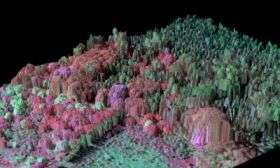
3-D Imaging of invasive tree species (reds-pinks) and native Hawaiian lowland rainforest (greens). For more images go to http://cao.stanford.edu/cao_gallery.html. Credit: Gregory Asner

To the list of threats to tropical rainforests you can add a new one — trees. It might seem that for a rainforest the more trees the merrier, but a new study by scientists at the Carnegie Institution warns that non-native trees invading a rainforest can change its basic ecological structure — rendering it less hospitable to the myriad plant and animal species that depend on its resources. Results are published in the Proceedings of the National Academy of Sciences.

The research team, led by Gregory Asner of the Carnegie Institution’s Department of Global Ecology, used innovative remote sensing technology on aircraft to survey the impact of invasives on more than 220,000 hectares (850 square miles) of rainforest on the island of Hawaii.

Previous studies of the impact of invasive plants on forests were limited to small areas. Instruments aboard the Carnegie Airborne Observatory (CAO) penetrate the forest canopy to create a regional “CAT scan” of the ecosystem, identifying key plant species and mapping the forest’s three-dimensional structure.

“Invasive tree species often show biochemical, physiological, and structural properties that are different from native species,” says Asner. “We can use these ‘fingerprints’ combined with the 3-D images to see how the invasives are changing the forest.”

This is the first use of this approach to track invasives in Hawaii, where roughly half of all organisms are non-native, and approximately 120 plant species are considered highly invasive. Undisturbed Hawaiian rainforests are often dominated by the ohia tree (Metrosideros polymorpha), but these slow-growing native trees are losing ground to newcomers, such as the tropical ash (Fraxinus uhdei) and the Canary Island fire tree (Morella faya).

CAO surveys of rainforest tracts on the Mauna Kea and Kilauea Volcanoes found that stands of these two invasive tree species form significantly denser canopies than the native ohia trees. Less light reaches lower forest levels, and as a result native understory plants such as tree ferns are suppressed.

Introduced trees can also pave the way for more invaders by altering soil fertility. The Moluccan albizia (Falcataria moluccana) “fixes” atmospheric nitrogen, concentrating it in the soil, which speeds the growth of a smaller invasive tree, the Strawberry Guava (Psidium cattleianum). The guava trees form a dense, mid-level thicket that blocks most light from reaching the ground and stifles young native plants.

“All of our invasive species detections were made in protected state and federal rainforest reserves,” says Asner. “These species can spread across protected areas without the help of land use changes or other human activities, suggesting that traditional conservation approaches on the ground aren’t enough for the long-term survival of Hawaii’s rainforests.”

“These new airborne technologies, which are sensitive enough to discern saplings and young trees, may make the problem more tractable,”comments study co-author Flint Hughes of the US Forest Service. “They allow scientists to probe the make-up of forests over large areas and detect invasions at earlier stages.”

Based on the success of this study, Asner and colleagues plan to expand CAO surveys of the ecological impacts of invaders in other forests on Hawaii and Kauai Islands, where premier, remote rainforest reserves remain virtually unmapped.

Source: Carnegie Institution


print this article email this article download pdf blog this article bookmark this article     Stumble it Digg this share on Facebook retweet share on Reddit add to delicious
Rate this story - 4.6 /5 (7 votes)

Rank Filter

Move the slider to adjust rank threshold, so that you can hide some of the comments.


Display comments: newest first

  • Wicked - Mar 04, 2008
    • Rank: not rated yet
    The species composition in rainforests isn't static and never has been. This isn't necessarily a threat to the rainforest, however.

March 3, 2008 all stories

Comments: 1

4.6 /5 (7 votes)
  • Stumble this up

  • Digg this

  • share this

  • hide
  • Related Stories

  • Tree-eating bugs threaten Monarch butterfly in Mexico
    created Nov 21, 2009 | popularity not rated yet | comments 0
  • We're off then: The evolution of bat migration
    created Nov 20, 2009 | popularity not rated yet | comments 0
  • Biologists save fish after landslide
    created Nov 20, 2009 | popularity not rated yet | comments 0
  • After mastodons and mammoths, a transformed landscape
    created Nov 19, 2009 | popularity not rated yet | comments 0
  • Ancient high-altitude trees grow faster as temperatures rise
    created Nov 16, 2009 | popularity not rated yet | comments 0


  • hide
  • Relevant PhysicsForums posts

  • The IPCC and the term "most"
    created 22 hours ago
  • Is global warming a fact?
    created Nov 23, 2009
  • Random variability of wind patterns
    created Nov 23, 2009
  • Record precipitation in the UK
    created Nov 22, 2009
  • More from Physics Forums - Earth

Other News

The drying shores of the Dead Sea

Dead Sea needs world help to stay alive

Space & Earth / Environment

created 48 minutes ago | popularity 5 / 5 (1) | comments 0

The Dead Sea may soon shrink to a lifeless pond as Middle East political strife blocks vital measures needed to halt the decay of the world's lowest and saltiest body of water, experts say.


Shuttle, station crews seal hatches for departure (AP)

Shuttle, station crews seal hatches for departure

Space & Earth / Space Exploration

created 36 minutes ago | popularity not rated yet | comments 0

(AP) -- After nearly a week together, the crews of shuttle Atlantis and the International Space Station said goodbye Tuesday and closed the hatches between them.


Global study of salmon shows: 'Sustainable' food isn't so sustainable

Space & Earth / Environment

created 19 minutes ago | popularity not rated yet | comments 0

Popular thinking about how to improve food systems for the better often misses the point, according to the results of a three-year global study of salmon production systems. Rather than pushing for organic or land-based ...


Icebergs head from Antarctica for New Zealand (AP)

Icebergs head from Antarctica for New Zealand

Space & Earth / Earth Sciences

created 6 minutes ago | popularity not rated yet | comments 0

(AP) -- Ships in the south Pacific Ocean have been alerted that hundreds of icebergs believed to have split off Antarctic ice shelves are drifting north toward New Zealand, officials said Tuesday.


LSU gets to the bottom of things -- in Antarctica

Space & Earth / Earth Sciences

created 56 minutes ago | popularity not rated yet | comments 0

Antarctica has long held secrets of the earth's history locked in its icy depths, and until recently, there has been very little information on the environments that have been sealed beneath miles of ice for millions of years. ...