Weird wave behavior may explain why the whirligig walks in circles
March 4, 2008 By Lisa Zyga Weird wave behavior may explain why the whirligig walks in circles

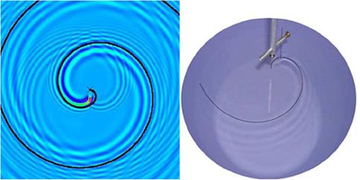
These diagrams show the surface deformation of water due to an object moving at 21 cm/s (0.9 times the minimum wave velocity) in a circular motion. Credit: Chepelianskii, et al.

The whirligig beetle is named for its trademark of walking in circles on the surface of water. Upon investigating a new phenomenon of water wave generation, scientists might now understand why.

Researchers from France have found that objects moving in circles on the surface of water exhibit a striking difference from objects moving in straight lines. Straight-moving objects require a minimum velocity to generate even tiny ripples in the water. But when moving in a circular trajectory, objects moving at much lower velocities can still create waves. In fact, the scientists demonstrate that no velocity threshold exists for objects moving in circles to generate waves.

Alexei Chepelianskii and Elie Raphaël of the City of Paris Industrial Physics and Chemistry Higher Educational Institution (ESPCI), and Frédéric Chevy of the University of Paris have published the results of their study in a recent issue of Physical Review Letters.

Waves generated by boats, insects, and other objects moving at the water-air interface are called capillary-gravity waves. They are caused by a balance between the liquid’s tendency to stay flat due to gravity and surface tension, and the outside force of the object that disturbs the liquid’s equilibrium. The waves often occur in the form of ripples behind boats (and, as the cause of drag, are preferably kept to a minimum for boating).

Capillary-gravity waves move across the water at a minimum velocity of 23 cm/s, below which point they just can’t overcome the gravity and surface tension of the liquid. So it was generally thought that all objects must move at this minimum velocity or greater in order to create the waves. However, the recent study shows that small objects moving below 23 cm/s can still generate waves, as long as the objects are moving in circles.

“The speed of the waves generated by the rotating object or animal is, as always, larger than 23 cm/s,” Raphaël explained to PhysOrg.com. “This does not violate any law of physics. For instance, when one drops a stone in water, the impact generates circular waves, while the velocity of the stone parallel to the surface is strictly zero.”

The researchers demonstrated this behavior both theoretically and experimentally. By moving a needle in circles in a bucket of water and using a laser to measure the waves, the researchers detected waves when the needle’s velocity was around 14 cm/s – just 0.6 times the minimum wave velocity. Below this velocity, the signal-to-noise ratio was too small to observe the laser deflection.

The researchers explain that the cause of this special case is directly related to the accelerated nature of the circular motion. They compare the behavior to that of Cherenkov radiation, which is electromagnetic radiation (which travels at the speed of light) emitted by a charged particle traveling at greater than the speed of light in a certain medium (but slower than the speed of light in air).

As the researchers explain, “just like accelerated charged particles radiate electromagnetic waves even while moving slower than the speed of light, an accelerated disturbance experiences a nonzero wave resistance Rw even when propagating below cmin [the minimum wave velocity].”

The group explains that the findings do not contradict the minimum velocity threshold, which is only valid for rectilinear uniform motion – an assumption that is, however, often overlooked in the literature.

“This is a very general phenomenon in physics: waves of any sort can be generated by accelerated objects,” Raphaël said. “Let's consider, for instance, the case of sound waves: you can emit sounds by moving periodically the membrane of a loudspeaker or the vocal cords – since the motion is periodic, the velocity is necessarily non-constant in time.”

As for the whirligig, it may use this wave behavior to its advantage. The researchers predict that the circular walking beetles might generate surface waves for echolocation, enabling them to navigate at low velocities. The team hopes that the new findings will also lead to insights into how small animals travel efficiently on the surface of water.

“Several insect species are thought to use waves at the surface of water as an analogue of SONAR, where ultrasound waves would be replaced by capillary-gravity waves,” Raphaël said. “We think that this property of circular motion can facilitate echolocation in two ways. For one, it makes the emission of waves easier since the insect can move slower than 23 cm/s. Also, the waves that are emitted are isotropic: there is no ‘blind spot,’ and the insect can therefore perceive in any direction an object (obstacle, prey, predator or fellow whirligig) at the surface of water.”

More information: Chepelianskii, A. D., Chevy, F., and Raphaël, E. “Capillary-Gravity Waves Generated by a Slow Moving Object.” Physical Review Letters 100, 074504 (2008).

Copyright 2008 PhysOrg.com.
All rights reserved. This material may not be published, broadcast, rewritten or redistributed in whole or part without the express written permission of PhysOrg.com.


print this article email this article download pdf blog this article bookmark this article     Stumble it Digg this share on Facebook retweet share on Reddit add to delicious
Rate this story - 4.5 /5 (56 votes)

Rank Filter

Move the slider to adjust rank threshold, so that you can hide some of the comments.


Display comments: newest first

  • Alexa - Mar 04, 2008
    • Rank: 2 / 5 (2)
    The capillary waves are having a much closere connection to the light spreading in vacuum, then just Cherenkov radiation. The Aether Wave Theory considers the vacuum as a system of nested foamy density fluctuations, similar to those, which appears during condensation of supercritical vapor. These artifacts can be considered as a quite natural explanation of these strange strings, branes and protosimplex or spin foam concepts of string, Heim's and LQG theories. You can compare such approach with recent ideas, the Universe is formed by interior of black hole.

    http://www.chem.l...co24.jpg

    The important point is, the energy spreading inside of such environment is realized nearly exclusivelly by surfaces of this foam by capillary waves, which doesn't penetrate the interior of foam (mem)branes, because the energy density of common light is many orders of magnitude lower, then the energy density of vacuum branes. By another words, the spreading of light is surface energy driven and it's not affected by the absolute motion of vacuum by the same way, like the spreading of capillary waves at the water surface isn't affected by underwater.

    By another words, the AWT model of vacuum explains the light speed invariance of relativity theory and the absence of the Aether reference frame, detected by Michelson-Morley experiment (between many other phenomena of relativity and quantum mechanics) by classical physics. So it can reconcile most of existing physical theories by the single (and very simple) model.
  • earls - Mar 04, 2008
    • Rank: 3 / 5 (1)
    The waves are generated in such a pattern as to create standing waves on the surface to support the insect. The fact that the insect can naturally produce the waves under an artfically created "threshold," "limit," "barrier" by humans is a minor revelation. What's provided is a window or doorway to a new paradigm of physics that can be extrapolated. Nature = path of least resistance. definitely 1

March 4, 2008 all stories

Comments: 2

4.5 /5 (56 votes)
  • Stumble this up

  • Digg this

  • share this

  • hide
  • Related Stories

  • New Digital 'Electronics' Concept May Continue Moore's Law
    created Nov 05, 2009 | popularity not rated yet | comments 0
  • Mathematical keys to a sixth sense -- the lateral-line system
    created Aug 28, 2009 | popularity not rated yet | comments 0
  • Study Reveals Small Lizard Tucks Legs and Swims Like a Snake Through Desert Sand (w/ Video)
    created Jul 16, 2009 | popularity not rated yet | comments 0
  • China environmental phenomena monitored from space
    created Jul 06, 2009 | popularity not rated yet | comments 0
  • Creating the astro-comb to locate Earth-like planets
    created May 07, 2009 | popularity not rated yet | comments 0


  • hide
  • Relevant PhysicsForums posts

  • Bodies in motionÂ…..
    created 1hour ago
  • Refraction optics help
    created 1hour ago
  • A basketball Jump Shot
    created 2 hours ago
  • help with accelerometer
    created 4 hours ago
  • Young's Double Slit - Fringe Width
    created 8 hours ago
  • Pressure exerted by a liquid is different to gas?
    created 9 hours ago
  • More from Physics Forums - General Physics

Other News

Solving big problems

Solving big problems with new quantum algorithm

Physics / Quantum Physics

created 11 minutes ago | popularity not rated yet | comments 0

(PhysOrg.com) -- In a recently published paper, Aram Harrow at the University of Bristol and colleagues from MIT in the United States have discovered a quantum algorithm that solves large problems much faster ...


First Bose-Einstein condensation of strontium

First Bose-Einstein condensation of strontium

Physics / Quantum Physics

created 5 hours ago | popularity 5 / 5 (4) | comments 1

In an international first, scientists from the Institute of Quantum Optics and Quantum Information (IQOQI, Austria) produced a Bose-Einstein condensate of the alkaline-earth element strontium, thus narrowly ...


The LHC tunnel

Peckish bird briefly downs big atom smasher

Physics / General Physics

created 12 hours ago | popularity 3.8 / 5 (9) | comments 11

A peckish bird briefly knocked out part of the world's biggest atom smasher by causing a chain reaction with a piece of bread, the European Organisation for Nuclear Research (CERN) said Monday.


Plasma-in-a-bag for sterilizing devices

Physics / General Physics

created 3 hours ago | popularity not rated yet | comments 0

The practice of sterilizing medical tools and devices helped revolutionize health care in the 19th century because it dramatically reduced infections associated with surgery. Through the years, numerous ways of sterilization ...


Ginzburg helped develop the Soviet Union's hydrogen bomb in the late 1940s and early 1950s

Russian bomb physicist Ginzburg dead at 93

Physics / General Physics

created 13 hours ago | popularity 5 / 5 (4) | comments 0

Nobel Physics prize winner Vitaly Ginzburg, who helped develop the Soviet hydrogen bomb, has died at age 93, the Russian Academy of Sciences said Monday.